Showing posts with label imagination. Show all posts

Tuesday, 13 November 2018

Wise Words: The Blinding Of The Stars

We are, as a species, finding it increasingly hard to imagine that we are part of something which is larger than our own capacity. We have come to accept a heresy of aloofness, a humanist belief in human difference, and we suppress wherever possible the checks and balances on us – the reminders that the world is greater than us or that we are contained within it. On almost every front, we have begun a turning away from a felt relationship with the natural world.
The blinding of the stars [due to light pollution] is only one aspect of this retreat from the real. In so many ways, there has been a prising away of life from place, an abstraction of experience into different kinds of touchlines. We experience, as no historical period has before, disembodiment and dematerialisation … And so new maladies of the soul have emerged, unhappinesses which are complicated products of the distance we have set between ourselves and the world. We have come increasingly to forget that our minds are shaped by the bodily experience of being in the world – its spaces, textures, sounds, smells and habits – as well as by genetic traits we inherit and ideologies we absorb. A constant and formidably defining exchange occurs between the physical forms of the world around us, and the cast of our inner world of imagination.

(Robert Macfarlane, The Wild Places, Granta Publications: London, 2007, pp. 202–203)
Monday, 27 August 2018

Wise Words: The Moon Is Yours (Their Progress Is Not Our Progress)

The moon is yours. And it belongs to the U’wa child and to the Hopi Indians, to the Inuit and to the Mexican woman collecting water and to the monks of Tibet. It belongs to every moth that flies towards it, to every dog who barks for it and to every cat on the hackled prowl for it. Untouched, it is a global commons unparalleled, for it belongs to the minds of millions upon millions of people; an emblem of purity, of women, of imagination or of time itself; a beautiful place of thought which can mean a million different things to a million different minds, all on one night. ‘The moon shines bright. In such a night’ as Shakespeare said, it shone for Dido, for Medea, for Troilus and Cressida all alike. But a few hundred overprivileged white males plan probes and moon maps and say the far side of the moon would be the site for an Observatory. Like an exact parallel with ‘progress’ on earth, it uses all the tools of imperialism – from Observatories, maps, enclosures and sheer political force – to colonize a commons. Their progress is not our progress. To lose the moon and be given instead a petrol station, a Hilton hotel, an industrial estate, a quarry and a nuclear waste deposit is not a good swap but a terrible theft; a theft from the very soul of humanity. And we, the millions who have lost something so infinitely precious, are expected to applaud it?

(Jay Griffiths, Pip Pip: A Sideways Look at Time, Flamingo: London, 1999, pp. 217–218)

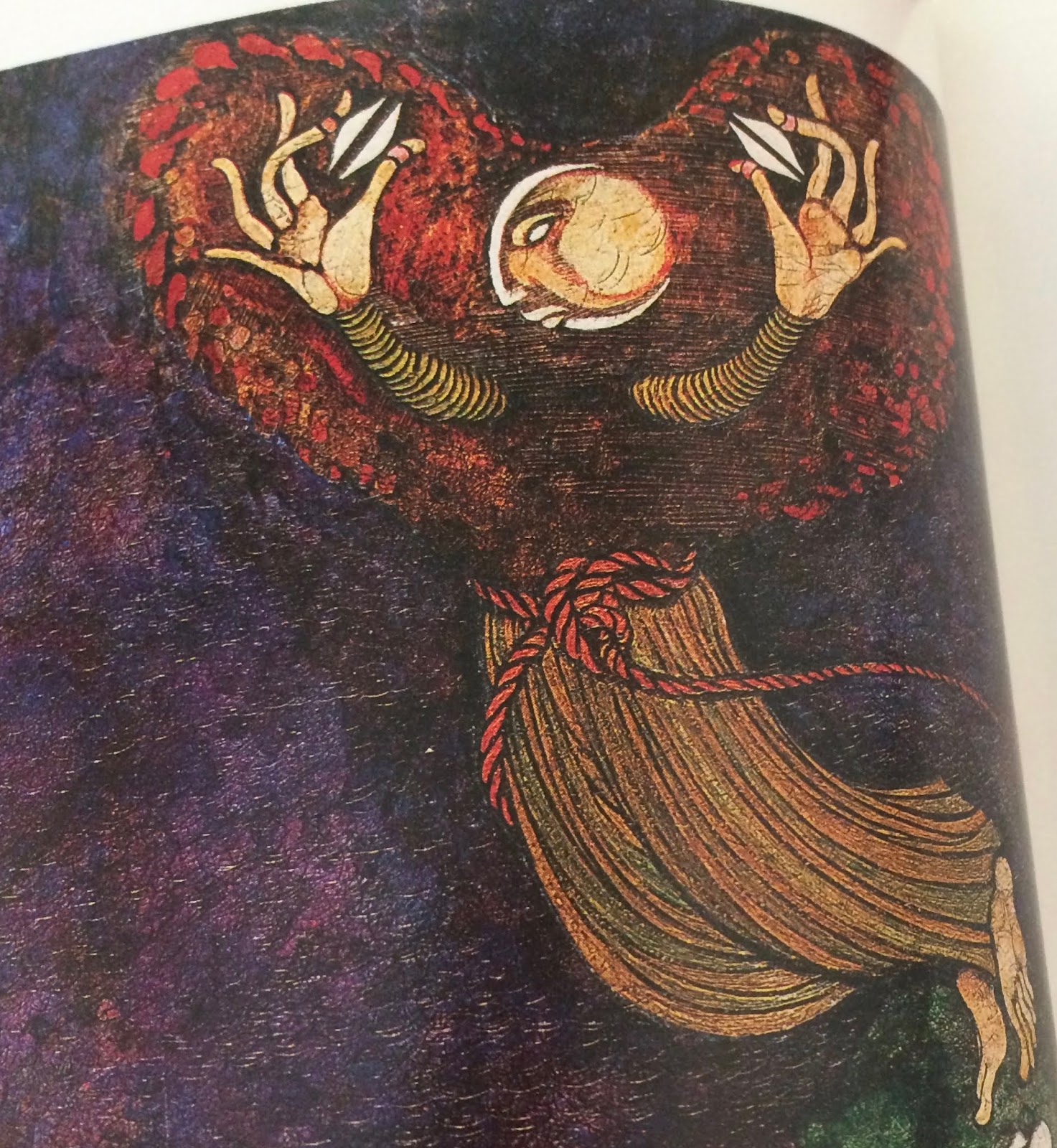
Detail from Memory, by Meinrad Craighead, from her book, The Mother's Songs: Images of God the Mother (1986)

Tuesday, 16 January 2018

Wise Words: The Body is in the Soul

For [French mystical philosopher, Henry] Corbin, the Otherworld is a pre-condition of our own world, meaning that our world would not exist without it. The Otherworld thus encompasses our reality rather than being situated by it. He explains this difficult concept by using the following analogy. Although we commonly consider our spirit to be situated within our body or brain during its incarnation, an assumption forced upon us by Descartes’ separation of the mind from the body (and the natural world), the converse is actually true. The body is encompassed by the spirit. Furthermore, imagination, which has the ability to connect with and move between the two worlds, encompasses our psychological and cognitive functions. We are therefore embraced and held by a world of magic which appears to us in visions, dreams and symbols yet it is a world to which we have become increasingly blind and mute. 

(Sinead Spearing, Wiccecræft: Shamanic Magic from The Dark Ages, Green Magic: Stathe, Somerset, 2011, p. 4)