Monday, 20 May 2019

The Lost Days

There are struggles with physical limitation in illness, the pain, weakness, and fatigue that so quickly erode our pride and aspirations and make simple tasks, even breathing, so difficult. But the pressures of these limitations call forth a deeper struggle which is ongoing within us but usually unconscious—that of the self in its efforts to be, to unfold and fulfill its purpose. 
~ Kat Duff (1)

* * *     

I’ve not been well for a number of weeks, and consequently I’ve barely set foot in my studio, let alone been able to work on anything. It’s strange how the onset of illness causes interests and aspirations to slip away to be replaced by apathy and meaninglessness. It’s painful. Yet for all its harshness, this lack of purpose is itself a self-protective message from the body, saying, You must rest.

I’ve rested and done very little. Still, there is a sense of loss at the days that have been consumed by illness, each day blurring into the next, such that there are few events to anchor memory on. It amazes me that autumn is almost over. Where has the time flown to?


It seems that I can trace the passage of the last few months through the paintings I have made. Creativity was beginning to flow more easily. To not create anything for weeks leaves an emptiness that begs to be filled somehow, but it brings with it an all-familiar stuckness. It took such effort to begin to create images, and now I have to begin yet again, not knowing what I am capable of.

Clarissa Pinkola Estés says: ‘Do your art. Generally a thing cannot freeze if it is moving. So move. Keep moving.’ (2) I think this is good advice. Yet how does it apply to someone with a chronic illness who needs to cease moving from time to time? It is all the more difficult to keep a creative practice alive when there are often long periods of not working that must be endured, and a deep sense of doubt that returns with every retreat from activity. I become scared that I will never have a good idea, never be inspired. I descend into a depression that makes me wonder if I will ever be creative again. 


It’s therefore just as strange that when I begin to return to some kind of wellness—meagre though it may be—I feel what I can only describe as a sense of euphoria. Joy begins to surge tentatively through my veins. I can’t say where it comes from, for the current state of the world still angers and upsets me, so it feels a little incongruous. I suppose it must be the energy of life, for life always wants to live, even when it seems an impossibility.  

So, I’m spending time in my studio once more, taking some cautious steps back into art-making. I trust that work will emerge again soon.

To be honest, though, I haven’t quite done nothing recently. I’ve knitted one beanie in readiness for the fast-approaching winter, and am working on a second. 


And I have begun reading a book that I hope will bring me some inspiration—Susan Griffin’s account of her own experience of illness, What Her Body Thought: A Journey into the Shadows. As she says, ‘the truth is that illness … uncovers hidden reserves of strength.’ (3) 

I suppose that is why I continue on, trying to make up for the lost days, and saving what inspiration I can for the next fallow time I will endure.


References
1. Kat Duff, The Alchemy of Illness, Bell Tower: New York, 1993, p. 71
2. Clarissa Pinkola Estés, Women Who Run with the Wolves: Contacting the Power of the Wild Woman, Rider: London, 1992, p. 183
3. Susan Griffin, What Her Body Thought: A Journey into the Shadows, HarperSanFrancisco: New York, 1999, p. 43

Tuesday, 30 April 2019

An Ode to Brain Fog

I can’t remember where I put my mind 
what thought I was last thinking 
left unfinished, open-ended 
dangling 
over the edge of 
nothing

I can’t remember what it feels like to be 
fully awake and alive 
knowing there is a path to follow 
scattered with experiences and emotions

There are a great many things I can’t recall 
or just don’t care to acknowledge at all


The spark’s gone out and I can’t see a thing
My life’s gone dim and I don’t know when I’ll live again

But life’s a funny thing for it just keeps going 
even when the going’s rough 
because at the core of it there is 

something

(A little seed of defiance?)


There must be a reason for this fog 
for the dimming of mind 
for the enclosure of self into 
a small space 
all fuzzy round the edges


I don’t understand 
but I let things be

Wednesday, 10 April 2019

Meinrad Craighead 1936–2019


Today I learned of the death of the artist-mystic Meinrad Craighead at the age of 83.

Born Charlene Marie Craighead in 1936 in Arkansas, she lived a remarkable life, teaching art in Albuquerque, then Italy and Spain, before spending fourteen years as a Benedictine nun in Stanbrook Abbey in England. It was there that she took the name Meinrad, after her mother’s great uncle, who had been a monk in Switzerland. (He is said to cure people.) In 1983 she returned to the US, settling near the Rio Grande in Albuquerque. 

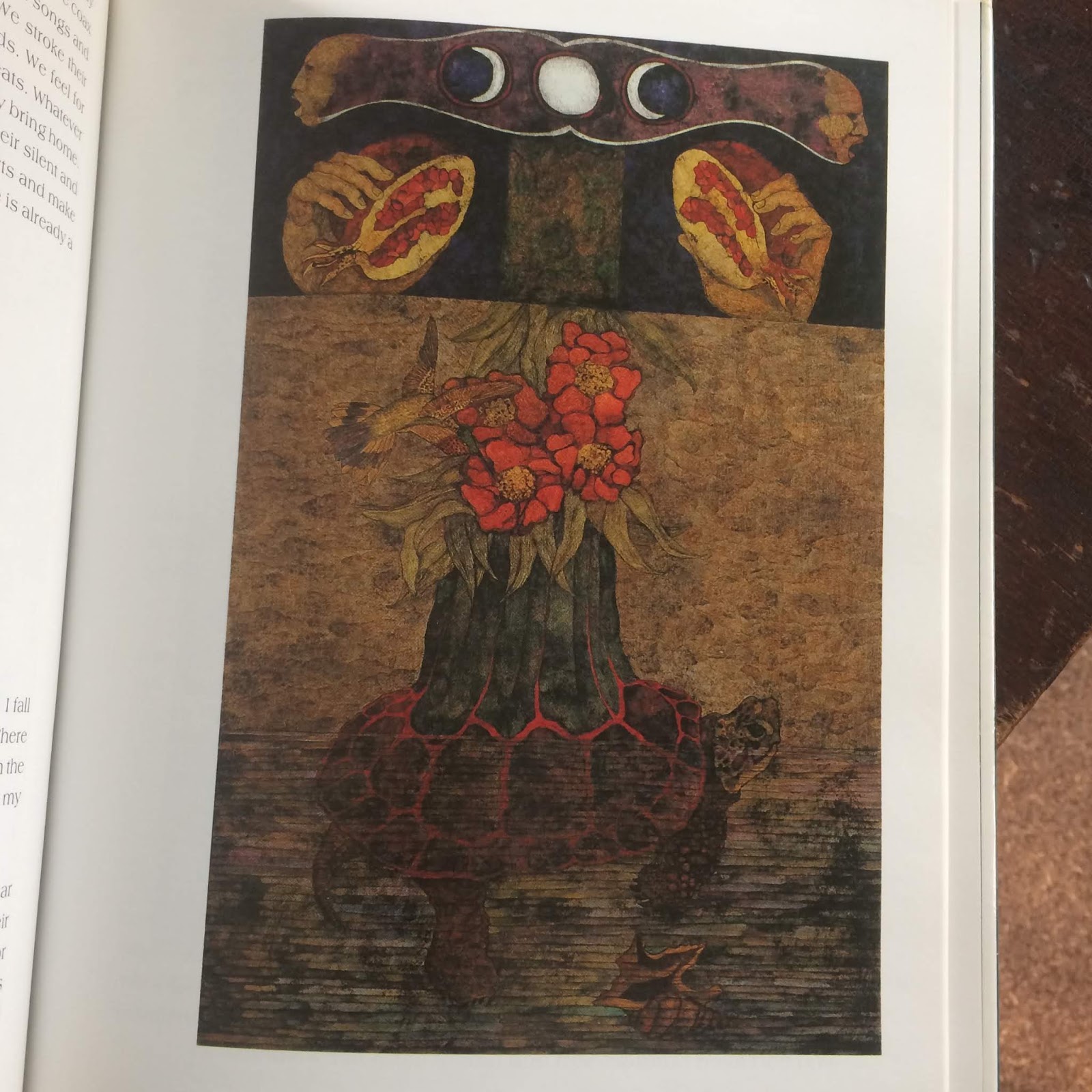
The Moons of the Vernal Equinox (from The Litany of the Great River, 1991) 
It is only in the past year or so that I have discovered Meinrad’s art, and watched the short videos made by Amy Kellum, Praying with Images and God Got Bigger, which I know I will continue to return to whenever I am feeling particularly uninspired. They do not fail to invigorate me, to show me what is possible, to make me want to keep seeking, keep trying, to be receptive and ready, and to create from that vast space of openness.

Though Meinrad seemed a small, unassuming woman, she was intimately connected with the wild, with the spirits of animals and the land around her, and the often overwhelming nature of God the Mother, who is certainly not just sweetness and light. Her work is beautiful, strange, and sometimes confronting in it’s depiction of birth and death, dream and transformation. It links spirit, woman and nature into a seamless weave of divine immanence.

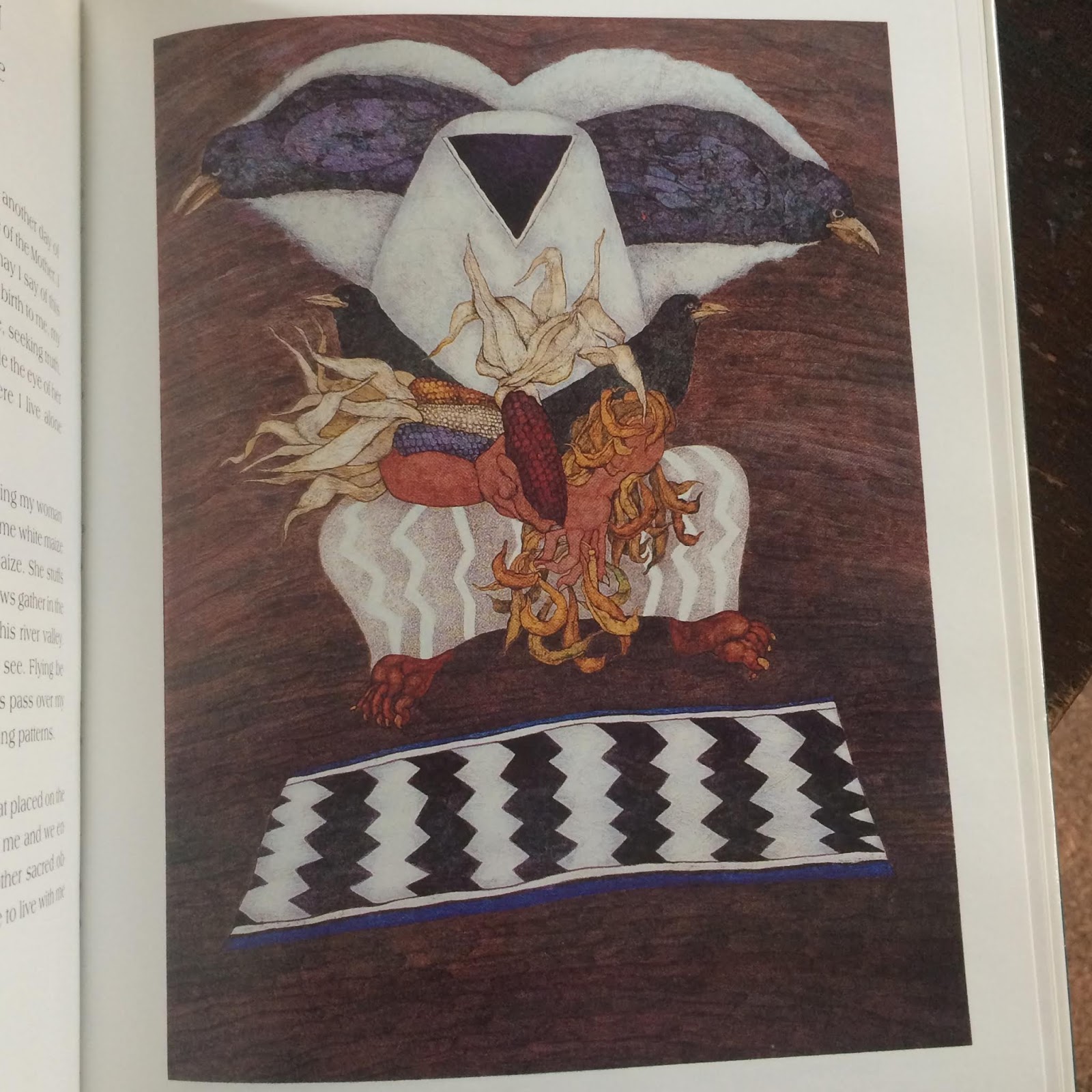
Crow Mother Over the Rio Grande (from The Litany of the Great River, 1991)
What I also love about Meinrad was that her studio was a shrine, and her art practice was ritual. Her approach to her work, as a sacred calling, as a communication with the many spirits she was in contact with, is an inspiration. 

She wrote:

My personal vision of God the Mother, incarnated in my mother and her mother, gave me, from childhood, the clearest certainty of woman as the truer image of Divine Spirit. Because she was a force living within me, she was more real, more powerful than the remote Fathergod I was educated to have faith in. I believed in her because I experienced her.


I draw and paint from my own myth of personal origin. Each painting I make begins from some deep source where my mother and and grandmother, and all my fore-mothers, still live; it is as if the line moving from pen or brush coils back to the original Matrix. Sometimes I feel like a cauldron of ripening images where memories turn into faces and emerge from my vessel. So my creative life is itself an image of God the Mother and her unbroken story of emergence in our lives. (From the introduction to Meinrad Craighead, The Mother’s Songs: Images of God the Mother, Paulist Press: Mahwah, New Jersey, 1986)

I feel so lucky that I have two of her books (which are mostly out of print and difficult to find). I will treasure them and remember Meinrad every time I return to their pages for inspiration and guidance.

Farewell, Meinrad. Journey well on the next stage of your being. 

Throne (from The Mother's Songs: Images of God the Mother, 1986)