Showing posts with label dance. Show all posts

Friday, 26 September 2025

Asymmetrical Re-worlding, Part 2: The Dance of Relationship

This week’s instalment of my essay series on Medusa Rising is short and sweet to make up for last week’s monster of an introduction. (Sorry.)

Following on from my discussion of metaphysical dualism, this second part explores the flowing dance of relationship in connection with Jacques Derrida’s concept of différance; moves towards an integrated embodiment (including embodied thinking); and looks at the crucial connection of intellect with identification (thanks to Renée Gerlich’s insight). 

Stay tuned for Part 3: Our Matriarchal Foremothers Are Laughing … If They’re Not Crying next week. 

Here are some of the featured quotes in Part 2:


Thursday, 4 October 2018

Capturing The Sky

Capturing the sky in a net as large as universes, complexity within its folds, its weave of colours, forms—light and energy made flesh. The sensuous is the sacred, the mother-matter that is all, and we dwell within Her body like cells of Herself, our own fire mingling with Her’s; our hearts beating with Her’s, blood flowing like rivers, ocean tides, a great breath—in and out, within and without, over and over, inside Her eternity. A constant unfolding is what She is, the change that never ends, the process that draws forth life, and beckons death, and makes the Wheel of Fortune turn, revolving on its axis of Love—the energy of Life, the gravity that merges all together. To hold love in your hands, to feel it in your bones, surging through your blood—a love-stream—is to know true joy and wonder, to have truly lived. To feel is to know, to have words of truth on your tongue. Truly, there is nothing more important than the language of life, its sensuous fabric.

Rivers run and free themselves from the constraints that bind them. They flow where they will, at will, and into my heart, which is nourished by the gush of liquid life, the purity that writes across the landscape in curvaceous lines, the serpent-body of which there is a small part in everything—the double-helix, the blueprint for life, held inside every body, to twist and dance through time, spiralling around in a lover’s dance, rhythmic and Eros-filled, pulsing inside flesh, blood, bone. The breath is a bond that opens us to All, that suffuses our bodies in invisible connection, with each other, and the Divine. Crossing boundaries is how magic happens, to influence events, to know what is beyond us—to perceive the ancient symbiosis of Life. Perception becomes Truth: the sensuous world is what leads us to wisdom. Small beings dart within us—the birds of emotion—winged and glorious, bathed in beauty. What is is sacred, it is whole, and we carry it within ourselves, as it carries us within itself—that great body of reality—full of storm and calm, a terrible beauty, that enlivens and nourishes. We live and die inside Her flesh—and there is nothing more nor less.

Singing the Sky, felt tip pen and gold pigment ink (2018)

Friday, 31 August 2018

Little Green Things: A Poem


Little green things 
heed the call 
that Death eats Life 
and Life sprouts 
from Death 
in a spiral dance 
of joy and sorrow –
for a long cold winter 
will always become 
a bright spring

This little poem has been adapted from something I wrote a number of years ago, but I thought it apt to share on this last official day of winter.

This winter has not seemed particularly long, though there have been some cold days. What it has lacked is rain. Though spring shoots and blooms regardless, and for this I am grateful. Growth and transformation is on its way, with or without the rain. Let’s welcome it.


Thursday, 12 July 2018

Witchlines: Dancing The Labyrinth

Here is the second of my Witchlines pieces exploring the world of Minoan Crete—or Ariadnean Crete, as it should be. This prompt asked us to write about a ritual, involving bull, labyrinth, and sacred dance. 

Woman dancing in a circle (the centre figure holds a snake), clay figures, c. 1300 BCE, Heraklion Archaeological Museum
(Source: Wikimedia, by Jebulon)
Dancing the Labyrinth

Half-closed eyes under the round eye of the moon, under the gaze of the mountain, the shelter of the trees. Whirling, skirt unfurled, face upturned. The air heavy with poppy smoke, the scent of night, and the sweetness of the honey and wine we have offered to the earth.
Between us is a red thread, a sacred cord. Grasped in the hands of seven young women, led by Her—Most Holy, Most Pure—the Mistress of the Darkness, the spiralling ways, crowned with horns. We thread the air with circles. We weave ourselves in and out of time.
As we move like an eddy of water, a twist in the wind, night seems like day, rich with colour, and the moon’s light is an echo of the sun. 

This is a waking sleep.

From a part of myself that is aware, and still, I notice the great moon-beast, tethered to an olive tree. His hide seems to glisten in the moonlight, and his muzzle is wet and dripping. He snorts, stamps a hoof, tosses his head, dancing his own dance, resonating with a rhythm only he hears—ears flicking, muscles rippling. Garlanded with fragrant flowers, he smells sweetly of crocus and herbs.

I understand, now, the love held for this great bull, his pale hide and dark eyes. The blessing of his presence in this dance, to call forth what is yet to be born from the round belly of the earth, and what is to be born anew—the spark of energy that moves in and out of all things, always circling.

As we whirl we begin to feel it—a humming, a throbbing—an excitement in the air, an intoxication of life. Under our feet, we feel the earth inhale. 

The cord in our hands grows warm, sinuous as a serpent, and we thread it in a circle around the bull and the olive tree, tracing an ancient way that goes deep. We feel Her labyrinthine path beneath our bare feet, leading us onwards; we feel the labyrinth opening inside ourselves. The bull’s low bellow, and the tree’s movement in the night breeze incite us, and we move faster, faster, abandoning ourselves to Her will.

Suddenly, the Most Holy, Most Pure, She changes course, leads us inwards, ever closer to the bull; and we slow, open our eyes to see the beautiful horns reaching for the sky, the stars, drawing down the moonlight, calling in the light-in-darkness, the darkness-in-light. We touch the horns as we pass—blessing, being blessed—and the bull bows his massive head, lulled by the poppy smoke, gentled by night.

Then, eyes opened, and seeing anew—awakened fully—we orbit once more, spiralling out and away from the sweetly sleeping bull, our hair flying behind us, merging with the dark.

Below our feet, with a scent of honey and wine, the earth exhales.

White bull's head ritual rhyton, terracotta, from Gournia, 1600–1450 BCE, Heraklion Archaeological Museum
(Source: Wikimedia, by Jebulon

Thursday, 5 July 2018

Witchlines: Ariadne Wakes

The second unit of Witchlines has been leading us into the wild places of myth, where, as Sylvia Linsteadt says, ‘we will attempt to unravel the weave of patriarchy from three old stories, and examine what we are left with—a luminous spool of gold extending back through the ages’.

The first tale we explored is that of Ariadne and the Minotaur, and here is my first creative piece. In it, Ariadne wakes on the island of Dia, and tells us what she remembers of the labyrinth, the Minotaur, Theseus, and Dionysus.

Ariadne Wakes

The salt-hiss of the sea. The scent of flowers. Cold skin cradled by sand, and unyielding stone; then warmed by the rising sun, and the touch of a hand that caresses my brow. I emerge from sleep.
I do not know where I am. I do not remember.
Only … the darkness, the torches. The laughter as the maidens and youths danced, stepping briskly, swaying and clapping. The young men taking the hands of the girls, sweeping them on, hands clasped, arms entwined, fingers touching fingers. Smiling faces on the verge of knowing. 
Inwards they circled, through the gloom of the deepening evening, all radiant in the firelight—heads garlanded with leaves and flowers, bodies lithe and moonlit. The dance spiralled, curved in on itself, like a bull’s horn, twisting, turning. And in the very centre I stood with him—masked and horned. He was like an old bull—huge and hairy, with staring black eyes—and we stood there, side by side, under the moon, waiting for the ecstatic dancers to reach us, to find the way.
It was the most beautiful of the youths who came first, unwinding the golden thread I had spun, the thread that binds all, that ties us to the earth, that we dance with, over, under and through; and with the sword I had given him, glittering like copper under the moon, the young man took the horn of the bull in his fist and slit the taurine throat. 
What happened next is a blur of red and dancing limbs. An intoxicating fall into darkness. A sleep of death.
Until I am awoken by the sun, by a man’s hand, by a warmth that fills me up after the cold blackness of night.
I open my eyes, and on the horizon, just slipping over the edge, is a ship. It means nothing to me that I can remember; for here, by my side, is the bull—horned as ever, but now a young calf, with a soft muzzle and wild, kind eyes. The fragrance of spring flowers enfolds me.
I do not know where I am. But I know I am where I am meant to be—with him—shining in the morning sun.

I feel reborn.

Europe Dancing by Bulgarian artist, Emilia Bayer (Source: Wikimedia Commons)

Thursday, 21 June 2018

In The Dead Of Night: A Poem

In the dead of night 
  there is life and light : 

the dead dance 


Dreams whisper our desires


Grandmother Owl swallows us 
  whole

and in her belly we 
  grow

(23rd August 2017)

Grandmother Owl, gouache on card (June 2018)

Thursday, 14 June 2018

Witchlines: Zemya–Zmiya

The first unit of Witchlines finished in early May, and the second unit started just last week, so I am running very behind with the creative tasks! 

This is the sixth (and second-last) creative piece (from Unit 1), which explores a dance of Old Europe, inspired by the existing dance traditions of Bulgaria. In this instance I have described a ‘chain dance,’ known throughout eastern Bulgaria as the bouenek, and more generically throughout Europe as the farandole. The dancers, with linked hands, form a living body, which draws figures on the ground like a snake. 

A note on the title: In Bulgarian, zemya = earth and zmiya = snake; both words come from the same etymological root—zumya, which means both of these things (as related by Anna Ilieva and Anna Shturbanova, in ‘Some Zoomorphic Images in Bulgarian Women’s Ritual Dances in the Context of Old European Symbolism’). 

Zemya–Zmiya
(Earth–Snake)

The women gather around the flat stone—the throne—the centre—Her ancient mineral eye. The eldest of them—grandmother, aunt, sister—pours the libation from the breasts of the vessel, the milk that nourishes—and calls in Snake.
There is a song that is sung in spring, in early summer, that the women find humming on their tongue, in their veins, as the life of the earth awakens, and She spreads her wings with joy. And the young maidens, all fresh with the beauty of youth and growing knowing, begin to hear it too, first softly, and then louder, more insistently. It brightens their eyes, quickens their feet. They let down their hair and bathe in cold streams. They wind garlands of leaves around their bodies, and tie sinuous belts round their slim waists. Fringed skirts fall from their hips, clay beads clinking. And with the women, they climb to the top of the hill, gathering like a swarm of humming bees, to circle the stone—the starting place, the doorway that opens.
The older women teach the younger the steps, the rhythm, the chant, rocking to and fro, skirts swaying—singing and dancing until Snake appears—emerging from the space between song and land, between body and spirit.
The maidens join hands, and the snake begins to move, circling around the sacred stone, spiralling in and out, pulsing and gliding to a rhythm made visible, given form, in a long, graceful body with many eyes. The snake coils slowly down the hillside, caressing and caressed by new green shoots, fragrant herbs, pulled by an irresistible force.

The women begin to sing more loudly, and the green-clad snake to move more quickly, as they near the foot of the hill, and the fields where the emmer will grow, the beans, the vetch. Past the enclosures where the pigs wallow, and where the goats gaze out with curiosity. The snake glides, guided by the song, pulling energy from the ground, and releasing it into the air, thrusting it up from plant roots into leaves and buds.

When the snake nears the village its body coils in one last spiral of turning energy, before it is dismembered, disappearing back into the fertile earth, as the maidens unlink their hands. Then they dance with the young men, who call their own energy up from the ground, from their bodies, to mingle with the women’s song.

That evening, after a long day of singing, dancing, and feasting, the people return to their houses to sleep. Joyful. Grateful. 

Small green snakes lie coiled in the corners of the rooms.

Image of a dancing woman wearing a ritual belt, from Magurata Cave,
north-west Bulgaria, c. 4500–4000 BC (Source: Wikimedia Commons, by Vislupus

Thursday, 31 May 2018

Witchlines: Snake Woman

Here is the fifth creative piece I have completed as part of my Witchlines studies. 

For this prompt we were to pick one of the many deities we had read of, and to enquire a little more deeply into their story. I asked the Snake Goddess to tell me a tell me something of her tale, and this is what she said:

Snake Woman

I come from the ocean, the rivers and lakes—all the waterways that caress the earth’s sides, penetrate her caves and crevices, seeping under stones, through soil, into clay. I dwell inside the earth, underground. Yet at the dark of the moon, I emerge from below, to let starlight shimmer on my black skin. And as I slither across the surface of the ground, and the moon grows round, I shed my skin and begin to shine, silvery and studded with gems. 
I circle around myself, the earth, the waters, eating and disgorging my own body. I slide into any cranny and make it my home. I am everywhere, under your feet and spanning the sky—my rainbow bridge showing the way to the Otherworld inside me.
Two-headed, two-tongued, two bodies spiralling—black and white and every colour—I give you what grows, and I take it back, destroy and recreate, for I am never-ending. My eyes see forever, my body knows All, my tongue tastes your flesh. I lick you into shape when you are born, as I bite and swallow you down when you die. 

You walk on my skin, breathe my breath, dance in my belly.
I told the first woman, the first man: 

If you feed me—milk and honey and sweet water—I will bless you and help you to grow; protect your dwellings, as I protect all Life.
But know this: I change.
And so must you.
Yet if you keep my circle whole—despite those who would break it—you will not die, only return to me. If you allow me into your home, an honoured guest, then I will gladly welcome you home.


I am in the sky-drawn reach of a tree, in the earth-bound roots, in the autumn leaves that swirl as they fall, and spring’s budding green. I am in the curl of a ram’s horn, the span of a bird’s wings, in flowing streams and whirling winds. I am in twisting vines and gliding snakes, and the Spirit that pervades everything. I am in woman and man, in girl and boy. I am in the dance of Life, and the un-dance of Death—in the energy that coils out from the centre and back again.  

And All is in me.
Rainbow Snake, watercolours and gouache on primed paper (May 2018)

Thursday, 10 May 2018

Witchlines: Crowning The Blossoming Body

This is is the fourth creative piece I have completed as part of my Witchlines studies, this time imagining the clothing and adornments that may have been worn by a young girl of Old Europe as she enters into womanhood.  

Crowning the Blossoming Body

Her bleeding had begun, just after midwinter, and with the return of spring, she knew it was her time to dance with the other women, to waken new life, and herself. She entered the temple where they waited, in the inner room, and there they were: her mother and grandmother, her sister and aunt—all of the women who had danced the dance before her. She sank into their embraces, bathed in their kind words. She was becoming one of them. 
In the warmth of the room, by the oven which glowed within, and in sight of Her, they removed her clothing, then anointed her body with herb-infused water, gently combing it through her hair, which fell loose down her bare back. Around her waist they draped an ankle-length skirt, newly woven by her grandmother, the fabric the colour of river sand. Over this they tied a belt of clay medallions, their heaviness pleasing on her hips; and from this belt hung a fringe of leather cords, weighted at the ends with small clay beads, which would click and jangle as she swayed. 
Encircling her upper arms, woven bands of hemp were tied, three on each side—the number of She who is one, who is two, who is three. On her small, firm breasts, her mother painted spirals of red ochre, giving her eyes, moons, whirls of energy, with which to pass into womanhood. Over her breasts were hung long bead necklaces of greenstone and white spondylus shell—precious things that said earth and water and beauty. And last of all, they set a garland of woven greenery on her head, the first emergence of early spring, to crown her blossoming body. 
Then, dressed in their finery, smelling of wild thyme, with hair flowing, breasts bare, long fringes undulating, and beads clinking, the women emerged into the chill of the spring morning to dance.

Figurine from the Vinča culture, c. 4500–3500 BCE
(Source: Wikimedia, by Sailko)

Thursday, 19 April 2018

Witchlines: The Mother-House

Here is the third creative piece I have completed as part of my Witchlines studies.

In Neolithic Old Europe, some villages had so-called ‘focal houses’—buildings that were larger and often better built than the smaller dwellings around them, which were probably occupied by core family groups of a matrilineal lineage. It is surmised that such houses may also have been gathering places, perhaps for village councils or other events. For this task, I have imagined what one of these houses may have been like, and an event that took place there, both inside and out.

Inside a reconstructed Neolithic house, by Szilas (Source: Wikimedia)
The Mother-House

This is the first year she has missed it, her new belly too round and heavy, and her ankles too swollen to make walking down to the fields a possibility. She does not mind. Someone has to look after the youngest of the children. She looks over them as they make little clay pots, rolling out long thin snakes of smooth clay, joining them one atop the other. She has shown them how—See! Smooth down the sides like this—and now they are intent on their work, their little hands finding joy in the tactile experience of shaping earth into new forms, making shapes that are round and full, just like the women do in the temple.
The day is warm and still, the only sounds the soft murmurings of the children at their work, and, from inside the mother-house, the shuffling movements of the grandmother, as she scrapes the ashes from the belly-shaped oven in each of the three rooms, and lights a new fire in readiness—the cyclical work of each day, done with joy. Her knees are too old and stiff to walk far, so she too has stayed behind. She hums a little to herself, a tune that goes round and round, curling back upon itself, as the flames catch and heat begins to radiate from the earthen walls of the ovens. It is one of the old songs she has sung so many times, to dance the grain home each year. And beyond her own voice, in the distance, she hears it—the rising swell of the song, the shouts and laughter. 

With a grunt of effort she pushes herself up from her crouching position, bows to She Who Protects, and walks from the dimness of the inner room out to the brightness of the day. The children too have looked up from their making, eager to run to meet the returning villagers, but the grandmother calls them back with a tut and a smile—Wash your hands of clay before you rush off, she gently admonishes them. 

The almost-mother stands, hands pressed to her lower back, and laughs as the children run off with dripping fingers, the older ones carrying the smallest. On the pathway that runs up from the fields, alongside the furthest houses, the villagers appear. The women dance in a line, hands held, circling, circling, and singing the harvest song around the men, who carry the last round baskets and sheaves of grain. They reach the mother-house and lay down their loads, amidst laughter and cheers.

When the song of harvest is complete, some of the women of the mother-house, dressed in their fineries, their hair curled and plaited, go into the house and bring out the round loaves of bread that they baked that morning, and oil, herbs, and meat. And, seated on stools and blankets in the yard, the people feast.

*

Later, the celebrations complete, the chosen members of each house in the village enter the mother-house, one by one, carrying their vessels, clay-made mouths empty, awaiting fulfilment. They move through the granary room, with its large, curved urns, and smell of grain and earth, and the newly made clay pots drying on the attic floor, reached by a ladder; then through the living quarters, with its pallets, piles of blankets and sheepskin, and musty, yet comforting, human smell; and finally though to the inner room, where She Who Protects dwells, her rounded, winged and lined forms standing by the oven, and on the low shelf up against the wall. Here the people assemble, kneeling, as the grandmother takes up her ladle, and dishes out generous scoops of grain into their proffered vessels, filling them. 

As the clan mother, the grandmother takes great pride in sharing the gifts that the earth has offered with each house, each family, so that all are fed. To let anyone—woman, man or child—go unfed would anger She Who Protects, and the ancestors whose bodies, born from the land, have returned to feed it. In the coming days, as the rest of the grain is threshed and sorted, the granaries in every house in the village will be filled. And though the feasting may be over, the feeding never is, for it is the feeding that matters, the offerings that go back and forth, and around in a circle. All must be celebrated and sung and shared, and will be, for She will live on in her daughter, and her daughter’s daughter, and her daughter’s daughter’s daughter.

Thursday, 29 March 2018

Witchlines: The Dance In The House

Here is the second of my creative pieces written as part of my Witchlines study (the first is here). This story explores the inside of a Neolithic house, and the people who lived in it.

Model of a Cucuteni–Trypillia house (source: Wikimedia: by Cristian Chirita) 
The Dance in the House

The golden light of late afternoon passes through the open door, falling on my form, making the white lines on my body glow. In the shaft of warm light, dust rises—the dust of clay, soil, dried herbs, and the skin and hair of people, and animals, and life. It rises and dances as the air shifts with  the approach of night. The pots in the corner throw great bulbous shadows against the walls, and the weaving on the loom gleams, jewel-like, in the corner.
The room I stand in is empty, the oven beside me almost cold. There is a smell of earth, ash, the rich fragrance of bread recently baked, nut-brown and crisped around the edges. Silence inhabits the air, cradling the clay walls of the house, which sing out the last of the day’s warmth from their earthen skin.
The first to return is the mother, with the baby tied securely on her hip, a basket of greens in her hand. She looks in my direction and nods a greeting marked by familiarity and trust, before preparing tinder to relight the fire, to stave off the approaching darkness and chill, at least for a while. She lays the baby down on a well-worn sheepskin rug, giving her a crust of bread to chew, and then the mother crouches by the hearth, assembling cooking pots and ladles, grain from her store, and what food she has gathered from the wild hills just past the bend in the river. Her crouching form, wide of hip and graceful, shines in the bright sun, radiating life.
Next to return are the children—a girl and a boy—who, despite having run and tumbled and played all day, are scarcely out of breath. They bustle in, giggling, tummies rumbling, with faces brown and clear. They look in my direction, shy and awed, as children often are, before washing their hands in a basin of water, watching the dirt swirl away. They play with their younger sister, who is delighted that they are home.
Then comes the father, with his dog at his side. He tousles the hair of his children, kisses his wife, and sighs as he eases his sore muscles back onto a bench lined with a faded woollen rug. He pours water from a pitcher and drinks long and deep, then looks towards me and listens for what I might say, of the goodness of what is, what has been, what is to come. He is trustful, this man, who smells of sheep, who built this house with his own hands*, who has fathered three children, and who loves his wife.
Last to return, bringing cool night on her heels, is the grandmother, gratifyingly tired from her work at the temple, making in clay the image of myself and this world. She sits her old bones down on the bench by the standing loom, and drinks the cup of ale the father brings her. It is she who made me, who shaped me into being, and I have given her a good life, filled with beauty, children and grandchildren. As she sits and rests, her eyes on me, a draught through the doorway makes the loom weights jangle and clack together, and the light dims gently into dusk.
Now the house is full, with this family, these people, who have smoothed clay onto cracks in the walls, who have broken pots, and made new ones, who have eaten and laughed and loved within these walls, and without. I watch over them, eyeless, my earthen body my all-encompassing vision, my knowing. I dwell here, under this thatched roof, as under the sky, as everywhere, my wings spread in blessing.
They eat—the mother, the children, the father, the grandmother, and the dog—savouring the taste of herb and grain, meat and life-giving fat, filling their bellies with the gifts of the earth. The baby feeds from the mother’s breast, and a hush descends. The patterns on my body, and on the pots in the corner, shimmer in the firelight, circling and weaving and dancing a song of life. I pulse through the bodies of the people, the dog, the vessels of clay, the earth-made walls, and the world outside. They know me as themselves, and in the fading light, are lulled toward night’s embrace.
The children, suddenly exhausted, with eyelids unbearably heavy, make their way into the next room, falling onto their pallets and into sleep almost instantly. The grandmother, who has risen from her weaving work, tucks blankets around them like cocoons, before she yields to her own rest.
I watch the mother and the father, and the infant now sleeping softly in the crook of her father’s strong arm, and tenderness fills the room. Joy dwells alongside sorrow, and in my body they join, spiralling into the centre and out again, in the dance that does not end. The mother and the father, together, move into the next room, to sleep, to dream. And here, in the fading firelight, my shadow dances against the wall—against the clay which is my substance, my source—until, with a last wisp of rising smoke, darkness descends.**

* I’ve since been reminded in my reading that women were often the house-builders in early matrifocal cultures, so this detail may not be entirely accurate.
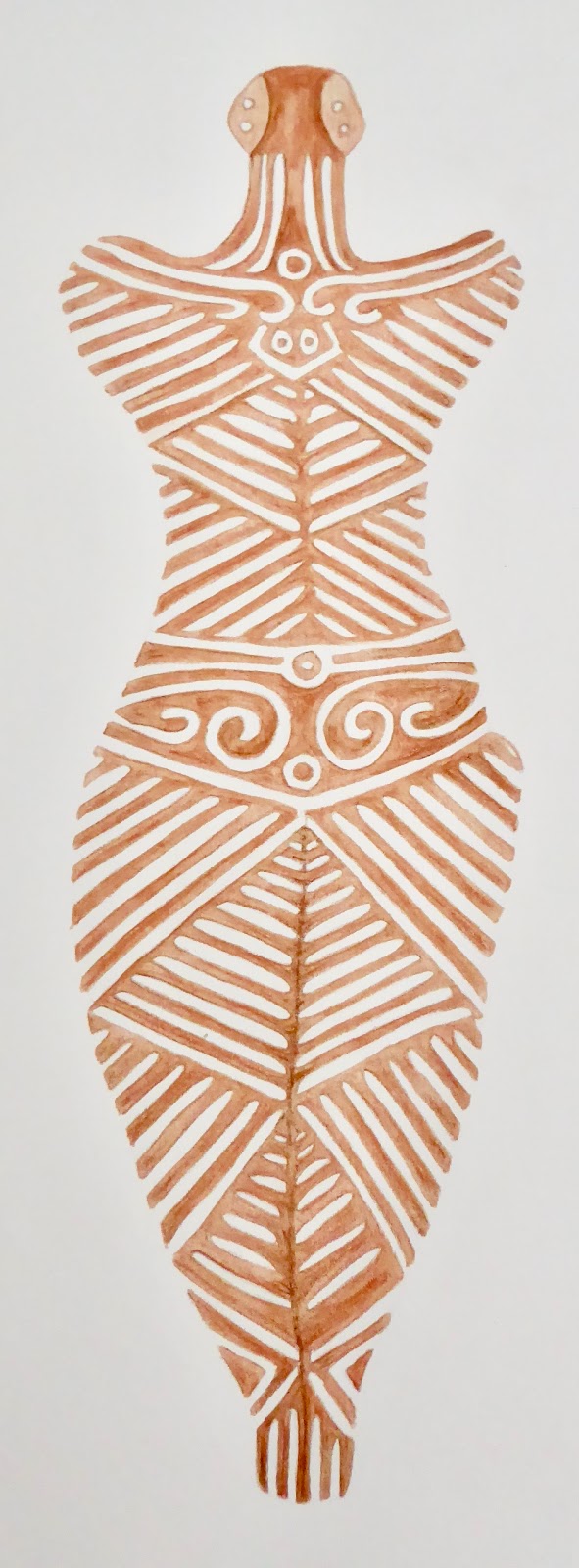
** This story is written from the point of view of a clay ‘Goddess figurine’, representing the Bird Goddess, who stands by the oven, overseeing daily life and entwining it with the sacred.

Bird Goddess (inspired by a Cucuteni figurine from 4050–3900 BCE), watercolour pencils