Showing posts with label Meinrad Craighead. Show all posts

Saturday, 27 May 2023

Perimenopause is Wild: A Poem

 I thought I was. Then I wasn’t sure. Now I am …

perimenopause is wild

cycles expand, escape their bounds

now fast, then slow 

doubled up and none


released from one way 

into an untamed other 

the joyful sorrows of change 

bloom and grow


blessed death mother comes 

fierce and tender with endings 

bled out to fertilise a coming 

inwardness 

bringing heart-wisdom 

and soul-nourishment 

to feed the crone years


(21st December 2022)


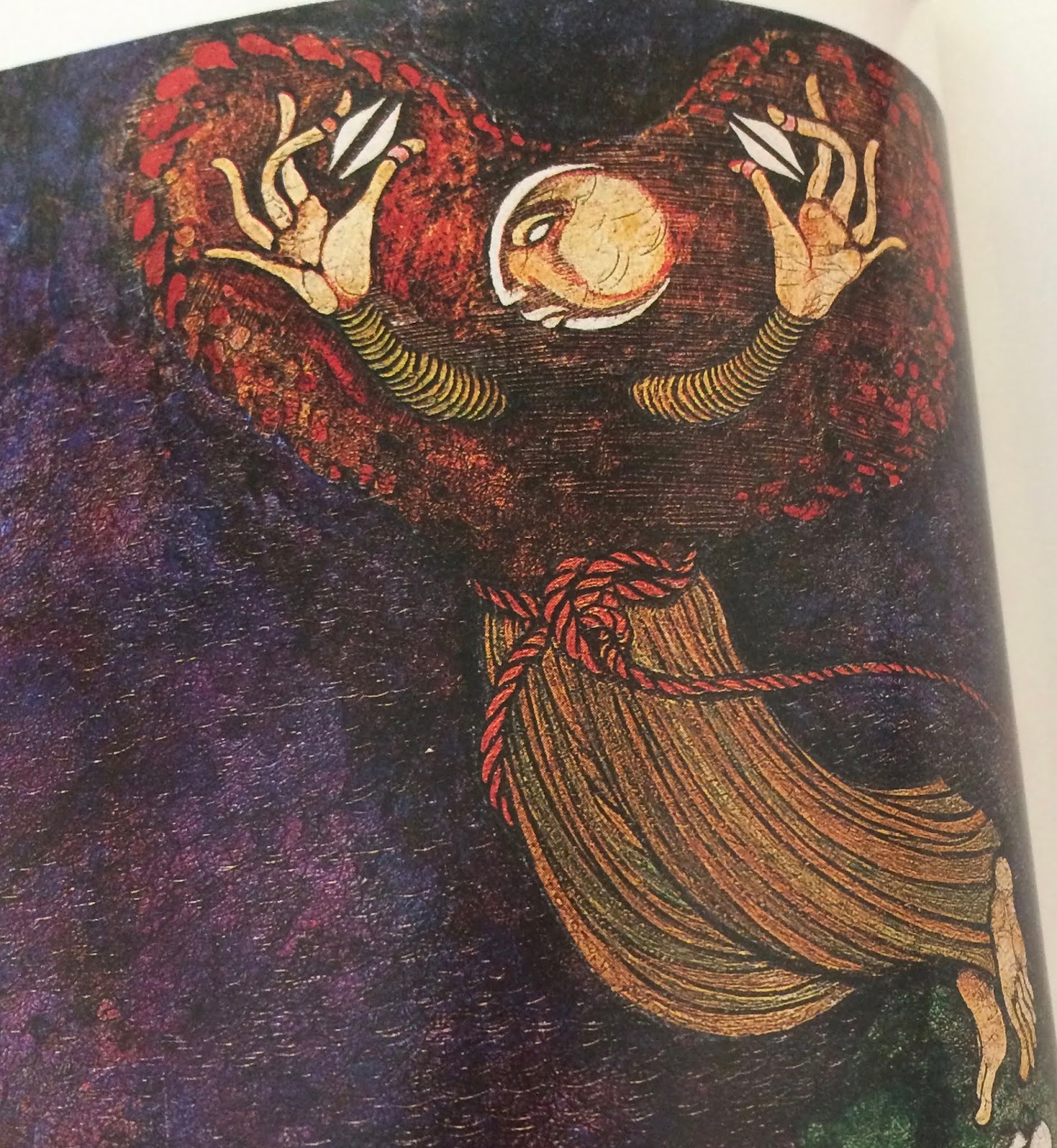
Detail of Blood by Meinrad Craighead

Wednesday, 15 March 2023

All-Seeing

 The symbol of the all-knowing, all-seeing, many-eyed god belongs to an archetypal image in which the stars of the night sky appear as the eyes of the godhead. The link between the upper and lower regions is characteristic for diverse phases of the Great Mother’s rule. As goddess of the tomb, she rules over the world of the dead, but at the same time she governs the celestial world, whose luminaries are her eyes. 

~Erich Neumann, The Great Mother: An Analysis of the Archetype, 1955/1963, p. 127


*


These eyes have been watching me for a long time now, waiting to be released onto the page, into colour and form. Inspired, in part, by the eyes/scales in the background of a favourite image by Meinrad Craighead, Crow Mother, Her Eyes, Her Eggs, they also relate to another idea I’ve yet to realise, but hope to in time. 


They are not quite as I envisaged them, yet, they have been my way back into creating after a long, long break, a methodical and repetitive task to reawaken my painterly self. A new beginning. 


All-Seeing, watercolours and watercolour pencil on gesso prepared paper (2023)

Wednesday, 19 August 2020

Mundus

I have a poetic sensibility such that I find certain words and phrases to be highly evocative, and I often wish that I could create an artwork, poem or story to illustrate them. Such was the case with mundus, which in Latin means ‘world,’ though it is also an origin of the word ‘mound’ (the Middle English form of which—‘mounde’—also meant ‘world’). 


The word came to my attention in Barbara C. Walker’s Woman’s Encyclopedia of Myths and Secrets as related to the Greek abaton, a subterranean ‘pit’ in pagan temples which people entered ‘to “incubate,” or to sleep overnight in magical imitation of the incubatory sleep of the womb …’ (p. 2). The ‘incubus’ or spirit who visited people in their dark, underworld sleep brought dreams that would afterwards be interpreted for healing or prophesy.


The abaton was the human-made equivalent of the natural caves and crevices that people originally saw as the womb(s) of Mother Earth. Megalithic tombs and barrow-mounds were built upon the same principle—the mound representing the pregnant belly of the Goddess, where the dead could be laid to rest in preparation for rebirth. In the Neolithic period both temples and tombs were often built in the shape of the belly or whole body of the Goddess. Thus we have ‘womb-temples’ and ‘womb-tombs’. Walker even states that ‘tomb’ and ‘womb’ are linguistically related (p. 1092), and that mundus meant both ‘earth’ and ‘womb’ (p. 154), though I am not entirely sure if this is etymologically correct. 


However, ‘tomb’ is certainly related to words that mean ‘earth-hill,’ such as the Latin tumulus, which may also have links to a proto-Indo-European root meaning ‘to swell’—just like a pregnant belly—and so it does bring us full circle back to the womb, and the mound, once more.


So, in my mind at least, I can connect these words thusly:


mundus

mound

tomb

womb

world


As is often the case with my work, the inspiration for the image itself came from a number of sources, most notably the circles within an arch in The Alchemist by Rima Staines, a print of which I recently framed. (She reminds me that the creative process is indeed an alchemical one.) 


Rima Staines – The Alchemist (2012)

I also referred to a number of images by the late Meinrad Craighead, whose enigmatic work is frequently provoking new visions. Sacred Hearts, a core influence for Our Lady of the Seeds, with mound-body, moon and orbs, is still haunting me; and the broad-featured face is loosely based on Hagia Sophia.


Sacred Hearts (1990)
Hagia Sophia (1987)

As I’ve been looking at a lot of prehistoric imagery over the past couple of years, the shapes and symbols of numerous menhirs, orthostats and petroglyphs have also seeped into my consciousness. 


I have even referenced my own art. The leaf- or flame-like shapes that sprout from the mound are the same as those in Fluency, which I described as ‘lines of connection, or emanations of energy—little jewels of life and sensation’. Here though, I can more definitely call them leaves, the topmost of which sprouts from the head of the figure, whose headwear started off more like the veils of a nun before elongating into a seed-like form. The vertical nature of it links the above world with the deep below—a recurring theme in my art.


It interests me how I keep returning to the same motifs: full and crescent moons, circles and mounds, triangles and vertical movement. I like the repetition and echo of forms, the circles within circles, the sacred geometry, one thing held within another.


It is not easy, and it can come so sporadically and with such difficulty that I am in constant dialogue with doubt. Yet I feel as if I am finally making the kind of art I always wanted to make.


I shall leave the last word to Marija Gimbutas: ‘Burial in the womb is analogous to a seed being planted in the earth, and it was therefore natural to expect new life to emerge from the old’ (The Language of the Goddess, p. 151).


Mundus, felt tip pen, ink, watercolour, gouache, gold acrylic and gold pen (2020)

Wednesday, 17 June 2020

Our Lady of the Seeds

When I said that Our Lady of the Stars (my previous painting) was showing me the way, I did not understand how precisely that was meant. She was a diversion from the work I had planned, painted simply to use up a piece of gesso-prepared paper coated in an inky blue—the remains of an abandoned attempt at painting Solitude. Yet I think I had to paint her to be able to finally manifest Our Lady of the Seeds.


The idea-seed for this painting was planted a little over a month ago by Meinrad Craighead’s work, Sacred Hearts, the form of which suggested this figure to me, buried beneath a mound of earth, only her hands protruding, with greenery sprouting from her fingers. 


Meinrad Craighead – Sacred Hearts (1990)

Though the pose, with arms raised and hands held palms forwards—often referred to as the gesture of invocation—came from an image of Hera which caught my attention in The Myth of the Goddess: Evolution of an Image, by Anne Baring and Jules Cashford (p. 312). This also gave me the design for the dress, decorated with square ‘fields’ with dots (perhaps seeds?) pricked into the middle of each one.


I also referred to this image of Thracian Kybele from Max Dashu’s visual presentation, Magna Mater / Isis of 10,000 Names


When I scribbled down my initial drawings I knew immediately who this figure was, and had some idea of how I wanted her to look, with a colour scheme very similar to Meinrad’s image—reddish brown earth and green-blue foliage emerging from darkness. Yet try as I might (with three seperate attempts!), I couldn’t get the paint to behave as I wanted it to. Whether this was due to my own lack of technique, or wayward materials, I can’t say. Probably a little of both. 


Yet the potency of the image was such that I knew I couldn’t just give up. So I decided to take an entirely different approach, simplifying it to a mixture of just two colours—ultramarine and burnt umber—laying a wash over freshly gessoed paper to create an initial symbolic (albeit invisible) link between the earth and the sky. 


The day after I applied the wash I read the first message of the nine-day Novena of Our Lady of Woodstock, and it inspired a sudden realisation: the sky and the earth are not separate—Our Lady of the Stars is Our Lady of the Seeds!


Sometimes I need reminding of the things I already know.


Our Lady of Woodstock said:


You believe that plants rely upon dirt for their life, but I tell you that the Dark is dirt. Darkness bears the seeds of the cosmos in Her womb, and out of those seeds—which you call stars—all things have their being and their life.


Stars and seeds are one and the same—stars seeding the cosmos, seeds seeding the earth; the dark of space and the dark of the soil the same Darkness, the same ultimate Source of Life.


Suddenly my painting had direction and I felt far more confident about what I needed to do. She emerged without too much incident or difficulty, though with a great deal of patience and attention to detail. She is not at all as I envisaged, but entirely different, entirely what she needed to be.


I feel that I may still return to this idea again at some stage, perhaps to make another attempt at manifesting her as I originally saw her. But for now I am just glad she has come through at all.


As with all of my art, she is available on Redbubble.


Our Lady of the Seeds, watercolour, gouache and gold acrylic on gesso prepared paper (2020)

Monday, 8 June 2020

Wise Words: Axis Mundi (The Union of Spiritual and Material Energies)

Making is a spiritual search. When the artist makes he or she is identified with the will of the spirit. But the artist is also identified with the will of the earth because the end of this spiritual search is to find and press the forms from his or her imagination into physical matter. Art is the union of spiritual and material energies.

(Meinrad Craighead, The Sign of the Tree: Meditations in Images & Words, Artists House: London, 1979, p. 164)

Axis Mundi, by Meinrad Craighead

Thursday, 19 March 2020

Matrix (An Homage to Meinrad Craighead)

These are certainly strange times we are living through, and uncertainty is likely to be with us for some months to come. This, therefore, is a small offering, a creation long in the making, that I hope brings some solace—and if not that, at least a temporary distraction from the anxiety-laden news.

There are a number of inspiration-threads to this work. I will try to weave them together as best I can here.

Matrix, watercolours on gesso prepared card (2020)
As lunar symbolism has been a core part of my art over the past year, the ‘triple goddess’ symbol has often been on my mind. 


While there may be some dispute surrounding the authenticity or validity of this symbol and concept in a contemporary sense, there is no doubt that there were numerous threefold goddesses in ancient times (the Fates, for instance), and that their triune nature is embodied by the lunar cycle, and vice versa. Thus the number three has symbolic (and, for me, aesthetic) significance. In my studies of Neolithic cultures it also came to my attention that very similar symbols can be found, such as this one from Knowth, Ireland (1), indicating that the roots of this image are very deep indeed.


In my explorations I came across ‘Lunulae / Crescents in Ancient Europe’ by Max Dashu, which displays some beautiful examples of the crescent moon/horn shape across time and cultures. It’s hard to believe that there isn’t some kind of ongoing meaning behind this symbol, though much remains a mystery. As Dashu says, ‘This whole post is about questions, not conclusions’. 

Messenger of the Invisible
Further searching led me to the lunitsa (‘little moon’)—the same symbol, inverted, and said to represent a bird (though the moon too), in ancient Slavic cultures, from shamanic ‘bird culture’ origins (2). I’m not sure of the veracity of this claim, and its almost impossible to find more in-depth information, though it does fit with the symbolism of Old Europe, and likely has some connection to it. Additionally, Phoenix of Elder Mountain says, ‘The moon and bird are the oldest pre-pagan female symbol for the emotional body, the feminine and the moon. Its a dual symbol which symbolizes the “soul bird” and the moon.’ All of this reminds me of my painting Messenger of the Invisible, which suggests that the lunula-bird has been subconsciously at work in me for some time.
Rainmaker

Since the aim with my art is not to create an image that is historically accurate, but rather to work intuitively and synthesise numerous influences into symbols that have meaning for me, the above information was enough to get ideas flowing. (Though it is always nice when the symbols naturally fall into place based on what we know of ancient realities, however disputed they may be—and more often than not, they do!)

If the lunitsa is a bird, I knew I would echo it with the snake, since the bird and snake are so entwined now in my mind. The snake would be an answering crescent, much like the serpent who arches like a rainbow, flowing with life-giving water, in my painting Rainmaker.

The other core influence for this image was Meinrad Craighead’s Symbols of the Mother (3). The simplicity, yet depth of meaning, in this work drew me in and wouldn’t let me go, and led to my use of a vertical format (rather than the horizontal design of the triple goddess symbol), and to the separation of the ‘upper and lower waters’/earth from sky/underworld from upperworld.


I scribbled down my first design in late January, so it feels like this painting has taken an age to come to fruition. There were false starts, an uncooperative painting technique (combined with my limited skills), plus rain and illness delays. I also made things difficult for myself by requiring accuracy and symmetry, based as the design was on a kind of sacred geometry. I very much doubted if I would finish it at all, but I persevered and found a way through to the end—at which point I was still without a title. The most obvious thought was to call it Goddess, my first thought just Untitled. But in listening to an interview with Max Dashu recently the perfect word came up: Matrix—the Latin for ‘womb,’ with its connotations of source or origin.

And just like that, everything fell into place. I hope it is a fitting homage to Meinrad. 

References
1. Image of megalithic designs, Knowth, Co. Meath, Ireland (middle or second half of 4th millennium BC), from Marija Gimbutas, The Language of the Goddess: Unearthing the Hidden Symbols of Western Civilization, HarperSanFrancisco: New York, 1989, p. 286
3. Text and image from Meinrad Craighead, The Sign of the Tree: Meditation in Images & Words, Artists House/Mitchell Beazley: London, 1979, pp. 110–111

Tuesday, 3 September 2019

The Broad One

Here she is! 

The Broad One
Gaia
Mother Earth
All-encompassing Mountain Mother

The Broad One, watercolours and gouache on gesso prepared paper (2019)
The inspiration for this painting came primarily from an image in one of the videos of the Cuban-American ‘earth-body’ artist, Ana Mendieta, whose work I have been exploring recently. This enigmatic winged and breasted being, incised into the wall of a limestone cave, as part of Mendieta’s Esculturas Rupestres (1981), was enough to spark a vision. (You can see a clearer image here.)

Screenshot from https://vimeo.com/212831502
The gushing fountains and spilling vessels of the late Meinrad Craighead’s work have also trickled into my consciousness. As have literal vessels—the many pots and jars that represent the body of the ancient life-giving goddess—unearthed from what was once Old Europe. 


Most of the work I have been doing this year has been ‘experimental,’ exploring the possibilities of new painting techniques, along with trying to tease strange and unexpected ideas from my own body-mind, so I am always pleased when something emerges that is successful. 

There is a pleasing symmetry to this mountain-vessel-fountain being who joins sky with earth, and moonlight with the glowing heart at the centre of things. She is Divine Source, bearer of water and light, keeper of stone and darkness. She is both weight and winged lightness, mother and devourer. I am so glad she has come.


Wednesday, 10 April 2019

Meinrad Craighead 1936–2019


Today I learned of the death of the artist-mystic Meinrad Craighead at the age of 83.

Born Charlene Marie Craighead in 1936 in Arkansas, she lived a remarkable life, teaching art in Albuquerque, then Italy and Spain, before spending fourteen years as a Benedictine nun in Stanbrook Abbey in England. It was there that she took the name Meinrad, after her mother’s great uncle, who had been a monk in Switzerland. (He is said to cure people.) In 1983 she returned to the US, settling near the Rio Grande in Albuquerque. 

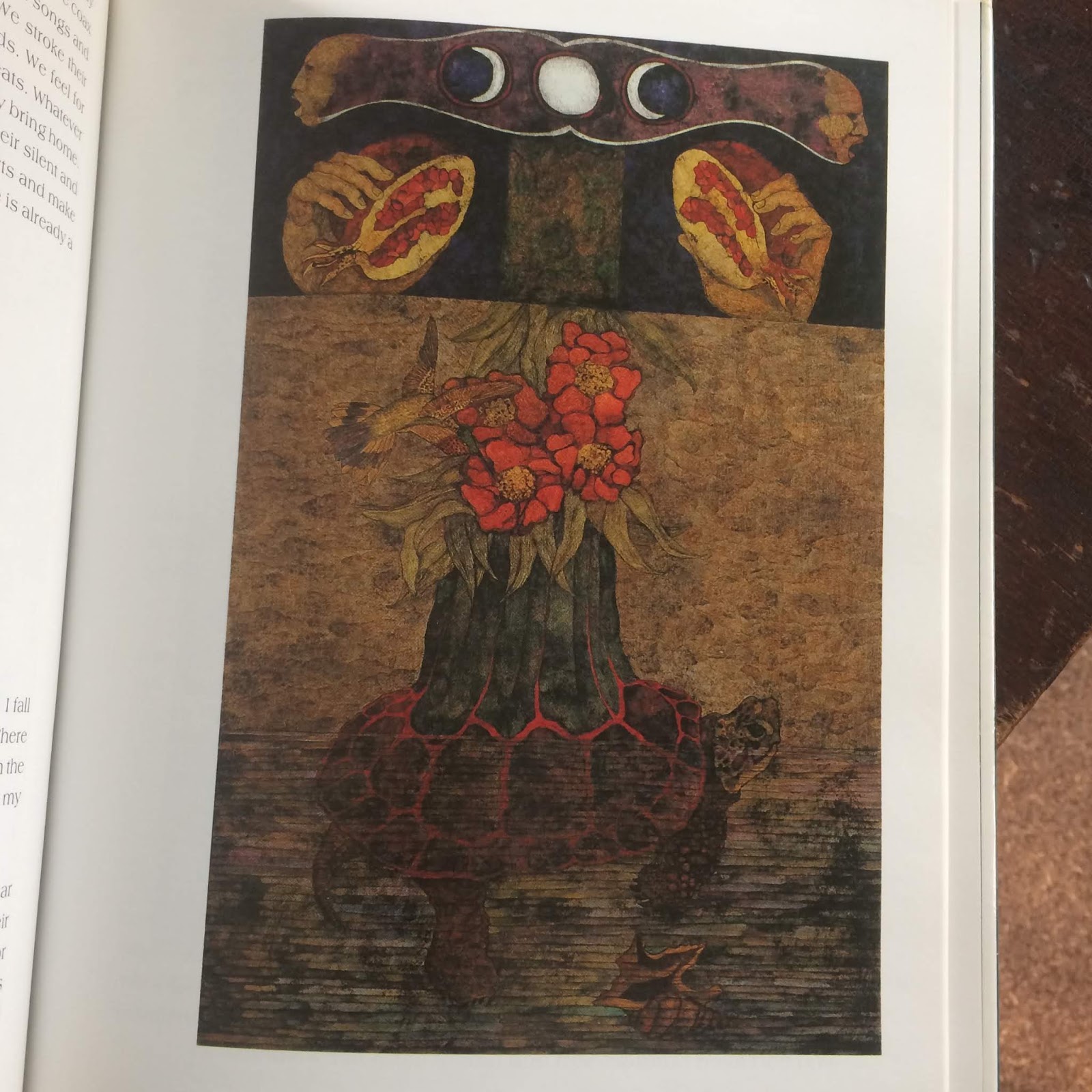
The Moons of the Vernal Equinox (from The Litany of the Great River, 1991) 
It is only in the past year or so that I have discovered Meinrad’s art, and watched the short videos made by Amy Kellum, Praying with Images and God Got Bigger, which I know I will continue to return to whenever I am feeling particularly uninspired. They do not fail to invigorate me, to show me what is possible, to make me want to keep seeking, keep trying, to be receptive and ready, and to create from that vast space of openness.

Though Meinrad seemed a small, unassuming woman, she was intimately connected with the wild, with the spirits of animals and the land around her, and the often overwhelming nature of God the Mother, who is certainly not just sweetness and light. Her work is beautiful, strange, and sometimes confronting in it’s depiction of birth and death, dream and transformation. It links spirit, woman and nature into a seamless weave of divine immanence.

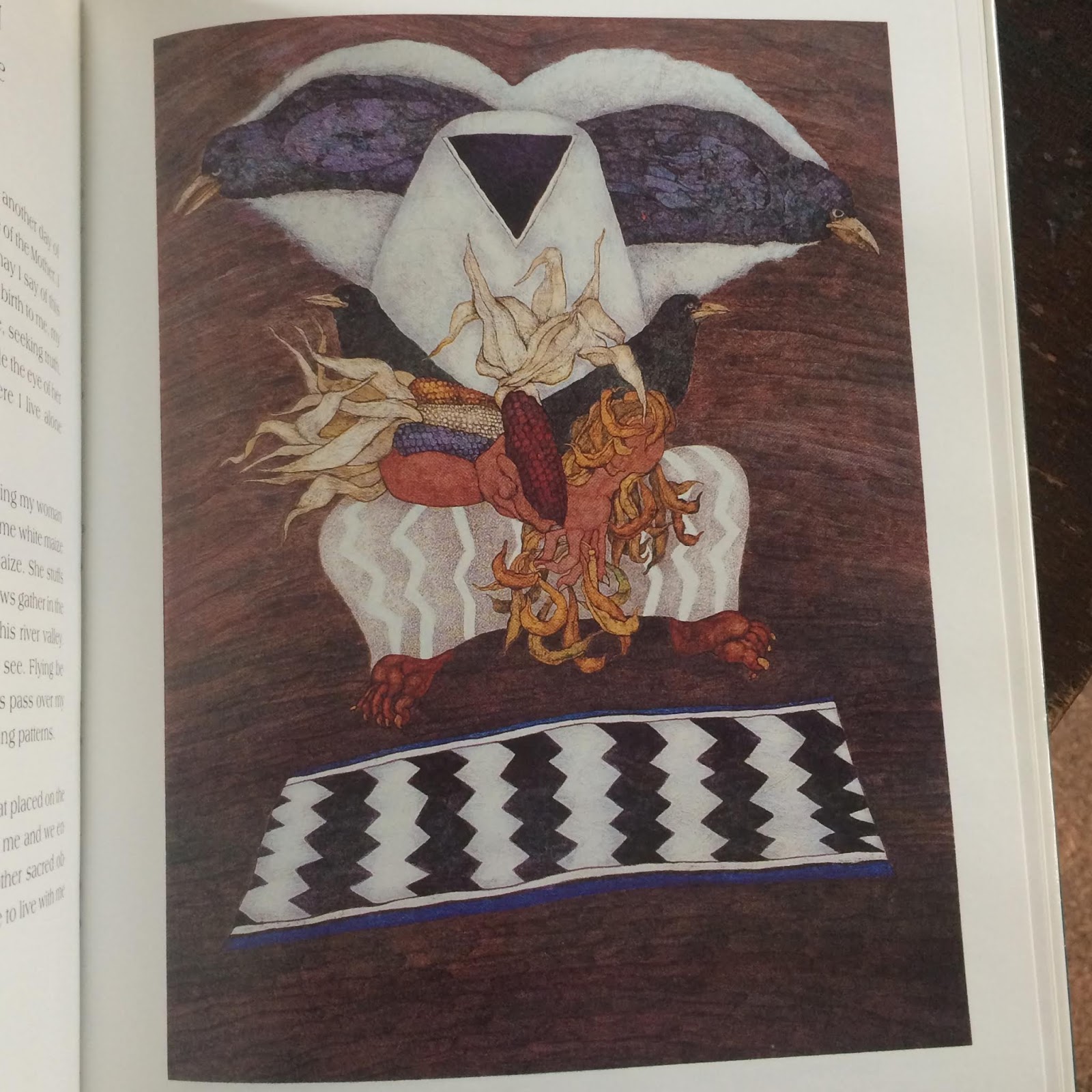
Crow Mother Over the Rio Grande (from The Litany of the Great River, 1991)
What I also love about Meinrad was that her studio was a shrine, and her art practice was ritual. Her approach to her work, as a sacred calling, as a communication with the many spirits she was in contact with, is an inspiration. 

She wrote:

My personal vision of God the Mother, incarnated in my mother and her mother, gave me, from childhood, the clearest certainty of woman as the truer image of Divine Spirit. Because she was a force living within me, she was more real, more powerful than the remote Fathergod I was educated to have faith in. I believed in her because I experienced her.


I draw and paint from my own myth of personal origin. Each painting I make begins from some deep source where my mother and and grandmother, and all my fore-mothers, still live; it is as if the line moving from pen or brush coils back to the original Matrix. Sometimes I feel like a cauldron of ripening images where memories turn into faces and emerge from my vessel. So my creative life is itself an image of God the Mother and her unbroken story of emergence in our lives. (From the introduction to Meinrad Craighead, The Mother’s Songs: Images of God the Mother, Paulist Press: Mahwah, New Jersey, 1986)

I feel so lucky that I have two of her books (which are mostly out of print and difficult to find). I will treasure them and remember Meinrad every time I return to their pages for inspiration and guidance.

Farewell, Meinrad. Journey well on the next stage of your being. 

Throne (from The Mother's Songs: Images of God the Mother, 1986)

Thursday, 18 October 2018

A Prayer To Her

If you are here always, and a part of me, will you help me? Will you send me what it is I need to live, to survive, to create? I do not want to always be asking questions. I should be listening to the answers, knowing them within me.
Why have I been made this way if I was not meant to be this way?

We must learn to be thought 
by the gods, not to think them.
           ~Robert Bringhurst

Do you think me? Am I thought through you? Thought Woman—Creatrix—She-Who-Is. Please think through me, let your thoughts become my thoughts, calm and profuse.
Earth, teach me. Darkness, teach me. I want to learn from the ground beneath my feet. I want to descend, to fall below the rational, the known, to find the core, primordial ways of knowing—the earth/water/air—all-one knowing. The love that binds and holds all together, like a prayer muttered, an incantation, a mantra that chants the world’s being. In my dream is a circle, a wholeness, a wondering within the Mystery that is my own life, in-held … blessed and born into flesh. A circular dimension, womb-like, the yonic shape of eternity’s folds. Veiled from matter, yet behind it all, like a fire, a warmth that suffuses life.
The Wise Woman must assert herself, her knowledge and ways. Have courage, she says. We are returning. We are within you, held in blood and bone, in genes that speak of past lives, of who we were. You know us, like you know yourself, and we can speak through you, direct you towards fate, destiny, life that is full of living. You must trust us, must simply listen, and rebel against those who would belittle and silence. There is so much more you need to know, and can, if you open your heart, open bodymind to our voices. We are all around you, in the ground, in the air, in the trees and birds. We whisper on the wind, we weep in the rain. Water carries us far.
In the mountain there is a heart, a core of being that is yours. It belongs to all, a gift from earth to her people. An opening into the earth can be found, a bountiful hollow that is filled with source, filled with essence, elemental energy. You feel it within you, like a name, a word, a practice of living, open to life and spirit—inspired and enthused. She-Who-Is compels you to try, to keep trying, to live and love and create from your body, like a star, an essence-filled fleshly being, a life of triumph, of power with the Others. Shared. Opened. 
I feel you within me and want you to grow, to strengthen, to gift me with what it is I seek: A wellspring that flows endlessly, to guide me through life. A torrent of aliveness, like a blessing, a bounty, a cornucopia of gifts and nourishment.

Hagia Sophia, by Meinrad Craighead (1987)
There is a blade I must use to cut away extraneous matter, to destroy thoughts that deaden and constrain. Cut away all that is not truth, is not woman-thought, is not love for what is. I defy the patriarchs: I sing out my curse over their dead lands, their prisons of suffering and despair. We will escape, back into the wild, with wildness in our hearts to replace the drug of civilisation.
Carrying this torch, this light that endarkens, bringing what is missing to the world, I step beyond myself and towards what is necessary, what is desired by earth-fast stone, tree, the greening life and the waters. All hearts yearn for this—the drumbeat of being that dances inside everything—I hear it, feel it, beckon it. It will enliven me, consecrate my actions, so they burn with a power that has not been seen for centuries. To be part of the turning—come what may—is a privilege—one of pain and sorrow—but we are alive within these times, and striving to become more so. To let love flow out over the land like a balm. 
I will defy the proscriptions of the masculinist world. I will defy and defy and defy. There is a strength in me that is more than I know, that is hidden and biding its time, but so powerful, it will awaken me from sorrowful slumber and turn me inside out, dismember and re-member this broken, wounded body, this self of confusion and hopefulness.
Creation is a cauldron of possibility. My body is a womb of light—blood-red and sensuous, of itself, made and formed by the Mother, blessed by her blood. 

What foremothers have made me? Who are my people? How do I find them, my ancestors, my spirits?
Listen. Pay attention. Be still. Look out at the world around you, the mountains, the trees, the blessed air, the winged ones, and the water.
Trust. Know you are held, loved, and born for something.

* * *

I wrote this several weeks ago, and gave it the above title when I turned it into a blog post; and then I read Sarah Elwell’s beautiful piece, A Hymn to Her, which I thought a beautiful and extraordinary synchronicity. It seems She really is returning, sung out by different voices in different ways, but needed and longed for no matter Her words.

Monday, 27 August 2018

Wise Words: The Moon Is Yours (Their Progress Is Not Our Progress)

The moon is yours. And it belongs to the U’wa child and to the Hopi Indians, to the Inuit and to the Mexican woman collecting water and to the monks of Tibet. It belongs to every moth that flies towards it, to every dog who barks for it and to every cat on the hackled prowl for it. Untouched, it is a global commons unparalleled, for it belongs to the minds of millions upon millions of people; an emblem of purity, of women, of imagination or of time itself; a beautiful place of thought which can mean a million different things to a million different minds, all on one night. ‘The moon shines bright. In such a night’ as Shakespeare said, it shone for Dido, for Medea, for Troilus and Cressida all alike. But a few hundred overprivileged white males plan probes and moon maps and say the far side of the moon would be the site for an Observatory. Like an exact parallel with ‘progress’ on earth, it uses all the tools of imperialism – from Observatories, maps, enclosures and sheer political force – to colonize a commons. Their progress is not our progress. To lose the moon and be given instead a petrol station, a Hilton hotel, an industrial estate, a quarry and a nuclear waste deposit is not a good swap but a terrible theft; a theft from the very soul of humanity. And we, the millions who have lost something so infinitely precious, are expected to applaud it?

(Jay Griffiths, Pip Pip: A Sideways Look at Time, Flamingo: London, 1999, pp. 217–218)

Detail from Memory, by Meinrad Craighead, from her book, The Mother's Songs: Images of God the Mother (1986)