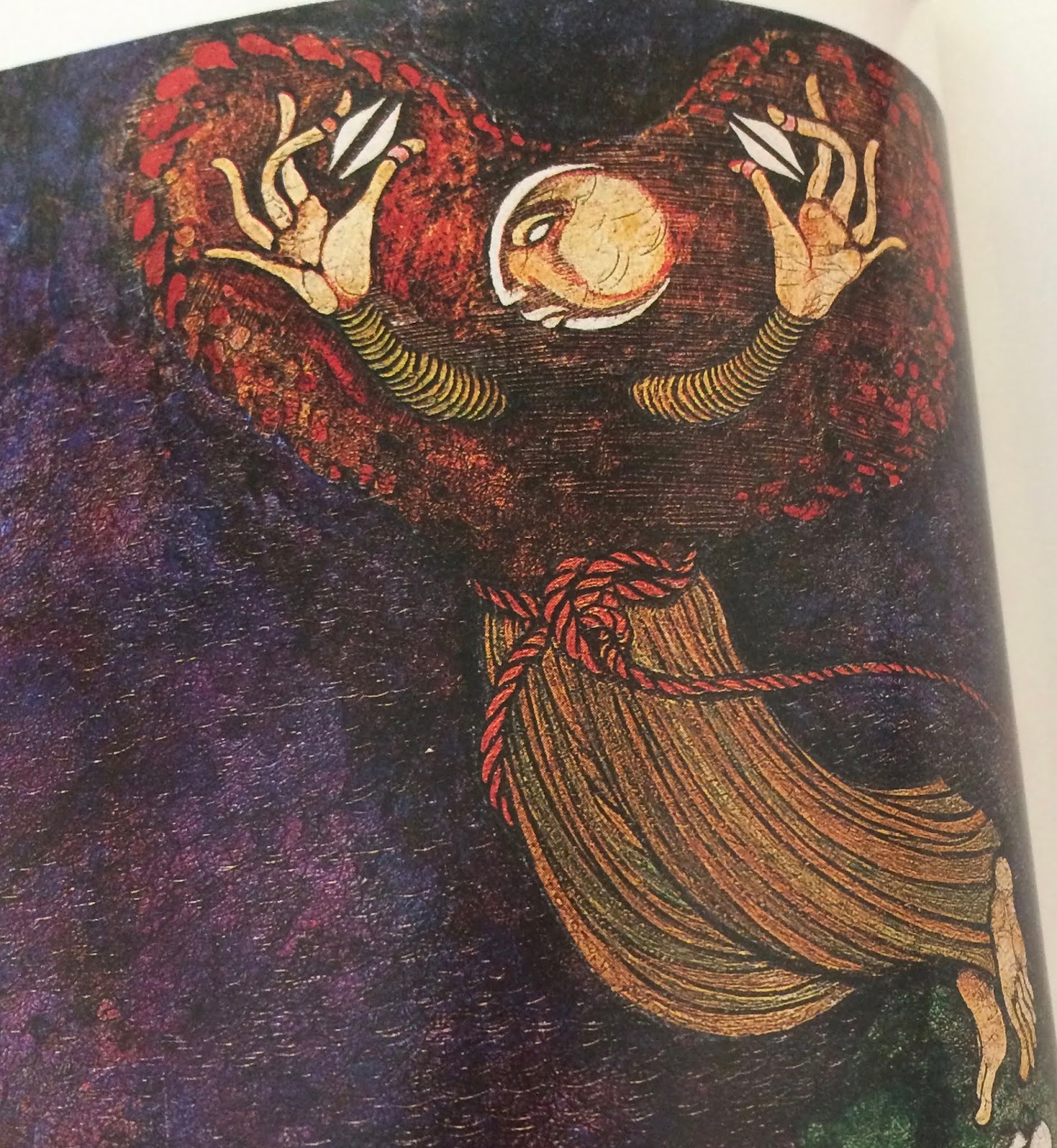
Showing posts with label ethics. Show all posts

Tuesday, 3 March 2020

Wise Words: Listening to Country

Love and sorrow connect you to Country. They help make Country part of you and if you listen to that you will learn about limits too. We all need to listen to Country so we are not blinded by our own desires. It is time to stop and listen, to learn about the land and what nature is saying.

There are many of us breathing the same air. The clouds are above us all, with their messages and their Rom [Yolŋu Law]. You don’t need to look somewhere else for answers, to go away and explore or build a new house or make a fortune. Life itself is important.

We need to tell those who are blinded by their own desires. It’s something we don’t want to hide. We want to tell the truth to the greedy people about climate change, building, building, never replanting, digging, killing. If it’s something we don’t want to tell the ŋäpaki [non-Indigenous people], then who are we going to tell, the spirits? Many don’t want to listen to us. But perhaps you can listen. Remember the limits. Those clouds are separating here, with us, with you.

It is about learning from the land, listening to the stillness, learning from the clouds as they separate …

(Gay’wu Group of Women, Songspirals: Sharing Women’s Wisdom of Country Through Songlines, Allen & Unwin: Crows Nest, 2019, p. 111)

Thursday, 6 February 2020

Dark Emu, by Bruce Pascoe

One of the most fundamental differences between Aboriginal and non-Aboriginal people is the understanding of the relationship between people and land. Earth is the mother. Aboriginal people are born of the earth and individuals within the clan had responsibilities for particular streams, grasslands, trees, crops, animals and even seasons. The life of the clan was devoted to continuance. (1)

*
Having just read Bruce Pascoe’s Dark Emu: Black Seeds: Agriculture or Accident?, which argues that an extensive system of agriculture (and aquaculture) existed in Australia prior to colonisation, I find I am having to completely reevaluate my understanding of indigenous Australia, which of course is a good thing. Though it is not because I thought that Aboriginal culture was ‘primitive’ or ‘unsophisticated’, but for quite the opposite reason: I think that the development of agriculture is problematic. It very often leads to overpopulation (and the conditions for famine), systematic violence (as food surpluses need to be protected, and more land acquired to provide for more people), as well as soil degradation and erosion – and the soil is the very thing all terrestrial life depends upon. 

Further, my (admittedly fairly limited) understanding of the Aboriginal way of life, and the nature of the land here, had led me to believe that agriculture simply wasn’t possible, and thus the hunter-forager way of life was both necessary and wise. And yet the evidence put forward in the book suggests that not only was extensive farming taking place, but that it was sustainable. It had been happening for at least 4000–5000 years (though potentially much longer), and involved careful attention to building and maintaining the soil, strict rules about how plants were to be harvested, and respect for other people’s crops and food stores. Importantly, there seems to have been no violence, no need for conquest of other people’s land, but instead a continent-wide web of mutuality and respect, based on cultural laws derived from the law of the land itself. Pascoe writes:

Aboriginal Australian law insisted that the land was held in common and that people were the mere temporal custodians. Individuals were responsible for particular trees, rivers, lakes and stretches of land but only so these could be delivered forward to the next generation in accordance with law. Individuals and families might be said to own a particular fish trap or crop but they worked in co-operation with the surrounding clans.


The system in operation could be considered a jigsawed mutualism. People had rights and responsibilities for particular pieces of the jigsaw but they were constrained to operate that piece so that it added to rather than detracted from the pieces of their neighbours and the epic integrity of the land.

The piece of the tree or stream or the land that a group retained responsibility for bled into country so distant that they may never visit that country. They had to imagine how the whole picture looked …

… 

The religious, social and governmental rules were forged and entwined in mandala that had to be imagined in the soul. (2)


If this system of farming existed then, clearly, Aboriginal Australia has always been much more complex than we have been led to believe. Much evidence has been suppressed or ignored (or literally obliterated by the hooves and mouths of sheep and cattle), in favour of the ‘nomadic hunter-gatherer’ narrative, because that is what suited, and often still suits, the white/Western perspective. 

Yet now what I am imagining is a land where many people lived more or less settled lives in comfortable houses of various designs, with crop farming, food storage (including dried and smoked fish and meat), and even some evidence of pottery use. It puts me in mind of what I know of life in Neolithic Old Europe, though of course I know it’s not a good idea to start developing new assumptions based on unrelated cultures. Aboriginal Australia, because of its isolation, is incredibly unique, and must be evaluated on its own terms. 

That a truly sustainable agriculture could develop, without population overgrowth or violence, based on respect for the soil and other people’s crops, and a sharing of the land’s bounty, proves that agriculture can be done very differently. There are many lessons that could be learned from this, though how they would be successfully implemented in the modern world I have no idea. Though without a change in the way we view and relate to the land, which means (re)developing a spiritual and moral understanding of it, I don’t think much can be achieved. Still, there is hope to be found in this newly uncovered narrative.

I, for one, want to know what the food of this indigenous agriculture tasted like: the seeds ground into flour and baked into cakes; the yam daisies; the fresh or smoked fish; the Bunya nuts. I want to know how the women sewed their possum skin cloaks with fine bone needles and kangaroo tail sinews as thread, and what their houses were like. I also want to know what the land looked like before European settlement, because the Australia that now exists clearly bears little resemblance to what it once was. This makes me incredibly sad. Even more has been lost than I realised.

The world’s most ancient and sophisticated culture just got way more complex and intriguing, and my eyes have been opened. Dark Emu has not only reminded me to be aware of my preconceptions and prejudices, but has also given me much to ponder.

References

1. Bruce Pascoe, Dark Emu – Black Seeds: Agriculture or Accident?, Magabala Books: Broome, Western Australia, 2014, p. 145
2. pp. 138–139 

Tuesday, 22 January 2019

Necklace of Mouths

When I painted Ancestress, I also prepared another piece of paper at the same time, and achieved the same cracking (which I have since learnt is probably because I added insufficient water to the gouache), so I used it to create this image. 


When I was watching Max Dashu’s video, ‘Grandmother Stones of Megalithic Europe,’  I am sure she said that the ancestor figures are generally depicted without mouths. As the ancestors no longer have bodies, and thus mouths, through which to speak, this made sense. Hence, Ancestress has no mouth, but rather, speaks through her presence.

Yet, the idea of voices, of story and poetry and language, echoing back through time, was something I kept returning to. That’s why this figure has seven mouths—her own, plus six hanging below like necklaces. There is a reason for this, as Jay Griffiths writes:

Many cultures conceive the future and plan for it by looking ahead seven generations; the Iroquois Confederacy of Six Nations, for instance, living in the remains of their ancestral land in America and Canada, consider the effects of every decision they take ‘unto the seventh generation’. African and Polynesian tribes, too, were, traditionally, said to look ahead at least seven generations. Seven generations, it is thought, is chosen because that is the greatest number one could hope to know in one’s own life; one’s great-grandmother, grandmother, mother, sister, daughter, grand daughter and great grand daughter. (Pip Pip: A Sideways Look at Time, Flamingo: London, 1999, p. 225)

To look ahead seven generations, to always keep the future in mind, would have a momentous impact on human behaviour and morality. But what about looking back also? What could we learn from listening to the voices of those who have come before us?


In the film Aluna, about the Kogi people of Colombia, I was struck by one of their ideas: that each generation knows less than the one before—not more, as Westerners would tend to assume. And we know less because we are moving away from the source, further in time from the first ancestors, the people and beings who knew the most, because they were closest to the beginning of things.

There is a thread of knowledge that winds back through time, a twisting labyrinth of story and words and wisdom, that spills from the silent mouths of our forebears. That thread runs through the now of our blood and living bodies, back to the then of ancient times. If we listen closely, perhaps we will hear it whispering.

Necklace of Mouths, watercolours and gouache on gesso prepared paper (2018–2019) 

Monday, 24 December 2018

Wise Words: Our Only Hope Is In The Soil

To save the world, we must first stop destroying it. Cast your eyes down when you pray, not in fear of some god above, but in recognition: our only hope is in the soil, and in the trees, grasses, and wetlands that are its children and its protectors both.

“And why are we not doing this now?” … For a lot of reasons, most of them having to do with power. But a new populism could spring from this need, a serious political movement combining environmentalists, farm activists, animal rights groups, feminists, indigenous people, anti-globalization and relocalization efforts—all of us who are desperate for a new, and living, world.

… The earth, our only home, needs that movement, and she needs it now. The only just economy is a local economy; the only sustainable economy is a local economy. Come at it from whichever angle matches your passion, the answers nest around the same central theme: humans have to draw their sustenance from where they live, without destroying that place.

That means we must first know that place. 

(Lierre Keith, The Vegetarian Myth: Food, Justice and Sustainability, Flashpoint Press: Crescent City, California, 2009, pp. 250, 252)

Monday, 24 September 2018

Wise Words: Things Are Meaning

The cheerful term postcolonial, which I often hear on campuses these days, might suggest that the age of destruction is over. In fact, the colonization is still at fever pitch. The great transformation of gold into lead and of forests into shopping malls continues. Some analogous transformations can be seen in the university itself. One of the reagents used for this purpose is the acid of postmodernism: the thesis that nothing has meaning because everything is language. It works especially well in parallel with the acid of unrestrained commerce: that nothing has meaning because everything is for sale. Repeated exposure to these ideological acids produces human beings who cannot wonder at the world because they are not at all sure the world exists, though they can wonder all the more at social power and reputation. When you take the world away from a human being, something less than a human being is left. That is the inverse of education.
To me it is clear that things have meaning because they are meaning, and that language has meaning – or can have meaning – because it can speak, poorly but truly, of some of the things that language is not. For me, these facts have a practical outcome: because things have meaning and I want them to continue to have meaning, not everything is for sale. In a healthy economy, only the surplus and the precipitate are for sale, because those are the only things in actual need of recirculation. 

(Robert Bringhurst, ‘The Vocation of Being, the Text of the Whole’ in The Tree of Meaning: Language, Mind and Ecology, Counterpoint: Berkeley, 2006/2008, pp. 62–63; my emphasis in bold)

Monday, 27 August 2018

Wise Words: The Moon Is Yours (Their Progress Is Not Our Progress)

The moon is yours. And it belongs to the U’wa child and to the Hopi Indians, to the Inuit and to the Mexican woman collecting water and to the monks of Tibet. It belongs to every moth that flies towards it, to every dog who barks for it and to every cat on the hackled prowl for it. Untouched, it is a global commons unparalleled, for it belongs to the minds of millions upon millions of people; an emblem of purity, of women, of imagination or of time itself; a beautiful place of thought which can mean a million different things to a million different minds, all on one night. ‘The moon shines bright. In such a night’ as Shakespeare said, it shone for Dido, for Medea, for Troilus and Cressida all alike. But a few hundred overprivileged white males plan probes and moon maps and say the far side of the moon would be the site for an Observatory. Like an exact parallel with ‘progress’ on earth, it uses all the tools of imperialism – from Observatories, maps, enclosures and sheer political force – to colonize a commons. Their progress is not our progress. To lose the moon and be given instead a petrol station, a Hilton hotel, an industrial estate, a quarry and a nuclear waste deposit is not a good swap but a terrible theft; a theft from the very soul of humanity. And we, the millions who have lost something so infinitely precious, are expected to applaud it?

(Jay Griffiths, Pip Pip: A Sideways Look at Time, Flamingo: London, 1999, pp. 217–218)

Detail from Memory, by Meinrad Craighead, from her book, The Mother's Songs: Images of God the Mother (1986)

Monday, 13 August 2018

Wise Words: Progress Is A Four-Letter Word

Cardinal John Henry Newman once said: ‘Progress is a slang term’. For many, it is a four-letter word. Vandana Shiva spits on the shoe of progress and development – including, not surprisingly, the Narmada dam.

‘What is currently called development is essentially maldevelopment, based on the … domination of man over nature and women. The economic “growth” that the masculinist model of progress has sold has been the growth of money and capital based on the destruction of other kinds of wealth such as the wealth produced by nature and women.’

She argues instead that ‘steadiness and stability are not stagnation, and balance with nature’s essential ecological processes is not technological backwardness but technological sophistication.’ ‘Chasing the mirage of unending growth, by spreading resource-destructive technologies, becomes a major source of genocide, the killing of people by the murder of nature is … today the biggest threat to justice and peace.’

(Jay Griffiths, Pip Pip: A Sideways Look at Time, Flamingo: London, 1999, p. 198)

Monday, 2 July 2018

Wise Words: The Future Is Not A Promised Land

Westerners like me implicitly understand that a temporal orientation is also a spatial orientation: we face the future; the past is behind us. Indigenous Australians make temporal-spatial links too, but theirs work differently. They face the source; those who come after them are called the “behind mob.” Each generation follows along behind their ancestors, and their descendants follow along behind them. I imagine this mode of time as waves of generations; we face the source, which is where we all came from, and we follow our predecessors back to the source, leaving behind us a “new mob” or “new generation” to take over. Those behind us walk in our footsteps, as we walk in the steps of our old people …

Within this indigenous world of time, space, and generations in motion, the future is delightfully complex. On the one hand, it can be assumed to be following behind us in the form of the next generations of people, plants, animals, and others. More significantly, though, it is in the ground. The future is waiting to come forth, to be born and to live, and then to return into the source, riding the waves of generations that have kept country and all the creatures alive “forever.”


[The indigenous] way of thinking of the future impels us to take care of the ground right now, right where we are, because we are here, because this is our source, because our purpose in life is to bequeath life, not to unmake it. Jessie [Wirrpa] expressed such ideas as “true stories”—true accounts of the real world and our responsibilities as humans. True for humans everywhere, and true for other creatures as well …

… The profundity and simplicity of Jessie’s caring for country is, for me, an ethical claim. The future is not a promised land waiting for us to arrive, nor does it bear down on us. The future is in the ground. It is life, and it wants to come forth and flourish. The future is creation in everyday life, and like all everyday miracles, it is as fragile as it is resilient. We are members of creature communities, and our appropriate work is to honor the bequest by taking care of it so that the future can come forth. 

(Deborah Bird Rose, ‘So the Future Can Come Forth from the Ground’, in Kathleen Dean Moore & Michael P. Nelson (eds.) Moral Ground: Ethical Action for a Planet in Peril, Trinity University Press: San Antonio, Texas, 2010, pp. 155 and 157; my emphasis in bold)

Monday, 4 June 2018

Wise Words: The Way Of The Wild

Philosopher Mary Midgley, in Beast and Man, describes how Western societies have considered beasts to be lawless and savage, yet studies of animal behaviour show the reverse: that animals lead highly ordered, “lawful” lives. Take the wolf. They are, writes Midgley, “by human standards, paragons of steadiness and good conduct. They pair for life, they are faithful and affectionate spouses and parents, they show great loyalty to their pack and great courage and persistence in the face of difficulties, they carefully respect one another’s territory, keep their dens clean, and extremely seldom kill anything that they do not need for dinner.” In folkloric terms, the wolf is used as an emblem for lawless cruelty, in contrast to humans. The truth, argues Midgley, is rather the reverse. People used to flay wolves alive in medieval France. Do wolves ever flay people alive? Do wolves flay wolves alive? Humans are more cruel to one another and to animals than any other creature, but humans have projected onto animals their own savagery. 

For much of the world, for most of history, Nature was Law—it was the way people organized morality. For indigenous people, Law is in the land and nature is anything but lawless; rather there is a profound core of order within wild nature. “I am the Way,” said Jesus. By contrast, all nature-based philosophies have seen that in Wilderness was Way. American anarchist Murray Bookchin comments that the term Way is universal to all early communities, meaning ethics, rituals, a sensibility and lifeways, as well as universal meaning, an eternal order that rules everything: the sun, the moon, plants and animals, all of nature.


… Wilderness,  nature, freedom and law are all part of this Way, not in opposition to it. Wildness—complex, free, beautiful and only apparently chaotic—is part of a larger, deeper order.

(Jay Griffiths, Wild: An Elemental Journey, Penguin: London, 2006, pp. 274–275)

Monday, 28 May 2018

Wise Words: Equilibrium

... ‘Do you see, Arren, how an act is not, as young men think, like a rock that one picks up and throws, and it hits or misses, and that’s the end of it. When that rock is lifted the earth is lighter, the hand that bears it heavier. When it is thrown the circuits of the stars respond, and where it strikes or falls the universe is changed. On every act the balance of the whole depends. The winds and seas, the powers of water and earth and light, all that these do, is well done, and rightly done. All these act within the Equilibrium. From the hurricane and the great whale’s sounding to the fall of a dry leaf and the gnat’s flight, all they do is done within the balance of the whole. But we, in so far as we have power over the world and over one another, we must learn to do what the leaf and the whale and the wind do of their own nature. We must learn to keep the balance. Having intelligence, we must not act in ignorance. Having choice, we must not act without responsibility. Who am I – though I have the power to do it – to punish and reward, playing with men’s destinies?’
‘But then,’ said the boy, frowning at the stars, ‘is the balance to be kept by doing nothing? Surely a man must act, even not knowing all the consequences of his act, if anything is to be done at all?’
‘Never fear. It is much easier for men to act than to refrain from acting. We will continue to do good, and to do evil . . . But if there were a king over us all again, and he sought counsel of a mage, as in the days of old, and I were that mage, I would say to him : My lord, do nothing because it is righteous, or praiseworthy, or noble, to do so; do nothing because it seems good to do so; do only that which you must do, and which you cannot do in any other way.’

(Ursula Le Guin, from The Farthest Shore, in The Earthsea Quartet, Puffin Books: London, 1993, p. pp. 361–362)

Monday, 21 May 2018

Wise Words: Make It Fair!

“Westerners are fond of the saying, ‘Life isn’t fair.’ Then, they end in a snide triumphant: ‘So get used to it!’ What a cruel, sadistic notion to revel in! What a terrible, patriarchal response to a child’s budding sense of ethics. Announce to an Iroquois, ‘Life isn’t fair,’ and her response will be: ‘Then make it fair!’ This is the matriarchal approach to learning.”

(Haudenosaunee/Iroquois woman, Barbara Alice Mann, quoted in Derrick Jensen, Dreams, Seven Stories Press: New York, 2011, p. 459)

Monday, 12 March 2018

Wise Words: Culture Protects Nature

The forests have been tended (cultivated) for millennia by Amazonian people. (“The wild is not the opposite of the cultivated,” says Vandana Shiva. “It is the opposite of the captivated.”) Nature and culture may be distinct; a house and the garden are domestic spaces, and have a different quality from the wild forests, but it is not an opposition. Further, one can be “at home” not only in a house but in the natural world outside. For nature and culture find trysting places in the forests, interweaving and reflexive in a lovely gyre of mutuality. Swedish ethnographer Kaj Århem writes, “Among Amerindians of the Amazon, the notion of ‘nature’ is contiguous with that of ‘society’,” and he notes that “the same can be said of many, if not most, indigenous peoples of the world.” Sometimes, writes Århem, even animals “are attributed with ‘culture’—habits, rituals, songs, and dances of their own.”

For forest people, nature is defended by culture: many rules concerning hunting and the nonexploitative use of resources—blunt ecological truths—are encoded in the myths and magic, tales and enchantments that makes up a society’s culture. Shamans and thinkers of the forest know that the mind learns best this way. Myths, comments Århem, are “extremely efficient” for the purpose as they are “at once ecologically informed, emotionally charged and morally binding.” If you scrape off the magic, then the raw facts and laws are harder to recall and harder to impose. So culture protects nature.

(Jay Griffiths, Wild: An Elemental Journey, Penguin: London, 2006, p. 45)

Tuesday, 9 January 2018

Wise Words: Defenders of Reality

We have the kind of economy we have, and we do the kind of science that we do, for all kinds of reasons, including those of history. But the main reason in the end is that we just don’t care enough. We do not get angry enough when we see animals, or indeed people, treated badly, or when forest is swept aside. Those who do protest are commonly derided as ‘greenies’. They are perceived to be in the way of economic progress, and so to be ‘unrealistic’. Yet they are the defenders of reality: the real realities of landscapes and of living creatures. It’s the present economy, that recognizes no limits to financial growth that is unrealistic. 

(Colin Tudge, The Secret Life of Birds: Who They Are and What They Do. Penguin: London, 2008, pp. 449–450)

~

Our economic models are projections and arrows when they should be circles. To define perpetual growth on a finite planet as the sole measure of economic well-being is to engage in a form of slow collective suicide. To deny or exclude from the calculus of governance and economy the costs of violating the biological support systems of life is the logic of delusion.

(Wade Davis, The Wayfinders: Why Ancient Wisdom Matters in the Modern World, UWA Publishing: Crawley, Western Australia, 2009, p. 217)