Showing posts with label divinity. Show all posts

Tuesday, 1 August 2023

Feared and Revered: Feminine Power Through the Ages

I recently went to see the exhibition called Feared and Revered: Feminine Power Through the Ages, at the National Museum of Australia (on loan from the British Museum).

I left it feeling glad that I had made the effort to go, and I would have liked to have spent some more time there, to really soak it all in, but I also had mixed feelings. As others have mentioned, many of the objects in the collection were of course stolen, so there is that uncomfortable legacy of British imperialism to grapple with; but the narrative provided was also flawed, at least in part. 


The title itself is a thorny thing. Are ‘feared’ and ‘revered’ suitable words to describe how women and the divine are/were understood? Reverence is apt, at least in a pre-patriarchal cultural context, though aspects of it did extend well into patriarchal times in some instances. But I wonder whether the notion of fear (in the cultural, not the individual, sense) is a more recent interpretation, stemming from the very times that began to lose that reverence for women and the Earth. It seems that either word could cancel out the other—a culture of reverence can have no real cause for fear; a culture of fear can have no real feeling of reverence. Though ultimately I think both terms do have relevance, and many goddesses do have fearsome aspects.


It’s the ‘feminine power’ of the subtitle that proves to be more controversial. I would have preferred it to be ‘female power’, or better yet, ‘female (cultural/spiritual) authority’. ‘Power’ is a loaded term, and easily misconstrued, especially when it comes to the kind of authority that women once wielded; but the use of ‘feminine’ instead of ‘female’, to my mind, suggests that the exhibition was less to do with women, or the fact of femaleness, whether human or divine, but more about an abstract idea of femininity. The opening commentary on the wall mentioned how some artefacts combined ‘multiple gender identities’ or ‘transcend gender entirely’—and I found myself rolling my eyes (as I’m sure many other women did too). Was it too much to hope that the regressive contemporary concept of ‘gender identity’ would not be mentioned, let alone imposed anachronistically upon past ages? Thankfully, I didn’t notice it cropping up again, but it left me with the sense that despite being a display full of images of the female body, actual women were sneakily and subtly being sidelined (just in case anyone was offended).


As for the notion of power/authority/strength, it was evident—though it has to be noted that the majority of the display was firmly ensconced in the patriarchal period in which the conception of the female divine (and of women themselves) was already, or was in the process of being, degraded, eroded, and redefined to suit a male-dominated narrative. The section titled ‘Passion and Desire’ was a good example of this, especially as two Greek painted vases seemed to deal almost exclusively with male sexual behaviour, which was inappropriate given the theme. The ‘Magic and Malice’ section also had the usual portrayals of women as witches and demons, without explaining that such depictions were usually the result of (often Christian) distortions of earlier earth-based practices and beliefs that did not split ‘good’ from ‘evil’. 


The only real exceptions to the patriarchal era (but only just) were the Cycladic figurines, the earliest of which was dated to c. 2800 BCE in the early Bronze Age. Being the oldest pieces, derived from an earlier neolithic tradition, and incredibly beautiful, these were the highlight for me, but they do indicate the temporal limitations of the exhibition. Feminine power through the ages should look back even further than the Bronze Age.


What’s more, the vague commentary for these three figurines said: ‘Their meaning is unclear, but their abundance suggests that women or femininity were culturally or spiritually significant for these early societies’ … It’s as if Marija Gimbutas never existed.


‘Through the ages’ did, however, mean that there were numerous contemporary pieces, which I was not expecting. Some of them were entirely suitable, like the yawkyawk (water spirit) pieces made by indigenous women from the Northern Territory; others were a little jarring, such as Kylie Minogue’s Aphrodite tour costume (though I did like the headdress; it’s in the background of the statue of Demeter below); but one, a series of images by a Muslim artist depicting the names of Allah via black and white abstract patterns, was entirely beside the point—not a trace of the female to be seen, as if the category had simply evaporated.


I’ve always struggled a little with the museum experience, finding it can be mind-numbing and generally exhausting to be constantly standing, looking, and reading tiny snippets of information. Perhaps it is due mostly to my own health issues, but I wonder whether it is also in part to do with the decontextualisation of the artefacts. Cultural ‘objects’, whether stolen or rescued from oblivion, end up completely abstracted from their original settings, and therefore partially devitalised, like wild animals are devitalised by being kept in captivity. The Russian icon of the Virgin Hodegetria (She Who Shows the Way) had clearly lost some of Her magic by being placed behind glass. I feel sad for her.


Overall, I wanted to know more about the lived context of the pieces: Where were the objects/images from? Where did they originally stand (a temple, a church, a private room)? Most importantly, how did people interact with them? Were they really feared and/or revered? I also wanted more enquiry into the meaning of things, and what this meant for women themselves, but in an exhibition that tended towards abstract ideas, a genuine appraisal of embodied culture and women’s place in it, then or now, was always going to be missing. (Though perhaps the accompanying book would fill in more of the details.) 


Despite my misgivings, it was still a great privilege to see the pieces in this collection, so I am grateful for the opportunity. With artefacts from six continents—from Egyptian Sekhmet to Mexican Cihuateotl, Indian Parvati to Inuit Sedna—it was diverse, culturally and aesthetically. Apart from the elegant Cycladic figurines, other highlights—and definite beings of reverence—were the Mesopotamian clay relief of the Queen of the Night (Inanna/Ishtar; also sometimes identified as Lilith), c. 1750 BCE, and the Irish Sheela-na-gig, 1100–1200 CE. 


And my pick for the most fearsome goddess was definitely Chamunda (the most terrifying manifestation of Kali), with her corpse-like aspect and those uncanny extra arms. But even she, as ‘the destroyer of the ego and of maya (illusion), the false distinction between opposites, including the mind and the body, the self and the universe’, as the commentary put it, ‘symbolises compassionate guidance.’ When we see beyond her frightening appearance, we find that she is just the other half of the beautiful Parvati. They are one.  


If Isis’s words from Apuleius’s Metamorphoses were understood as a spiritual truth about the nature of Earth and Cosmos, if we remembered that reality is a who rather than a what, and if women truly were venerated, what a different world—of much more reverence and far less fear—we would live in. 


A few more images can be seen on Instagram here and here.


Tuesday, 20 April 2021

Isness: The Symbol

Three years ago, when I was deep in my Witchlines studies of Old Europe, this symbol came to me, but it is only now that it became ready to come into being as a painting.


Triangles and arcs have made regular appearances in the art I have made over the past few years, and in some ways this symbol is their origin—this manifestation of emergent being, of above and below, sky and earth, of difference within wholeness.


I felt such a sense of enjoyment as I worked on this painting, of things coming together, of creativity flowing. I think it was worth the wait.


*


A symbol was the physical demonstration of a community’s recognition of the unity underlying apparent diversity.

(Michael Dames, The Silbury Treasure: The Great Goddess Rediscovered, 1976, p. 81)


The image is sacred, for it is this above all that binds that part of the psyche incarnated in time and space to the unseen dimension that enfolds it. 

(Anne Baring and Jules Cashford, The Myth of the Goddess: Evolution of an Image, 1991, p. 484) 


A sacred image was not an illusion but the possessor of reality itself … 

(Marina Warner, Alone of All Her Sex: The Myth and Cult of the Virgin Mary, 1976, p. 292) 


Symbols are seldom abstract in any genuine sense; their ties with nature persist, to be discovered through the study of context and association. 

(Marija Gimbutas, The Language of the Goddess: Unearthing the Hidden Symbols of Western Civilization, 1991, p. xv)


The theorists of the Symbolist Movement recognized that the symbol could be something that existed in its own right, diffusing a mysterious influence around itself, and affecting the whole context in which it was placed. Its operations were by no means completely predictable. 

(Edward Lucie-Smith, Symbolist Art, 1972, pp. 16–18)


Isness, watercolours, gouache and Japanese ink on gesso prepared paper (2021)

Thursday, 17 December 2020

Our Lady of the Sea

Now there are three: 

Sky 
and Sea

Our Lady of the Sea, watercolours, gouache and acrylic paint on gesso prepared paper (2020)

Wednesday, 17 June 2020

Our Lady of the Seeds

When I said that Our Lady of the Stars (my previous painting) was showing me the way, I did not understand how precisely that was meant. She was a diversion from the work I had planned, painted simply to use up a piece of gesso-prepared paper coated in an inky blue—the remains of an abandoned attempt at painting Solitude. Yet I think I had to paint her to be able to finally manifest Our Lady of the Seeds.


The idea-seed for this painting was planted a little over a month ago by Meinrad Craighead’s work, Sacred Hearts, the form of which suggested this figure to me, buried beneath a mound of earth, only her hands protruding, with greenery sprouting from her fingers. 


Meinrad Craighead – Sacred Hearts (1990)

Though the pose, with arms raised and hands held palms forwards—often referred to as the gesture of invocation—came from an image of Hera which caught my attention in The Myth of the Goddess: Evolution of an Image, by Anne Baring and Jules Cashford (p. 312). This also gave me the design for the dress, decorated with square ‘fields’ with dots (perhaps seeds?) pricked into the middle of each one.


I also referred to this image of Thracian Kybele from Max Dashu’s visual presentation, Magna Mater / Isis of 10,000 Names


When I scribbled down my initial drawings I knew immediately who this figure was, and had some idea of how I wanted her to look, with a colour scheme very similar to Meinrad’s image—reddish brown earth and green-blue foliage emerging from darkness. Yet try as I might (with three seperate attempts!), I couldn’t get the paint to behave as I wanted it to. Whether this was due to my own lack of technique, or wayward materials, I can’t say. Probably a little of both. 


Yet the potency of the image was such that I knew I couldn’t just give up. So I decided to take an entirely different approach, simplifying it to a mixture of just two colours—ultramarine and burnt umber—laying a wash over freshly gessoed paper to create an initial symbolic (albeit invisible) link between the earth and the sky. 


The day after I applied the wash I read the first message of the nine-day Novena of Our Lady of Woodstock, and it inspired a sudden realisation: the sky and the earth are not separate—Our Lady of the Stars is Our Lady of the Seeds!


Sometimes I need reminding of the things I already know.


Our Lady of Woodstock said:


You believe that plants rely upon dirt for their life, but I tell you that the Dark is dirt. Darkness bears the seeds of the cosmos in Her womb, and out of those seeds—which you call stars—all things have their being and their life.


Stars and seeds are one and the same—stars seeding the cosmos, seeds seeding the earth; the dark of space and the dark of the soil the same Darkness, the same ultimate Source of Life.


Suddenly my painting had direction and I felt far more confident about what I needed to do. She emerged without too much incident or difficulty, though with a great deal of patience and attention to detail. She is not at all as I envisaged, but entirely different, entirely what she needed to be.


I feel that I may still return to this idea again at some stage, perhaps to make another attempt at manifesting her as I originally saw her. But for now I am just glad she has come through at all.


As with all of my art, she is available on Redbubble.


Our Lady of the Seeds, watercolour, gouache and gold acrylic on gesso prepared paper (2020)

Wednesday, 20 May 2020

Our Lady of the Stars

Doing this painting was a welcome diversion from, but also a stepping stone towards, another image that I am working on.

This is Our Lady of the Stars, and she is showing me the way.

Our Lady of the Stars, watercolours, gouache and gold acrylic on gesso prepared paper (2020)

Wednesday, 10 April 2019

Meinrad Craighead 1936–2019


Today I learned of the death of the artist-mystic Meinrad Craighead at the age of 83.

Born Charlene Marie Craighead in 1936 in Arkansas, she lived a remarkable life, teaching art in Albuquerque, then Italy and Spain, before spending fourteen years as a Benedictine nun in Stanbrook Abbey in England. It was there that she took the name Meinrad, after her mother’s great uncle, who had been a monk in Switzerland. (He is said to cure people.) In 1983 she returned to the US, settling near the Rio Grande in Albuquerque. 

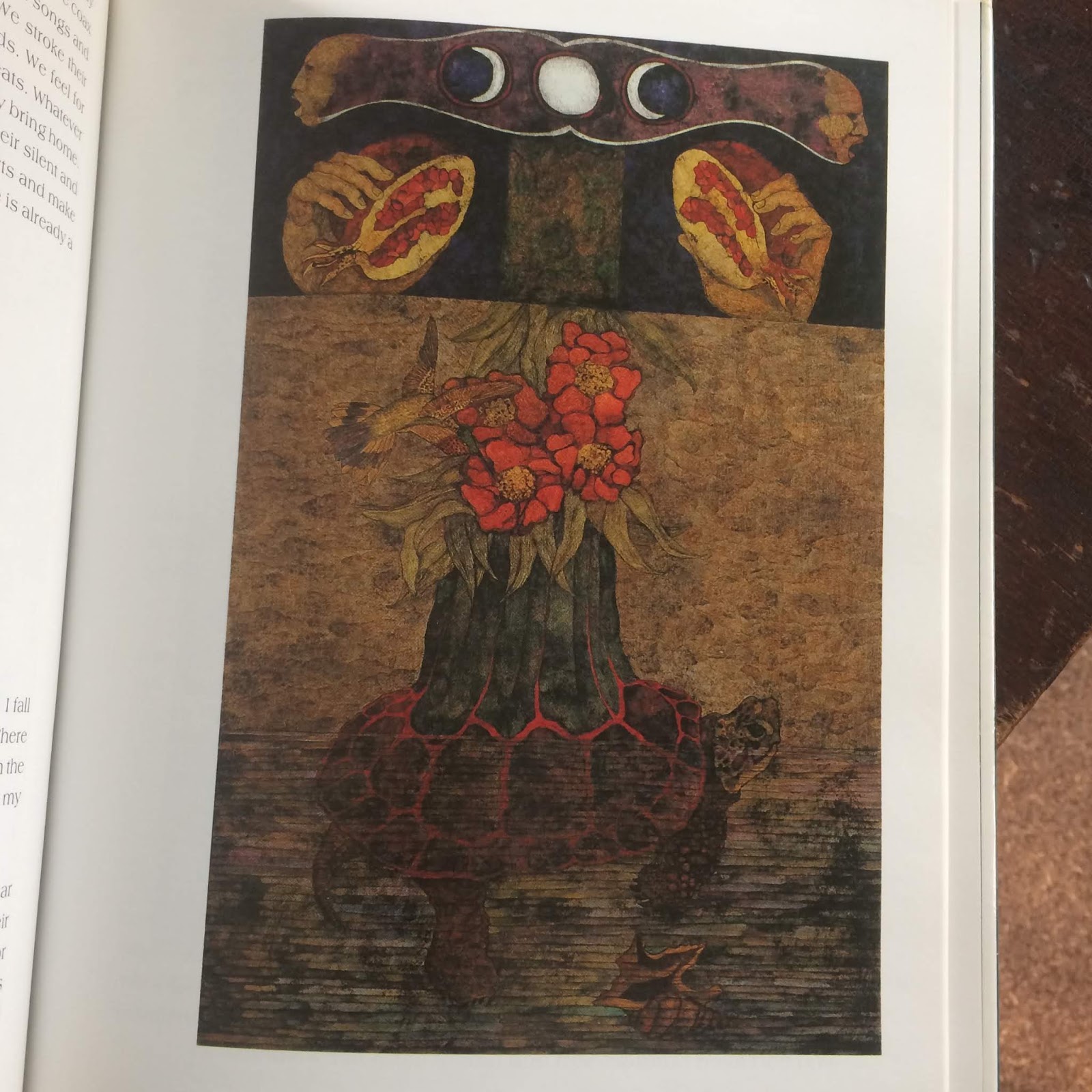
The Moons of the Vernal Equinox (from The Litany of the Great River, 1991) 
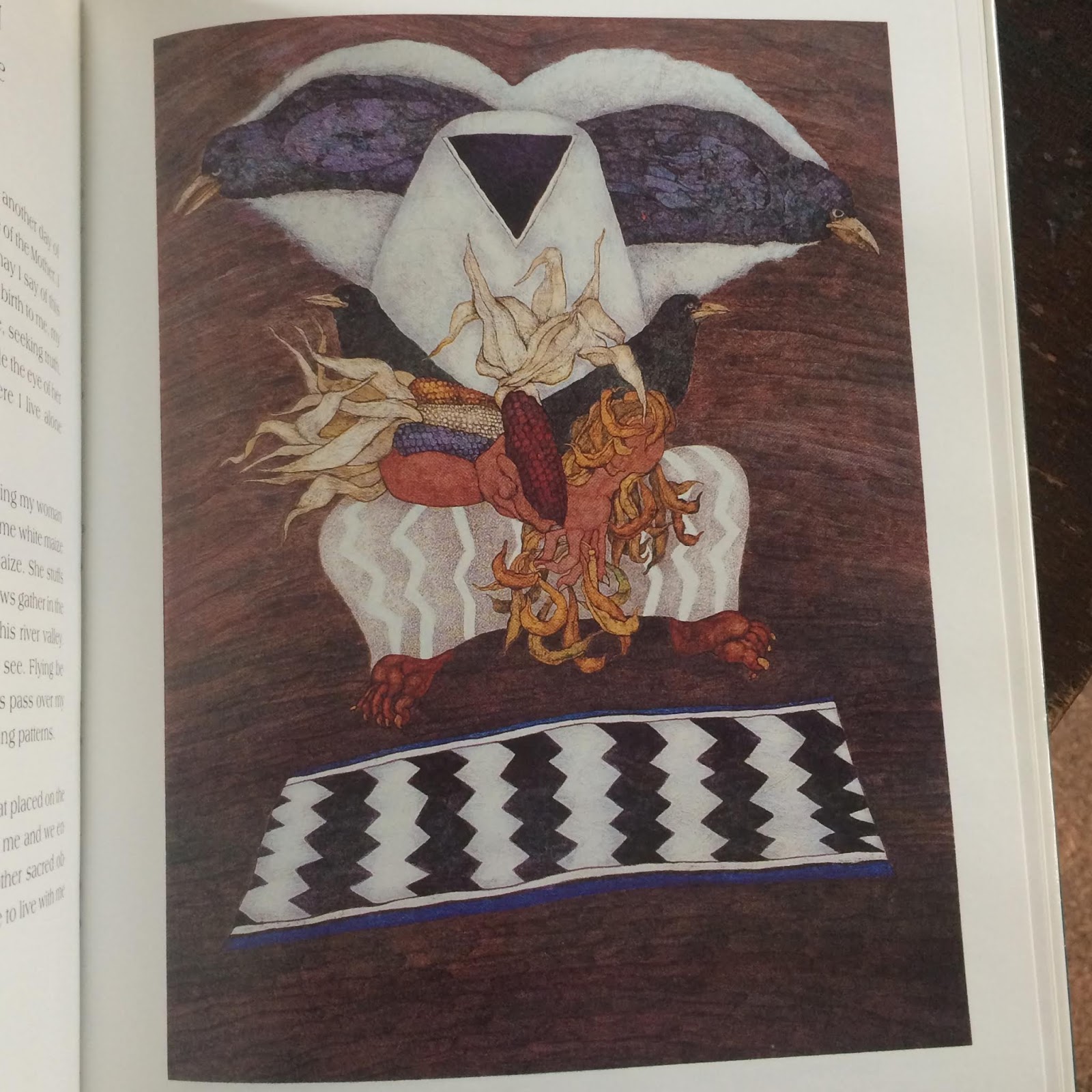
It is only in the past year or so that I have discovered Meinrad’s art, and watched the short videos made by Amy Kellum, Praying with Images and God Got Bigger, which I know I will continue to return to whenever I am feeling particularly uninspired. They do not fail to invigorate me, to show me what is possible, to make me want to keep seeking, keep trying, to be receptive and ready, and to create from that vast space of openness.

Though Meinrad seemed a small, unassuming woman, she was intimately connected with the wild, with the spirits of animals and the land around her, and the often overwhelming nature of God the Mother, who is certainly not just sweetness and light. Her work is beautiful, strange, and sometimes confronting in it’s depiction of birth and death, dream and transformation. It links spirit, woman and nature into a seamless weave of divine immanence.

Crow Mother Over the Rio Grande (from The Litany of the Great River, 1991)
What I also love about Meinrad was that her studio was a shrine, and her art practice was ritual. Her approach to her work, as a sacred calling, as a communication with the many spirits she was in contact with, is an inspiration. 

She wrote:

My personal vision of God the Mother, incarnated in my mother and her mother, gave me, from childhood, the clearest certainty of woman as the truer image of Divine Spirit. Because she was a force living within me, she was more real, more powerful than the remote Fathergod I was educated to have faith in. I believed in her because I experienced her.


I draw and paint from my own myth of personal origin. Each painting I make begins from some deep source where my mother and and grandmother, and all my fore-mothers, still live; it is as if the line moving from pen or brush coils back to the original Matrix. Sometimes I feel like a cauldron of ripening images where memories turn into faces and emerge from my vessel. So my creative life is itself an image of God the Mother and her unbroken story of emergence in our lives. (From the introduction to Meinrad Craighead, The Mother’s Songs: Images of God the Mother, Paulist Press: Mahwah, New Jersey, 1986)

I feel so lucky that I have two of her books (which are mostly out of print and difficult to find). I will treasure them and remember Meinrad every time I return to their pages for inspiration and guidance.

Farewell, Meinrad. Journey well on the next stage of your being. 

Throne (from The Mother's Songs: Images of God the Mother, 1986)

Friday, 5 April 2019

Wise Words: The Sacred Image

We cannot know or even imagine the nature of the consciousness which is the universe. All we can do is formulate an image of what we conceive as divine in relation to the limitations of our own consciousness. We do not know how or when the goddess-or-god image first arose, whether from dreaming sleep or from waking vision. All that can be said is that the experience of divinity exists in the soul and that the soul insists on making an image of it because, through that image, it feels itself related to something greater than itself. The image is sacred, for it is this above all that binds that part of the psyche incarnated in time and space to the unseen dimension that enfolds it.

(Anne Baring and Jules Cashford, The Myth of the Goddess: Evolution of an Image, Arkana: London, 1991, p. 484)