She is the Holy Spirit, Dark Mother of unseen worlds singing between the world of form.
She is the feminine aspect of God, enshrined in the tradition of the Goddess.
She is the cavity in the heart, the womb of life, the cave of revelation.
She is sanctuary.
She is the primordial void before creation.
She is of earth and of the stars, reverent and holy.
She is ethereal life, the Dark matter between all life.
The Black Madonna,
She is the dark, and She is beautiful. (14)
The Song of the Human Heart: Dawn of the Dark Feminine in Islam (2023) is the first in a forthcoming series of books by Shireen Qudosi on Islam, and more broadly the crisis of civilisation, through the kaleidoscopic lens of the Dark Feminine. A writer and speaker with a focus on faith, identity and belonging, Shireen looks with the eyes of the heart at our confusing and uncertain world in order to (re)discover old/new understandings about the human experience.
The Song of the Human Heart is both a memoir and an exploration of what faith is, has been and could be, through the metaphor, and spiritual and emotive reality, of song. As she writes,
This work, this question of faith in its highest altruistic expression, is art – or at least in my opinion, it is best positioned thorough a pairing of art and inquiry versus simply a strictly political, social, academic, or theological lens. Religious inquiry is enriched by creative spiritual expression. (9)
True to this, the book is a multi-sensory and layered experience, interweaving personal history and current events with theological and mythical examination, poetic revelations as part of an unfolding spiritual journey, and, of course, music and natural soundscapes (an accompanying playlist can be found on Spotify, which features one of my favourite songs!).
A core focus of the book is that of illusion—the curse of civilisation, the distortion of ideology—that makes it impossible to see the true wonder of reality.
Presciently, at just four years of age, Shireen knew that she wanted to be a witch when she grew up—someone who could transform things, transform herself; someone who could see through the illusion of a curse, and break it. But the witch of folklore is also an outsider, an outlier, and in questioning exactly what it meant to be a Muslim in the years following 9/11, Shireen found that she became that too. As she remarks, ‘most people branded into a religion at birth tend not to know much about the workings of that religion … The label doesn’t diffuse the essence of the faith, no more than a piece of paper can create a marriage or cultivate a sense of citizenship’. (7)
To her, at the surface level, Islam was grotesque: ‘A religion of beards, robes, demands, hysteria, and the force of authority’. (11) This was Man’s Islam—a distortion; an identity label devoid of actual faith. Yet by having the courage to wander in dark lands without a map, to slough off layers of false identity and assumptions, and to awaken to ‘a greater presence beyond the container of an ideology’, (9) she finally found Allah’s Islam: ‘a feminine faith rich with mystery and duality’. (11)
The modern world prides itself, for the most part, on being secular, rational and scientific, relegating religion and faith to the realm of superstition and ultimate irrelevance, at least in the fields of politics, economics, and social policy. Yet the purpose of religion—or perhaps we could call it a sacred cosmology—is to offer us a way to understand and relate to the world, thereby influencing how we live, and whether that way of life is sustainable or not. The secular world, with its lie about human separation from nature, its myth of progress, its endless destruction disguised as ‘development’, and faith in the salvation of technology, is itself composed of numerous belief systems, grown from and propagating many falsities, therefore causing how we live to be harmful and unsustainable.
Anne Baring and Jules Cashford state that ‘the sacred is not a stage in the history of consciousness but an element in the structure of consciousness, belonging to all people at all times. It is therefore part of the character of the human race, perhaps the essential part’. (My emphasis in bold; The Myth of the Goddess: Evolution of an Image, 1991, 8–9) If this is the case then the question that must be asked, as Shireen says, quoting Professor Omid Safi, ‘is not do we need less faith or more faith…but what kind of faith’. (17) What sacred stories should we be telling to create a life-enhancing culture?
Importantly, the secular world often fails to understand that
the patterns of extremisms and cults that grew from distorted and oppressive ideologies are not exclusive to one religion or the other – they’re a part of belief systems and are surging across secularism and the cult of progress no differently than any other ideology …
… The problem isn’t religion so much that it’s broken patterning of the human mind and behavior – the curse. The curse is not a curse exclusive to Islam or any other religion. The curse is encoded into the grids we keep propelled and in working order within the prison system we call civilization. (17)
Shireen explains that if religion is a template for understanding the world, then rather than being rigidly dogmatic and imposed by force, it should be adaptable and based on playfulness, for ‘Orthodoxy leaves no room for wilderness. It leaves no room for wonderment.’ (77) Our current religions clearly lack the qualities of playfulness, wildness and wonder, but also one other crucial element: the feminine. (In this instance ‘feminine’ means that pertaining to the female, rather than any kind of sexist gender role or characterisation.) In the context of Islam this is particularly ironic as the authority ‘was only initially given to a man as a placeholder until the women rose from the earth we’ve been buried in’. (11) It was never intended to be a male-dominated faith of order, fixed symmetry, and constant illumination. Instead, the hidden reality is that, beautifully, ‘Islam is like the moon in a time-lapse of the night sky across a month, changing faces and forms as it spirals and curves in the pattern of infinity’. (12) It is nested in the natural world, and a flowing, unpredictable feminine darkness, brimming with the sacred.
Shireen’s conception of the Abrahamic faiths sees Judaism as the foundation of monotheism, Christianity as its heart, and Islam as the crown. ‘All three stem from something that knows God by an older name: the anima mundi, the soul of the world’, and at the heart of her work is a ‘devotion to how the root touches the crown’, for
What is the temple without all parts in balance, including the crown, the star atop the tree of life, and the crescent rising above the minaret? … The crown is not an entitlement or a birthright because you happened to be born into that expression – into that religion. It has to be activated. (14)
Like the chakras, the root, heart and crown of monotheism are like energy points within the body of collective human consciousness. If one is blocked there is imbalance, rigidity, and closure of the mind and soul to the wisdom we desperately need. In order to unblock and activate the crown represented by Islam, a journey into the abyss of the Dark is called for.
 |
| 'La Moreneta', the Virgin of Montserrat, Spain (Source: Wikimedia Commons) |
Recognition of the need for darkness, of its fertile ground, of a movement downward and within, has been with me for several years now. It is fascinating how this earthy spiritual truth (including an interest in the enigmatic Black Madonnas) is emerging all over the place as an antidote to the excess of light that characterises the modern world—both literal, in the case of electric light and our ubiquitous screens; as well as figurative, in our overly ‘enlightened’ rational minds that have forgotten how to feel our way into other worlds. We are blinded by the light of civilisation and have forgotten how to see reality in all of its multi-faceted glory. The Song of the Human Heart therefore provides another unique perspective in this ongoing conversation.
We are being called to return to something so primordial that it cannot be contained, an elemental faith that remembers the world as spirit. That is how we reclaim what has been violated, murdered, scrubbed, and malformed by theorists who know nothing of the Dark. The Dark, the elemental faith, and the benevolent chaos will tear down what must not stand, especially in our own lives. And she does – the question is are we listening? (82–83)
That this perspective comes from a Muslim woman is, I think, significant, for Islam has been a focal point since the shocking events of 9/11, not just due to ongoing extremist acts, but also in regards to the fate of that religion’s women and girls. Thus, Shireen’s standpoint, beginning by questioning what Islam is, accepting the label of Muslim Reformer, then finally moving ‘toward something beyond inherited identity’(9)—as well as from the point of view of a woman and a mother with a uniquely imaginative intelligence and voice—is both needed and distinctive.
Yet what she has to say goes beyond the question of Islam and examines the problem of civilisation as a whole. Part of her work is in the field of combatting radicalism and extremism. She defines radicalism as stemming from religious and secular ideologies that believe there is only one way to be and belong in the world; while extremism stems from the belief that the use of force (whether physical or psychological) is an acceptable way to get people to believe what you believe. (69) These terms need to be seen as distinct from being a radical, which Shireen defines on her website as ‘[thinking] like an outlier’, and therefore possessing the critical, creative and adaptive faculties that extremists lack.
Shireen makes it clear that extremism—any war over reality—is not merely a problem of religion or the East, for the East and the largely secular West are both cultures of control, both ‘devoid of the sacred and [sharing] the commonality that in order to belong to either, you have to give up something of yourself’. (41) These problems are therefore relevant to everyone, everywhere, and urgently need to be addressed. As extremism is on the rise, manifesting in numerous new forms, I find Shireen’s book particularly timely. She says,
Our realities are a collection of little bubbles of history and experiences that shape our world. Sometimes those realities crash, but where they overlap we have a habit of staking a flag or an identity marker: race, politics, religion, nationality, and other largely inherited and groomed dispositions. Rather than see the explosion of views and respect those views as long as they are not destroying another reality, we try to expand our bubble – mistaking our own interpretive reality with facts, and facts with truth.
She goes on to say:
When violent separatists attack [people] who have chosen to do as they will free from influence, what they’re enraged by isn’t the freedom of expression itself; they’re fighting for what they believe is true. They are willing to annihilate the vessel of an idea (another person) so that their idea is held unblemished in the mind of the collective. In other words, it’s not enough that they believe in something; others must believe it too. It is the highest order of violation of natural law or God’s law, that honored the freedom to examine and understand the world for ourselves. (69)
There are a multiplicity of ways to be in the world, and myriad manifestations of faith. Ideas should be discussed openly and constructively, and religious beliefs should be mutable, they should flow and change as the need arises; they should spring up in different regions in different ways, as emanations of the natural world and its distinct variations of place and Spirit. Instead, we have a world in which different groups clash as confused and fearful people hold increasingly myopic and inflexible views; globalisation simultaneously attempts to homogenise everything, erasing cultural and ecological diversity; and our disconnection from the land causes us to live in progressively more virtual mindsets.
A central component of any religion, indeed any understanding of life, is the concept of Mystery, which, I believe, should provoke healthy doubt as much as awe. As Shireen states,
… the confidence of fundamentalist extremists can be dangerous. Confidence belies faith. To be utterly confident in your assumption without study, inquiry, life experience, and devotion to the spiritual world can be dangerous. Conversely, to be of faith is to have confidence in the communion between God and the world … To be of faith is to be curious and humble in the knowledge that we really know nothing … (My emphasis in bold; 67)
All spiritual traditions, and even our comprehension of what it means to be human, should be open to questioning and critical analysis, for the constantly changing cosmos, let alone our rapidly changing culture, cannot be understood in any kind of fixed or complete way. The human mind in general, and each individual, can only understand and experience a minuscule fragment of the whole. Hence, a humble openness to the as-yet-unknown and the ultimately-unknowable is needed, alongside acknowledgement that faith and personal maturation are evolving processes that continue throughout life (and perhaps beyond). Without acceptance of faith and learning as continual, as things that must be pursued and worked for and deeply considered, as a journey without a clear destination, all we are left with are empty labels and identities. We’re left with stale, senseless dogma rather than a wild and unpredictable Darkness filled with treasures, and a heart-song that fills us.
As Shireen says, confidence—the mark of ideology and false identities—belies faith, and thus any questioning is perceived as a threat: ‘In the minds of those for whom religion [or identity] is a label, a question creates a crack in the illusion of faith. The rage we see against what is ideologically provocative is often a projection of one’s own lack of faith.’ (66)
All of this hinges on the notion of truth. ‘[L]egendary samurai, Miyamoto Musashi said: “Truth is not what you want it to be; it is what it is. And you must bend to its power or live a lie”’. (70) Truth is an attribute of foundational reality, of nature, and is largely beyond our control. It has an existence outside of our always incomplete interpretations of it. And the notion of bending, flowing, and submitting to truth leads straight back to Islam, which literally means ‘submission’.
I remember hearing an extremist say just that—that Muslims are slaves to Allah—and obviously I found this idea of submission and enslavement to a patriarchal God repulsive. But as Shireen explains, true submission isn’t ‘submission through surrender or defeat … Faith is submission to God of free will and pure heart that trusts God wholly. There is no force, no compulsion, no war, no convincing, and no debating. It just is’. (36) For her, Allah’s Islam is a fluid faith in rhythm with nature that has ‘no interest in control, rigidity, force, or separation’. (55) Faith is not something you are, it is something you experience. It’s a relationship with the sacred that must be cultivated.
This watery, cyclical and relational quality is particularly feminine, directly evident in female embodiment and intuition, our moon-influenced biological cycles, our movement in life from maiden to mother (biologically or otherwise) to crone. Our changeable, ungovernable female bodies are themselves a threat to systems that value order and control over anything else. The Dark Feminine, a vastness beyond any comprehension, which has always been feared and loathed by light-worshipping cultures, is also a threat.
What is most beautiful about the Dark is that She is not compliant … At this point in our human history, there is nothing greater than that which is outside artificiality and control, including the artificial control of our ideologies, our systems, and the stories that are reinforcements of the curse. The Dark, the most decadent human aspect of womanhood that would be revered as holy in other times, will seem entirely alien to many now. The first deep breath of a once-caged animal is always a threat to those who have made homes of their cages. (48)
 |
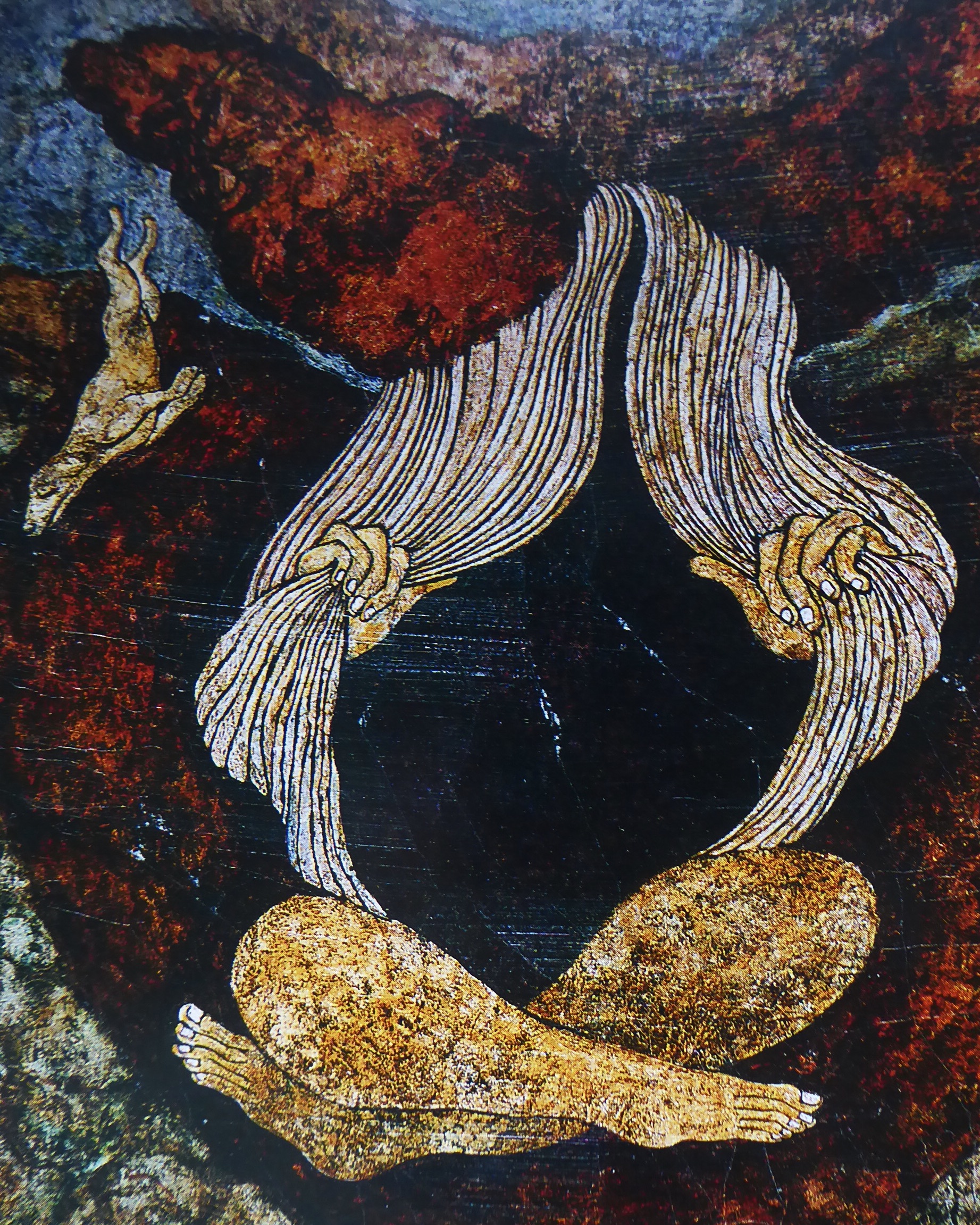
| Detail of Hallower, by Meinrad Craighead |
It may seem counterintuitive to say that a movement away from recognised and fixed (if distorted) categories of knowing and identification and instead towards the unnamed and unplumbed plurality of Mystery is a movement towards truth—yet this is the paradox of faith that Shireen reveals. By going against the flow of our cultural ideologies and internalised assumptions, by moving into vulnerability, we enact a sacred rebellion, we open ourselves to the song of the heart. We need ‘The vulnerability to stay with the song through its entirety without looking for the finality of arrival. The vulnerability to allow dissolution: the dissolution of our ideas, our preconceptions, our pride, our certainty’. (73)
In the practice of shamanism one of the core initiatory journeys is that of ‘dismemberment’, when the body/identity is torn apart in the spirit world, perhaps even devoured, before being ‘re-membered’, reassembled in a new form, hopefully free from false identities or misunderstandings of reality. Even in everyday life we endure many kinds of ‘deaths’ and ‘reconfigurations’ as we respond to life’s challenges. This process can and does occur multiple times, for our assumptions and habits are often deeply engrained and difficult to shift. In the spirit world—the Dark—the destruction of falsity and contact with truth allows the initiate to return to ordinary reality with an enduring connection with Spirit, and wisdom to share with the community.
Ultimately then, we must find the courage to welcome the terror of complete vulnerability in order to be internally transformed before we will have any hope of transforming the external world: ‘You don’t need to preach or change anything beyond your being. You look for what changes in you. That is the song you sing. Your duty in faith if you accept it, is to find your song and sing it unashamedly.’ (16)
And if/when we find our heart-song, and no longer require external validation from culture, that is when we become dangerous to the system—sacred rebels creating a true revolution. Shireen makes clear that
In the path of the sacred feminine, you go within and reclaim, restore, and rebalance a personal connection with the outer world so that it doesn’t matter as much whether our external system is patriarchal or not, we are like water and flow around what is rigid and immovable … The sacred feminine finds the power within … (56)
This internal change is essential, because ‘how can you force a group to recognize women’s rights as human rights when they just as easily violate human rights? You can’t. You have to find a new story, a new carrier for the message, a new song’. (57) The task is to go beyond Man’s Islam into the dark underworld, where the false beliefs we destroy can be rotted down into a fertile compost that will provide the new soil to rebirth the old/new story of Allah’s Islam—‘a faith birthed in the womb of a cave [which is just] one song in the chorus of creation … one gateway to God’. (21) In the blackness of the cave, humankind’s most ancient sacred space, sheltered in the sanctuary of the primordial earth, we can find ‘Our common humanity, the source of genuine interfaith between devotees’. (59)
I love and agree with Clark Strand’s personal motto—‘Ecology, not theology!’—so Shireen’s conception of faith being of the earth, of emerging out of a cave, and connecting everyone, resonates. She also speaks of a fully embodied spirituality, not the transcendent, disembodied theism of patriarchy, but an immanent feminine faith, interconnected and intertwined with all elements of life; and in particular a remembrance of the role of women as ‘vessels of embodied creative life force born into this world while also tethered to the world of spirit through our wombs and cycles’. (32)
The Dark Mother of all creation has been speaking to us our whole life through our bodies. She is the mother we ignored when we were conditioned or rewarded for ignoring the wisdom of our body, the medium between the spirit world and the material world … The language of the body is the first tongue that is silenced … I am a woman. We are women. We will not apologize for it, not shrink away because one ideology or another is unsettled by our presence … (50–51)
I think (hope) that perhaps the world is finally on the threshold of meaningful change because women are (re)asserting our boundaries and saying, fiercely, No more! The rage we feel is ‘a signpost of a boundary violated, sacred ground deconsecrated’. (85) Embodied truth has always mattered, but possibly no more so than now.
The activated sacred feminine is to be a woman embodied in her experience, which no man can hack into on a whim or as a passing interest. A womb-an is both a portal for the creation and the birth of life, whose intuition is beyond logic. A woman, who like the elements cannot be controlled or contained, is terrifying to a program of control. (48)
The return of the Dark augurs the return of women as guardians of the sacred; the reemergence of an ancient paradigm of natural law. Our current world is falling apart as we are engulfed by seemingly unsolvable conflicts and calamities, but Shireen maintains that the Dark Mother ‘will stop at nothing to heal what she loves, including burning the world in order to break the egg and birth us into a new world so that we may rise as the phoenix’. (51) The role of the Dark—the Black Madonna—Kali, as Clark Strand writes in Waking Up to the Dark: Ancient Wisdom for a Sleepless Age (2015), is ‘to restore balance by bringing the powerful to their knees’. (115) Through destruction will come a new creation.
 |
| Detail of Night, by Meinrad Craighead |
Importantly, Shireen’s journey has led her to discover that ‘I was the answer to my questions. I was what I needed to find’; (12) and ‘what is of the highest value to learn, what will serve you most, is what you figure out on your own’. (101) Thus, our interactions with the sacred—the anima mundi—need not occur within the vessel of any particular belief system, but should be on our own terms, according to the call of our own heart-songs. However, her claim that ‘Islam is brimming with non-linearity that, if understood and embraced, would help us break the gridlock of the static world and submerge our consciousness into a rich metaphysical reality’, (98) is intriguing. She describes this as a quantum reality, fractal and multiple, encompassing mythic time and unknown possibilities, and an entire pantheon of repressed goddesses.
These ideas prompted me to reread Henry Corbin’s paper, ‘Mundus Imaginalis or the Imaginary and the Imaginal’ (1972), which examines the visionary narratives of 12th century Persian sheik Sohrawardi, and his concept of Nâ-Kojâ-Abâd, ‘the country of non-where’. To me this non-place seems somewhat analogous with the Dark that Shireen describes, for once the journey there has been completed,
the reality which has hitherto been an inner and hidden one turns out to envelop, surround, or contain that which at first was outer and visible. As a result of internalization, one has moved out of external reality. Henceforth, spiritual reality envelops, surrounds, contains so-called material reality. Spiritual reality can therefore not be found “in the where”. The “where” is in it. In other words, spiritual reality itself is the "where" of all things. (My emphasis in bold, 4)
This is tricky to envisage, but this hidden reality (which Corbin argues is imaginal not imaginary), once entered and related with, actually inverts and encompasses external reality. Henceforth the spiritual journeyer comes to dwell constantly within and connected to the sacred, despite also being in the seemingly everyday world. This understanding of life as immersion in the anima mundi, an animistic perception of everything alive and ensouled, has mostly been forgotten, but it desperately needs to be rediscovered. I believe that The Song of the Human Heart is the kind of visionary work that might just help us find it again.
In the end, whether we have been placed into a religious tradition or not, we are all free to pursue our own relationship with the sacred, and find our own unique path, because ‘faith is a dance with the divine that we are here to remember and invoke. We’re moving belly against the ground, skin raw, slithering, in a divine dance that is the frequency of life forever in movement toward Source, to the wellspring of Love, toward union of all parts’. (15)
Shireen Qudosi’s book is overflowing with wisdom, most of which I have only just touched upon here. I am so looking forward to reading the next book in the series, The Song of the Mystery.
The Song of the Human Heart can be purchased as a PDF from Shireen’s website, or as an ebook or paperback from Amazon.