Showing posts with label house. Show all posts

Thursday, 9 August 2018

Witchlines: The Fire

The third and final tale we have been exploring as part of Witchlines is The White Bear King Valemon—a Norwegian version of the tale more commonly known as East of the Sun, West of the Moon, or sometimes The Bear Husband. This myth is also closely related to the story of Psyche and Eros. 

For this creative task I was called to focus upon one aspect of the story that had drawn my attention, and to tell the tale from the point of view of the bear-wife as an old woman, relating the events to a grandchild.

The Fire

It happened long ago, before I became lined with wrinkles; before I became stooped and grey-haired, like one of the three wise old women who helped me. But in my memory, it happened yesterday, for it is all so clear, and so dear to me. 

I’ve told you before of how I left my father’s house and went willingly with the great white bear, so large and fine, his fur softer than anything I had ever touched. I was a queen riding on his back. 

When we reached the bear’s house, he carried me across the threshold, as has always been the custom in these parts, and he set me down in a large kitchen, with the biggest hearth I had ever seen. Well, I walked thrice around that room, marvelling at the solid wooden table, with platters of bread and cheese upon it; admiring the shiny copper pots and pans that hung from hooks above the fireplace; breathing in the scent of the dried herbs that dangled in bunches from the ceiling. It was the most handsome and well-appointed kitchen I had ever seen. Yet what amazed me most was the fire, for it glowed with a strange warmth I had never noticed in a fire before, as if it was saying ‘Welcome home’—to me!—who had never set foot in that house before. Yet there I was, mistress of it, and I had never felt such belonging.

My bear-husband, kind soul that he was, assured me that I would be content in his house—all I had to do was keep that friendly fire lit. To this I readily agreed, for what is a home without the light, warmth and comfort of a fire? I knew I would keep it well.

That first night, in the darkness of our bedroom, I knew my husband as a man for the first time—and it was the sweetest of sleeps in his strong arms. But in the morning, before the sun rose and illuminated the room, he was gone.

Well, I was quite bereft. Yet when I went into the kitchen, all alone for the day, I was cheered by the sight of the fire, which burned low, but with such a strong ember-glow that it hungrily devoured the kindling I fed it, and grew quickly into a jovial, dancing flame.

Each day I would go out to collect wood from the edge of the forest where my bear-husband roamed, and where orange butterflies flickered through the trees, and I would build a pile of firewood large enough to feed the fire until the darkness came again. In the kitchen I would knead dough to bake bread, and sing love songs to myself; or I would sit and sew or knit, all the while giving fuel to the fire. That fire became the constant companion of my lonesome days, and I came to know all its colours and moods: the flickers of red and gold, and the white-blue heat at its heart.

Each night, as the light in the kitchen began to grow dim, and the fire became ever more amiably golden as it cast its glow about the room, I would present it with the last of the wood I had collected, enticing it into a gentle roar, and then retreat to the darkness of the bedroom to await my husband’s return.

Every night was dark and sweet; and every day was filled with the friendly warmth of the fire. In the morning it would be waiting for me—embers still aglow—somehow alive. It ate up sticks like a wild animal chewing on bones. It danced crazily as it grew, laughing and singing its fire-song.

I loved that fire. Its warmth sustained me, filled me, made my body sing with delight at the love I had found. It was always gentle and welcoming. Yet, with time I noticed the fire taking on a new and wilder light. It would beckon me close, so that its heat would make my skin blush red, and it would whisper strange things to me—of how it could bring me light in the dark; of how it could reveal the unknown. 

Well, after three years of this fireside bliss, I journeyed back to my first home to visit my parents, and you know what my mother gave me, what my father said. Yet I could not help myself—the fire had planted a question-seed in the dark of my breast. I carried the candle stub my mother had given me in my pocket, a tiny receptacle for a tiny flame, almost ready to come to light within me. 

When I returned to my home once more, the fire was there to greet me, as if I had never been away. It danced mischievously, it sang a mysterious song. It shimmered more golden than ever, and lit the hidden place in my heart.

That night, after reuniting with my husband in the darkness, I crept out of the room and into the kitchen where the fire smouldered red and pulsed, like a beating heart. I tenderly roused the fire, watched it birth itself the same and anew. Then I took the candle stub from where I had folded it into my nightgown, and with a piece of tinder I lit that candle, and thanked the fire—that generous, warm, wild friend of my days—and I turned back towards the darkness.

(Source: Wikimedia, by Giovanni Dall'Orto)

Thursday, 19 April 2018

Witchlines: The Mother-House

Here is the third creative piece I have completed as part of my Witchlines studies.

In Neolithic Old Europe, some villages had so-called ‘focal houses’—buildings that were larger and often better built than the smaller dwellings around them, which were probably occupied by core family groups of a matrilineal lineage. It is surmised that such houses may also have been gathering places, perhaps for village councils or other events. For this task, I have imagined what one of these houses may have been like, and an event that took place there, both inside and out.

Inside a reconstructed Neolithic house, by Szilas (Source: Wikimedia)
The Mother-House

This is the first year she has missed it, her new belly too round and heavy, and her ankles too swollen to make walking down to the fields a possibility. She does not mind. Someone has to look after the youngest of the children. She looks over them as they make little clay pots, rolling out long thin snakes of smooth clay, joining them one atop the other. She has shown them how—See! Smooth down the sides like this—and now they are intent on their work, their little hands finding joy in the tactile experience of shaping earth into new forms, making shapes that are round and full, just like the women do in the temple.
The day is warm and still, the only sounds the soft murmurings of the children at their work, and, from inside the mother-house, the shuffling movements of the grandmother, as she scrapes the ashes from the belly-shaped oven in each of the three rooms, and lights a new fire in readiness—the cyclical work of each day, done with joy. Her knees are too old and stiff to walk far, so she too has stayed behind. She hums a little to herself, a tune that goes round and round, curling back upon itself, as the flames catch and heat begins to radiate from the earthen walls of the ovens. It is one of the old songs she has sung so many times, to dance the grain home each year. And beyond her own voice, in the distance, she hears it—the rising swell of the song, the shouts and laughter. 

With a grunt of effort she pushes herself up from her crouching position, bows to She Who Protects, and walks from the dimness of the inner room out to the brightness of the day. The children too have looked up from their making, eager to run to meet the returning villagers, but the grandmother calls them back with a tut and a smile—Wash your hands of clay before you rush off, she gently admonishes them. 

The almost-mother stands, hands pressed to her lower back, and laughs as the children run off with dripping fingers, the older ones carrying the smallest. On the pathway that runs up from the fields, alongside the furthest houses, the villagers appear. The women dance in a line, hands held, circling, circling, and singing the harvest song around the men, who carry the last round baskets and sheaves of grain. They reach the mother-house and lay down their loads, amidst laughter and cheers.

When the song of harvest is complete, some of the women of the mother-house, dressed in their fineries, their hair curled and plaited, go into the house and bring out the round loaves of bread that they baked that morning, and oil, herbs, and meat. And, seated on stools and blankets in the yard, the people feast.

*

Later, the celebrations complete, the chosen members of each house in the village enter the mother-house, one by one, carrying their vessels, clay-made mouths empty, awaiting fulfilment. They move through the granary room, with its large, curved urns, and smell of grain and earth, and the newly made clay pots drying on the attic floor, reached by a ladder; then through the living quarters, with its pallets, piles of blankets and sheepskin, and musty, yet comforting, human smell; and finally though to the inner room, where She Who Protects dwells, her rounded, winged and lined forms standing by the oven, and on the low shelf up against the wall. Here the people assemble, kneeling, as the grandmother takes up her ladle, and dishes out generous scoops of grain into their proffered vessels, filling them. 

As the clan mother, the grandmother takes great pride in sharing the gifts that the earth has offered with each house, each family, so that all are fed. To let anyone—woman, man or child—go unfed would anger She Who Protects, and the ancestors whose bodies, born from the land, have returned to feed it. In the coming days, as the rest of the grain is threshed and sorted, the granaries in every house in the village will be filled. And though the feasting may be over, the feeding never is, for it is the feeding that matters, the offerings that go back and forth, and around in a circle. All must be celebrated and sung and shared, and will be, for She will live on in her daughter, and her daughter’s daughter, and her daughter’s daughter’s daughter.

Thursday, 29 March 2018

Witchlines: The Dance In The House

Here is the second of my creative pieces written as part of my Witchlines study (the first is here). This story explores the inside of a Neolithic house, and the people who lived in it.

Model of a Cucuteni–Trypillia house (source: Wikimedia: by Cristian Chirita) 
The Dance in the House

The golden light of late afternoon passes through the open door, falling on my form, making the white lines on my body glow. In the shaft of warm light, dust rises—the dust of clay, soil, dried herbs, and the skin and hair of people, and animals, and life. It rises and dances as the air shifts with  the approach of night. The pots in the corner throw great bulbous shadows against the walls, and the weaving on the loom gleams, jewel-like, in the corner.
The room I stand in is empty, the oven beside me almost cold. There is a smell of earth, ash, the rich fragrance of bread recently baked, nut-brown and crisped around the edges. Silence inhabits the air, cradling the clay walls of the house, which sing out the last of the day’s warmth from their earthen skin.
The first to return is the mother, with the baby tied securely on her hip, a basket of greens in her hand. She looks in my direction and nods a greeting marked by familiarity and trust, before preparing tinder to relight the fire, to stave off the approaching darkness and chill, at least for a while. She lays the baby down on a well-worn sheepskin rug, giving her a crust of bread to chew, and then the mother crouches by the hearth, assembling cooking pots and ladles, grain from her store, and what food she has gathered from the wild hills just past the bend in the river. Her crouching form, wide of hip and graceful, shines in the bright sun, radiating life.
Next to return are the children—a girl and a boy—who, despite having run and tumbled and played all day, are scarcely out of breath. They bustle in, giggling, tummies rumbling, with faces brown and clear. They look in my direction, shy and awed, as children often are, before washing their hands in a basin of water, watching the dirt swirl away. They play with their younger sister, who is delighted that they are home.
Then comes the father, with his dog at his side. He tousles the hair of his children, kisses his wife, and sighs as he eases his sore muscles back onto a bench lined with a faded woollen rug. He pours water from a pitcher and drinks long and deep, then looks towards me and listens for what I might say, of the goodness of what is, what has been, what is to come. He is trustful, this man, who smells of sheep, who built this house with his own hands*, who has fathered three children, and who loves his wife.
Last to return, bringing cool night on her heels, is the grandmother, gratifyingly tired from her work at the temple, making in clay the image of myself and this world. She sits her old bones down on the bench by the standing loom, and drinks the cup of ale the father brings her. It is she who made me, who shaped me into being, and I have given her a good life, filled with beauty, children and grandchildren. As she sits and rests, her eyes on me, a draught through the doorway makes the loom weights jangle and clack together, and the light dims gently into dusk.
Now the house is full, with this family, these people, who have smoothed clay onto cracks in the walls, who have broken pots, and made new ones, who have eaten and laughed and loved within these walls, and without. I watch over them, eyeless, my earthen body my all-encompassing vision, my knowing. I dwell here, under this thatched roof, as under the sky, as everywhere, my wings spread in blessing.
They eat—the mother, the children, the father, the grandmother, and the dog—savouring the taste of herb and grain, meat and life-giving fat, filling their bellies with the gifts of the earth. The baby feeds from the mother’s breast, and a hush descends. The patterns on my body, and on the pots in the corner, shimmer in the firelight, circling and weaving and dancing a song of life. I pulse through the bodies of the people, the dog, the vessels of clay, the earth-made walls, and the world outside. They know me as themselves, and in the fading light, are lulled toward night’s embrace.
The children, suddenly exhausted, with eyelids unbearably heavy, make their way into the next room, falling onto their pallets and into sleep almost instantly. The grandmother, who has risen from her weaving work, tucks blankets around them like cocoons, before she yields to her own rest.
I watch the mother and the father, and the infant now sleeping softly in the crook of her father’s strong arm, and tenderness fills the room. Joy dwells alongside sorrow, and in my body they join, spiralling into the centre and out again, in the dance that does not end. The mother and the father, together, move into the next room, to sleep, to dream. And here, in the fading firelight, my shadow dances against the wall—against the clay which is my substance, my source—until, with a last wisp of rising smoke, darkness descends.**

* I’ve since been reminded in my reading that women were often the house-builders in early matrifocal cultures, so this detail may not be entirely accurate.
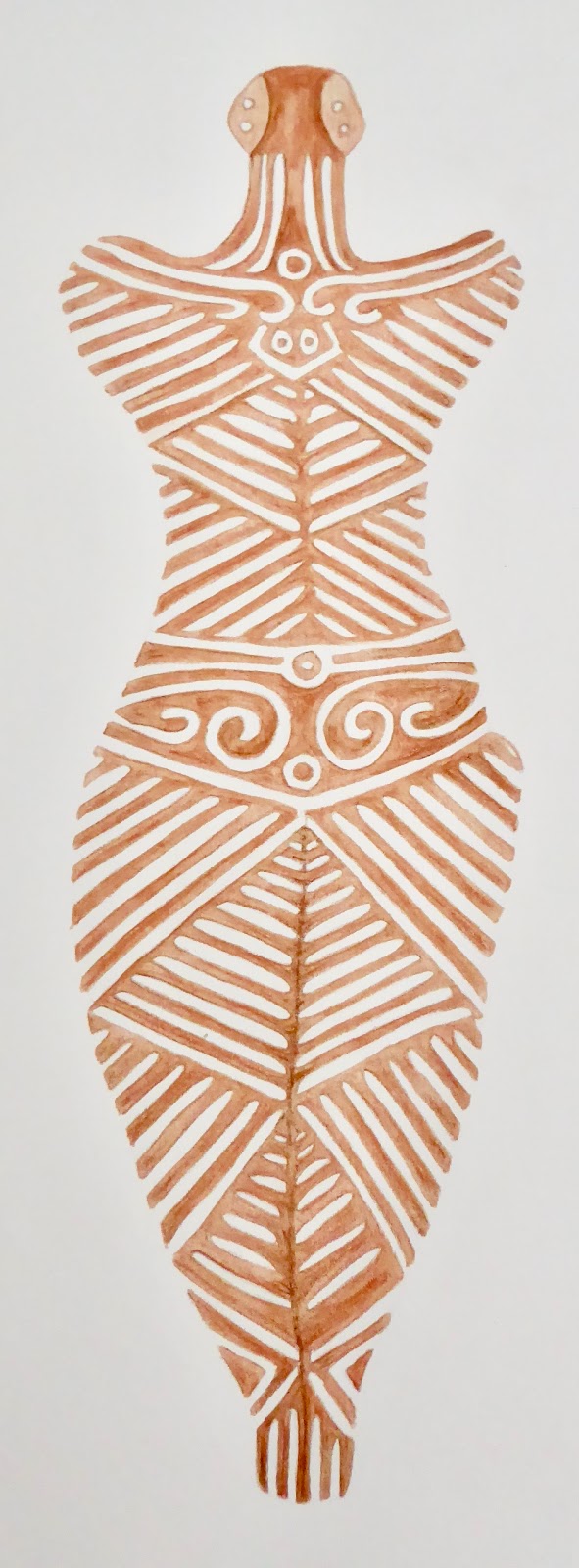
** This story is written from the point of view of a clay ‘Goddess figurine’, representing the Bird Goddess, who stands by the oven, overseeing daily life and entwining it with the sacred.

Bird Goddess (inspired by a Cucuteni figurine from 4050–3900 BCE), watercolour pencils