Showing posts with label visionary fiction. Show all posts

Tuesday, 19 September 2017

Elsewhere, Elsewhen

I spent much of my youth longing to be elsewhere, elsewhen. Perhaps not the wisest thing, to be dreaming of other places and times rather than being fully immersed in my own. Still, I’ve been thinking lately of how I need a holiday, a change of scenery. I feel like I have been stuck for too long on the same old wheel, going round and round, not knowing how to get off and strike out in a new direction. I want to have adventures; at the very least, some novelty to my days.

These kinds of wishes—for new places, new experiences—however, are fruitless. My body-mind barely has the energy for normal, everyday activities at the moment, let alone the idea of travel. Sometimes I can barely even read! And yet, when I can read, it is books that have been taking me to places elsewhere and elsewhen. After several months of reading far too much nonfiction, it is story that has managed to take me out of myself, to show me other views, other ways of being. I thought I would tell you about a few of them.

Deep in the Far Away (2014/2017) by Sarah Elwell

The first part of this novel was full of much that I expected, knowing from Sarah’s blog the kind of gentle, quiet things she loves, and the magical, mythic writing she is capable of. I found myself identifying with the plight of her character, Emma, stuck inside with a mystery illness, not feeling herself (indeed, not even really knowing herself):

… I have been unwell too long : outside of myself. 

The thought makes me restless. I want to open my body to the wind like the earth does, let clods of poetry, and tears like dew, fall out. I miss dancing when no one is watching, and flower-gathering, apple-picking, taking rambling walks in random weather from wayward skies. I miss myself. 

But it's just being unwell, that's all. It's not about the house or my husband. I'm suffering weariness, not sorrow. And so I turn away from the window, for after all what hope lies in dreaming alone? If I get dressed, go downstairs, something real might happen. (p. 12)

The writing is lush and poetic, the setting wonderful. Though as the story progressed, I found myself feeling a growing sense of unease. And this unease led to the second part, which is a complete departure from the first, unexpected and exciting. 

You can purchase this novel from Sarah as a PDF for a small donation of US$6. I’d also highly recommend her six-part essay series, Suburban Magic.

The Dark Country (2017) by Sylvia V. Linsteadt

This novella is set on the fictional island of Kefthyra, somewhere in the ancient Aegean. It arrived beautifully wrapped with red string, stamped with Bear, Moon and Crocus, and the cover art by Catherine Sieck is stunning.


It is hard to know where to start with Sylvia’s writing. It is always so layered with meaning, evocative and poetic. She has an immense knowledge of so many things, from ancient cultures, to ecology, to myth and folklore, and she seamlessly weaves that knowledge into her narratives. I can only dream of being able to write like her.


The Dark Country is something of a feminist story, telling of the arrival of a patriarchal, destructive culture to the island, and the abuse of both land and women. There are three key characters: Lillet, a young bandit girl; Zola, a mother, renowned for her red kermes dye; and Arete, an old charwoman. Between them they represent the three aspects of women—maiden, mother and crone—and they are the heroines of the tale, bringing about a ruthless, beautiful justice, and bringing back the lost wisdom of their foremothers.

I loved this book. Like most of Sylvia’s writing, it spoke to me. One chapter gave me quite a visceral experience—I shivered at the strange beauty of the events, as if in some bone-deep recollection of truth. I think that is part of what I love about Sylvia’s writing—that it is mythical, magical and so elementally true, all at once.


Unfortunately, this book was only available as a limited print run. We can only hope that it, and more of Sylvia’s writing, become obtainable as more ‘official’ publications in the future. In the meantime, there is her debut novel, Tatterdemalion, which is wonderful; and her blog, The Gleewoman’s Notes, is a treasure trove as well. 

Corrag (2011; also published as Witch Light or The Highland Witch) by Susan Fletcher 

I listened to the audiobook of Corrag at the beginning of last year, and loved it, more than I’d loved any novel in a long time. Thus I have just started reading the book, to immerse myself in the Scottish highlands once again. Fletcher’s descriptions of the landscape are so vivid, I even dreamed I was there!

This novel is particularly powerful because it is based on real events (the Glencoe Massacre) and characters—Corrag was indeed a famous highland witch, though little is known about her. Still, Fletcher has conjured up a character of strength and wildness, and she tells her story in the most haunting way. 


In a dank prison cell, awaiting execution, Corrag is interviewed by Charles Leslie. At first, he hates her. Yet Corrag summons up visions and feelings of such magic and love for the world that she manages to completely change the heart and mind of her interrogator. For all the harshness of Corrag’s life, it is also full of immense beauty. Everything about this book—the characters, the landscape, the language—is about as good as writing gets. 

All of Fletcher’s novels are brilliant—I particularly admire her attention to detail—but Corrag is, to my mind, the very best. She writes:

… the theme of instinct, of faith in the self and inner wisdom, pervades the book entirely. It leads on to the concept of kindness, of tolerance of the other, on to the importance of caring for the world we walk in, and even to religion itself. It runs into everything, as if self-acceptance is in fact the source of it all. Such themes were relevant in a time of witch-burning and political intrigue; such themes, unfortunately, remain as relevant now. The joy of Corrag, for me, was her simplicity, her small beliefs: treat all lives well, including your own; be grateful for all that comes by you; believe, quietly, that there is something more to this life than we know. It was joy writing as a person with such a take on the world. (Susan Fletcher, ‘“An eye which sees the smaller parts of life”: How living in Glencoe brought the language alive’, pp. 11–12, in the bonus materials at the back of Witch Light, Fourth Estate: London, 2011)

It is a joy to read as well.

Thursday, 4 May 2017

Books & Beauty

In recent weeks, the postman has brought me some beautiful things.

First came a spotted pardalote necklace, which is also a whistle, for my birthday. Though I have never seen one, in theory these birds do make their home in the Blue Mountains, so I shall have to keep an eye out for them from now on.


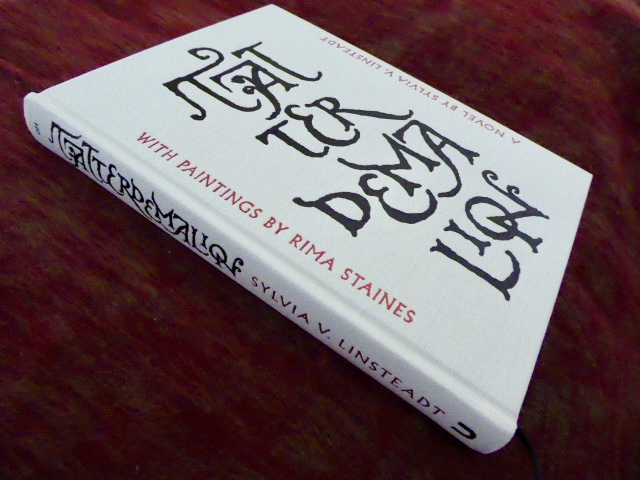
Then came Sylvia Linsteadt’s long-awaited Tatterdemalion, a post-apocalyptic novel inspired by the art of Rima Staines. 


I’ve been waiting for this book since I first read Witch Bottle, an excerpt from the then novel-in-progress, published in Dark Mountain: Issue 4, in the northern summer of 2013—almost four years ago! Then the publishing process, after a month of crowd-funding, took over a year, so the wait has been long and expectations have been high. The book I now have in my hands is a thing of beauty, filled with Rima’s extraordinary, earthy and strange art, from which Sylvia’s poetic, wild, myth-filled story was birthed. 


For more information about the book and how it came to be, please click here and watch the video, in which Sylvia says:

The novel is really a call to attention. Right now we’re surrounded by environmental, cultural, social collapse, and embedded in this dominant narrative, that really treats land and animals, plants, stones, water, people, and especially marginalised peoples, as objects to be used, rather than subjects to be honoured and respected in their own right. So we’re really in great need of new narratives and new stories to help us reimagine what it means to be human in a more-than-human world.


I've said it before myself—we desperately need new stories. So, if you are interested in reading this greatly needed new story, special editions of Tatterdemalion can still be purchased via Unbound, though a trade edition has also just been released. Most importantly, you will be supporting a young writer in making a living from her craft.


And if you are not familiar with the work of either Sylvia or Rima, I suggest you take a look at their magnificent blogs, which have partially inspired my own humble efforts in the blogosphere. They are both wise and talented women: Sylvia at The Gleewoman’s Notes and Rima at The Hermitage

Next came Kate Walters’s Iona Notebooks, a limited edition book published by Guillemot Press, composed of paintings, drawings and writing that Kate made during residencies on the Hebridean island of Iona.


I first came across Kate’s work through the Dark Mountain books (with works published in issues 6 and 10), and (the sadly now defunct) EarthLines magazine, in issues 10 and 12, as well as gracing the front and back covers of the very last issue.


What intrigued me about her work was not just the subject matter, style and aesthetic, but her working methods, which are shamanic in nature, drawing forth imagery from a womb-like and unknown place. She uses a technique which she calls ‘becoming the hollow bone’, in which she

instruct[s her] ego and personality to step aside to allow other voices to come through. Using the drum, strong intention, and the drawn mark [she is] able to respond in the moment to humans or trees or place … (‘Featured Artist: Kate Walters – Riding into Darkness on my Horse-of-Music-Body’, EarthLines, Issue 12: July 2015, p. 66). 

She often works with her eyes closed and with her non-dominant hand (a technique I have been inspired to try myself), and especially explores the connections and interactions between humans and animals, and the Divine Feminine.


I bought the Iona Notebooks, which came with six postcards as well, as a birthday present to myself. It is a book of beauty, shamanic wisdom and inspiration which I will treasure.


For more information about Kate and her work, please pay a visit to her website.

Lastly, a friend gave me a pure white cyclamen to congratulate me on my first year of blogging.

Tuesday, 19 July 2016

Always Coming Home

In her acceptance speech when awarded the Medal for Distinguished Contribution to American Letters in November 2014, Ursula Le Guin said:

Hard times are coming, when we’ll be wanting the voices of writers who can see alternatives to how we live now, can see through our fear-stricken society and its obsessive technologies to other ways of being, and even imagine real grounds for hope. We’ll need writers who can remember freedom – poets, visionaries – realists of a larger reality. (The Wind’s Twelve Quarters and the Compass Rose, 2015, ix)

Le Guin has been one of those visionary writers herself, and perhaps never more so than in her book Always Coming Home. Published in 1985 it is hardly recent, yet it imagines a future society—the Kesh—living in a radically altered world, long after the ‘hard times’ which are coming, and happening, now. As Le Guin writes, by way of explanation: ‘The people in this book might be going to have lived a long, long time from now in Northern California’. Thus, it was, and still is, a book ahead of its time.


I first learned about Always Coming Home in an article by Sharon Blackie, in which she describes it as one of the few science-fiction, post-apocalyptic novels that tells of a society that she would willingly live in, because ‘it offered a world that was built on strong, caring community’ (What Comes After Civilisation? – The Wild Women Versus the Wild Men). Reading this, and because I already love and admire the work of Le Guin, I knew I had to get my hands on a copy.

Perhaps what struck me most about the book was the animistic relationship the Kesh have with the land around them, conveyed most eloquently through their language, and their unique perception of the world (which is clearly inspired in part by Native American culture and philosophy, but also contains Le Guin’s own distinctive form of wisdom). For instance, to the Kesh the word ‘people’ is applied to nonhumans as much as to humans; so there are quail people, coyote people, woodrat people, oak people, and so on. (If we saw all creatures as people, we would treat them differently, no?)

Most beautifully, they call death ‘Going Westward to the Sunrise’, and a series of songs are sung for the dead or dying, to send them on their way; when a child is born it is said that the girl/boy made so and so their parents, not that so and so had a girl/boy; feathers are considered to be words, and therefore accepted with reverence as gifts or messages from the birds; and when a person is in the presence of something holy, or that fills them with awe, they say (and often repeat) the sacred word: ‘Heya’.


Names are also of great significance to the Kesh, and most of them have a number of names throughout their lives. Names that are not just given by parents, but that come to them, or are found, due to life experiences, happenings, or visions. As a person grows and changes, so does their name. The character of the main story, Stone Telling, says:

In [the town of] Sinshan babies’ names often come from birds, since they are messengers. In the month before my mother bore me, an owl came every night to the oak trees called Gairga outside the windows of High Porch House, on the north side, and sang the owl’s song there; so my first name was North Owl. (7)


If you are familiar with Le Guin’s Earthsea series, then you will know that names are of vital importance in those books too. In that world people have an everyday, ‘use name’ (which is the name their parents give them, or a nickname they acquire, known to everyone), as well as a ‘true name’, given to them in adolescence by a witch or wizard skilled in naming (known to the namer, the named, and perhaps never disclosed to anyone else, unless they are truly trusted). This true name usually reveals something about the character or qualities of the person, and therefore fits them (perhaps you could call it a soul name). A true name is also a word in the Old Speech and therefore contains great power. Wizards can control someone or something if they know their or its true name; this is the basis of all magic in the world of Earthsea. 

I love the way the Kesh imbue meaning in their names, many of which are related to the natural world. To be called something that embodies some aspect of yourself or your life, or indeed, the wider world—to be Morning Star, Flicker, Lark Rising or Mooncarder—seems so much more authentic than the way we generally use names.

Further, Kesh culture, being animistic, is shamanistic, which I find fascinating. They practice vision quests, drumming, trance dancing, fasting, dreamwork, speaking with nonhumans, and use song and chanting for healing (alongside more conventional medicines)—all spiritual practices that are common in nature-based societies, and that we need to relearn in our own culture. 

Also in common with most nature-based societies, they define wealth by how much is given, not how much is gained or accumulated; to be wealthy is to be generous—a moral position quite foreign in our modern world.

The culture that Le Guin has created in Always Coming Home is indeed extraordinary, and does provide an example of an alternative way of being, a strong, soulful community in close relationship with the natural world, embracing the great mystery that is life, and for this it is truly inspiring. Like Sharon Blackie, I too would willingly live in the world of the Kesh.

To end, I wish to share with you a few wise quotes that particularly resonated with me, all taken from Stone Telling’s story, which is told in three parts throughout the book, surrounded by poems, songs, myths, histories and other cultural lore.  

On authenticity and the true self:

As a kitten does what all other kittens do, so a child wants to do what other children do, with a wanting that is as powerful as it is mindless. Since we human beings have to learn what we do, we have to start out that way, but human mindfulness begins where that wish to be the same leaves off. (29)

On knowing and unknowing:

We have to learn what we can, but remain mindful that our knowledge not close the circle, closing out the void, so that we forget that what we do not know remains boundless, without limit or bottom, and that what we know may have to share the quality of being known with what denies it. What is seen with one eye has no depth. (29)

On the importance of using our hands in collaboration with our minds:

Nothing we do is better than the work of handmind. When mind uses itself without the hands it runs the circle and may go too fast; even speech using the voice only may go too fast. The hand that shapes the mind into clay or written word slows thought to the gait of things and lets it be subject to accident and time.  (175)


The cover illustration above is by Mike van Houten; the beautiful illustrations from within the book are by Margaret Chodos.