Showing posts with label artists. Show all posts

Wednesday, 16 June 2021

The Life I Have Not Lived But Can Remember: The Art

Our little exhibition of women’s art in New Zealand is about midway through now. If you are interested in seeing the works included you can find them on Instagram: @womenremember

Art pictured here from top left is by Nina Paley, Rima Staines, me, Renee Gerlich, Rima Staines, Ruby Constance, Jeanie Tomanek, me, Max Dashu, Nina Paley, Rima Staines, and me. (You can find links to all the artists included in the exhibition in my previous post.)

Monday, 7 June 2021

The Life I Have Not Lived But Can Remember: An Exhibition of Women's Art

I’m so excited to reveal that some of my art is being featured in an exhibition at the Otaki Library in New Zealand from 7–28 June. 

The Life I Have Not Lived But Can Remember: An Exhibition of Women’s Art is the creation of feminist writer and illustrator, Renee Gerlich, who wanted ‘to offer women a collection of depth and vision, in an age full of superficiality, argument and compromise’.


Reproductions of my art are being shown alongside work by Bec Wonders, Deidra Sullivan, Janet Fraser, Jeanie Tomanek, Joanna Pinkiewicz, Lizzie Yee, Max Dashu, Nina Paley, Rima Staines, Ruby Constance and Renee.


As you can imagine, I’m incredibly honoured to have my work seen beside that of these eleven talented women.


The title of the exhibition resonated strongly, for so much of the art I have been making over the past few years has been exactly that—an exploration of the knowing that what once was may be once more. Bringing the reality of ancient culture, myth and spirituality—which I have not lived, but can remember in my bones—back into memory, with the intention of bringing it back into life also.


I hope to be able to show you some of the exhibition from the inside over the next couple of weeks, but in the meantime please follow the links to explore the work of the women artists/writers/culture-makers above. And of course my own art can be found on Redbubble.


Below are the posters I designed, featuring Rainmaker and Our Lady of the Seeds.


Wednesday, 26 August 2020

Wise Words: The Artist

… an artist is not, in essence, a virtuoso. An oeuvre can hold our attention and move us only to the extent that we perceive in it a response to a spiritual and emotional necessity. The artist seeks to compensate for some deep-rooted sense of lack which causes acute discomfort. Impelled by an existential unease whose nature is not our concern, he or she surpasses others despite feeling bereft of something which they apparently take for granted. “What distinguishes the artist from the dilettante”, [Odilon] Redon observed, “is simply the pain experienced by the former. The dilettante looks to art only for his pleasure.”


(Michael Gibson, Odilon Redon: 1840–1916 – The Prince of Dreams, Taschen: Köln, 2011, p. 8)


Odilon Redon – Reflection, pastel (1900–1905) 
Source: Wikimedia Commons

Wednesday, 19 August 2020

Mundus

I have a poetic sensibility such that I find certain words and phrases to be highly evocative, and I often wish that I could create an artwork, poem or story to illustrate them. Such was the case with mundus, which in Latin means ‘world,’ though it is also an origin of the word ‘mound’ (the Middle English form of which—‘mounde’—also meant ‘world’). 


The word came to my attention in Barbara C. Walker’s Woman’s Encyclopedia of Myths and Secrets as related to the Greek abaton, a subterranean ‘pit’ in pagan temples which people entered ‘to “incubate,” or to sleep overnight in magical imitation of the incubatory sleep of the womb …’ (p. 2). The ‘incubus’ or spirit who visited people in their dark, underworld sleep brought dreams that would afterwards be interpreted for healing or prophesy.


The abaton was the human-made equivalent of the natural caves and crevices that people originally saw as the womb(s) of Mother Earth. Megalithic tombs and barrow-mounds were built upon the same principle—the mound representing the pregnant belly of the Goddess, where the dead could be laid to rest in preparation for rebirth. In the Neolithic period both temples and tombs were often built in the shape of the belly or whole body of the Goddess. Thus we have ‘womb-temples’ and ‘womb-tombs’. Walker even states that ‘tomb’ and ‘womb’ are linguistically related (p. 1092), and that mundus meant both ‘earth’ and ‘womb’ (p. 154), though I am not entirely sure if this is etymologically correct. 


However, ‘tomb’ is certainly related to words that mean ‘earth-hill,’ such as the Latin tumulus, which may also have links to a proto-Indo-European root meaning ‘to swell’—just like a pregnant belly—and so it does bring us full circle back to the womb, and the mound, once more.


So, in my mind at least, I can connect these words thusly:


mundus

mound

tomb

womb

world


As is often the case with my work, the inspiration for the image itself came from a number of sources, most notably the circles within an arch in The Alchemist by Rima Staines, a print of which I recently framed. (She reminds me that the creative process is indeed an alchemical one.) 


Rima Staines – The Alchemist (2012)

I also referred to a number of images by the late Meinrad Craighead, whose enigmatic work is frequently provoking new visions. Sacred Hearts, a core influence for Our Lady of the Seeds, with mound-body, moon and orbs, is still haunting me; and the broad-featured face is loosely based on Hagia Sophia.


Sacred Hearts (1990)
Hagia Sophia (1987)

As I’ve been looking at a lot of prehistoric imagery over the past couple of years, the shapes and symbols of numerous menhirs, orthostats and petroglyphs have also seeped into my consciousness. 


I have even referenced my own art. The leaf- or flame-like shapes that sprout from the mound are the same as those in Fluency, which I described as ‘lines of connection, or emanations of energy—little jewels of life and sensation’. Here though, I can more definitely call them leaves, the topmost of which sprouts from the head of the figure, whose headwear started off more like the veils of a nun before elongating into a seed-like form. The vertical nature of it links the above world with the deep below—a recurring theme in my art.


It interests me how I keep returning to the same motifs: full and crescent moons, circles and mounds, triangles and vertical movement. I like the repetition and echo of forms, the circles within circles, the sacred geometry, one thing held within another.


It is not easy, and it can come so sporadically and with such difficulty that I am in constant dialogue with doubt. Yet I feel as if I am finally making the kind of art I always wanted to make.


I shall leave the last word to Marija Gimbutas: ‘Burial in the womb is analogous to a seed being planted in the earth, and it was therefore natural to expect new life to emerge from the old’ (The Language of the Goddess, p. 151).


Mundus, felt tip pen, ink, watercolour, gouache, gold acrylic and gold pen (2020)

Monday, 8 June 2020

Wise Words: Axis Mundi (The Union of Spiritual and Material Energies)

Making is a spiritual search. When the artist makes he or she is identified with the will of the spirit. But the artist is also identified with the will of the earth because the end of this spiritual search is to find and press the forms from his or her imagination into physical matter. Art is the union of spiritual and material energies.

(Meinrad Craighead, The Sign of the Tree: Meditations in Images & Words, Artists House: London, 1979, p. 164)

Axis Mundi, by Meinrad Craighead

Tuesday, 3 September 2019

The Broad One

Here she is! 

The Broad One
Gaia
Mother Earth
All-encompassing Mountain Mother

The Broad One, watercolours and gouache on gesso prepared paper (2019)
The inspiration for this painting came primarily from an image in one of the videos of the Cuban-American ‘earth-body’ artist, Ana Mendieta, whose work I have been exploring recently. This enigmatic winged and breasted being, incised into the wall of a limestone cave, as part of Mendieta’s Esculturas Rupestres (1981), was enough to spark a vision. (You can see a clearer image here.)

Screenshot from https://vimeo.com/212831502
The gushing fountains and spilling vessels of the late Meinrad Craighead’s work have also trickled into my consciousness. As have literal vessels—the many pots and jars that represent the body of the ancient life-giving goddess—unearthed from what was once Old Europe. 


Most of the work I have been doing this year has been ‘experimental,’ exploring the possibilities of new painting techniques, along with trying to tease strange and unexpected ideas from my own body-mind, so I am always pleased when something emerges that is successful. 

There is a pleasing symmetry to this mountain-vessel-fountain being who joins sky with earth, and moonlight with the glowing heart at the centre of things. She is Divine Source, bearer of water and light, keeper of stone and darkness. She is both weight and winged lightness, mother and devourer. I am so glad she has come.


Wednesday, 10 April 2019

Meinrad Craighead 1936–2019


Today I learned of the death of the artist-mystic Meinrad Craighead at the age of 83.

Born Charlene Marie Craighead in 1936 in Arkansas, she lived a remarkable life, teaching art in Albuquerque, then Italy and Spain, before spending fourteen years as a Benedictine nun in Stanbrook Abbey in England. It was there that she took the name Meinrad, after her mother’s great uncle, who had been a monk in Switzerland. (He is said to cure people.) In 1983 she returned to the US, settling near the Rio Grande in Albuquerque. 

The Moons of the Vernal Equinox (from The Litany of the Great River, 1991) 
It is only in the past year or so that I have discovered Meinrad’s art, and watched the short videos made by Amy Kellum, Praying with Images and God Got Bigger, which I know I will continue to return to whenever I am feeling particularly uninspired. They do not fail to invigorate me, to show me what is possible, to make me want to keep seeking, keep trying, to be receptive and ready, and to create from that vast space of openness.

Though Meinrad seemed a small, unassuming woman, she was intimately connected with the wild, with the spirits of animals and the land around her, and the often overwhelming nature of God the Mother, who is certainly not just sweetness and light. Her work is beautiful, strange, and sometimes confronting in it’s depiction of birth and death, dream and transformation. It links spirit, woman and nature into a seamless weave of divine immanence.

Crow Mother Over the Rio Grande (from The Litany of the Great River, 1991)
What I also love about Meinrad was that her studio was a shrine, and her art practice was ritual. Her approach to her work, as a sacred calling, as a communication with the many spirits she was in contact with, is an inspiration. 

She wrote:

My personal vision of God the Mother, incarnated in my mother and her mother, gave me, from childhood, the clearest certainty of woman as the truer image of Divine Spirit. Because she was a force living within me, she was more real, more powerful than the remote Fathergod I was educated to have faith in. I believed in her because I experienced her.


I draw and paint from my own myth of personal origin. Each painting I make begins from some deep source where my mother and and grandmother, and all my fore-mothers, still live; it is as if the line moving from pen or brush coils back to the original Matrix. Sometimes I feel like a cauldron of ripening images where memories turn into faces and emerge from my vessel. So my creative life is itself an image of God the Mother and her unbroken story of emergence in our lives. (From the introduction to Meinrad Craighead, The Mother’s Songs: Images of God the Mother, Paulist Press: Mahwah, New Jersey, 1986)

I feel so lucky that I have two of her books (which are mostly out of print and difficult to find). I will treasure them and remember Meinrad every time I return to their pages for inspiration and guidance.

Farewell, Meinrad. Journey well on the next stage of your being. 

Throne (from The Mother's Songs: Images of God the Mother, 1986)

Tuesday, 12 March 2019

I Am Still Here, With Books

It has been lovely to be quiet in this space while I work on other things, but I just wanted to pop in to say that I am still here, and I do hope to return to posting a little more regularly as soon as I can. 

More art is being birthed in my studio, though the technique I am using is time-consuming, so progress is slow; and if I am not happy with a work, I begin again … and again. Hence, I don’t have anything new to reveal as yet, but I am working on something.

In other news, I’ve been *trying* not to buy books, as things got more than a little out of hand last year, but a few more have entered my collection. The first is Marija Gimbutas’ The Language of the Goddess, which (to be fair) I had been trying to get hold of since I began Witchlines last February. It’s proving to be a veritable treasure trove of imagery and ideas, which I intend to use to inspire my own artistic work.

Since our ancient ancestors lived so close to the earth, this is reflected in the art they made, which, though it often features the human form, also has a strong connection with the nonhuman and the numinous. Furthermore, they made much use of multivalent symbols, which I find particularly fascinating. These symbols and signs are doorways into meaning, into the sacred; and the work Gimbutas has done in deciphering them, and bringing the world of Old Europe back into consciousness, is invaluable.


The next books I have acquired are The Shetland Notebooks and Sketchbooks by Kate Walters—a sequel to her beautiful Iona Notebooks (2017), from Guillemot Press. I have loved Kate’s work for a number of years, so this is a special treat, particularly as it came with an exquisite original watercolour, which I adore. 

I’m going to enjoy the process of allowing these intimate embryonic paintings to seep in to nourish me from the inside, and hopefully also to emerge again, transformed, in my own art. 


Earlier this month I was also lucky enough to see the incomparable Margaret Atwood speak about her dystopian fiction at the Sydney Opera House, and got a couple of books signed by the ‘goddess of the north’ herself. 

So, while the last few months have been very difficult, right now I am feeling so very fortunate.


Thursday, 18 October 2018

A Prayer To Her

If you are here always, and a part of me, will you help me? Will you send me what it is I need to live, to survive, to create? I do not want to always be asking questions. I should be listening to the answers, knowing them within me.
Why have I been made this way if I was not meant to be this way?

We must learn to be thought 
by the gods, not to think them.
           ~Robert Bringhurst

Do you think me? Am I thought through you? Thought Woman—Creatrix—She-Who-Is. Please think through me, let your thoughts become my thoughts, calm and profuse.
Earth, teach me. Darkness, teach me. I want to learn from the ground beneath my feet. I want to descend, to fall below the rational, the known, to find the core, primordial ways of knowing—the earth/water/air—all-one knowing. The love that binds and holds all together, like a prayer muttered, an incantation, a mantra that chants the world’s being. In my dream is a circle, a wholeness, a wondering within the Mystery that is my own life, in-held … blessed and born into flesh. A circular dimension, womb-like, the yonic shape of eternity’s folds. Veiled from matter, yet behind it all, like a fire, a warmth that suffuses life.
The Wise Woman must assert herself, her knowledge and ways. Have courage, she says. We are returning. We are within you, held in blood and bone, in genes that speak of past lives, of who we were. You know us, like you know yourself, and we can speak through you, direct you towards fate, destiny, life that is full of living. You must trust us, must simply listen, and rebel against those who would belittle and silence. There is so much more you need to know, and can, if you open your heart, open bodymind to our voices. We are all around you, in the ground, in the air, in the trees and birds. We whisper on the wind, we weep in the rain. Water carries us far.
In the mountain there is a heart, a core of being that is yours. It belongs to all, a gift from earth to her people. An opening into the earth can be found, a bountiful hollow that is filled with source, filled with essence, elemental energy. You feel it within you, like a name, a word, a practice of living, open to life and spirit—inspired and enthused. She-Who-Is compels you to try, to keep trying, to live and love and create from your body, like a star, an essence-filled fleshly being, a life of triumph, of power with the Others. Shared. Opened. 
I feel you within me and want you to grow, to strengthen, to gift me with what it is I seek: A wellspring that flows endlessly, to guide me through life. A torrent of aliveness, like a blessing, a bounty, a cornucopia of gifts and nourishment.

Hagia Sophia, by Meinrad Craighead (1987)
There is a blade I must use to cut away extraneous matter, to destroy thoughts that deaden and constrain. Cut away all that is not truth, is not woman-thought, is not love for what is. I defy the patriarchs: I sing out my curse over their dead lands, their prisons of suffering and despair. We will escape, back into the wild, with wildness in our hearts to replace the drug of civilisation.
Carrying this torch, this light that endarkens, bringing what is missing to the world, I step beyond myself and towards what is necessary, what is desired by earth-fast stone, tree, the greening life and the waters. All hearts yearn for this—the drumbeat of being that dances inside everything—I hear it, feel it, beckon it. It will enliven me, consecrate my actions, so they burn with a power that has not been seen for centuries. To be part of the turning—come what may—is a privilege—one of pain and sorrow—but we are alive within these times, and striving to become more so. To let love flow out over the land like a balm. 
I will defy the proscriptions of the masculinist world. I will defy and defy and defy. There is a strength in me that is more than I know, that is hidden and biding its time, but so powerful, it will awaken me from sorrowful slumber and turn me inside out, dismember and re-member this broken, wounded body, this self of confusion and hopefulness.
Creation is a cauldron of possibility. My body is a womb of light—blood-red and sensuous, of itself, made and formed by the Mother, blessed by her blood. 

What foremothers have made me? Who are my people? How do I find them, my ancestors, my spirits?
Listen. Pay attention. Be still. Look out at the world around you, the mountains, the trees, the blessed air, the winged ones, and the water.
Trust. Know you are held, loved, and born for something.

* * *

I wrote this several weeks ago, and gave it the above title when I turned it into a blog post; and then I read Sarah Elwell’s beautiful piece, A Hymn to Her, which I thought a beautiful and extraordinary synchronicity. It seems She really is returning, sung out by different voices in different ways, but needed and longed for no matter Her words.

Monday, 27 August 2018

Wise Words: The Moon Is Yours (Their Progress Is Not Our Progress)

The moon is yours. And it belongs to the U’wa child and to the Hopi Indians, to the Inuit and to the Mexican woman collecting water and to the monks of Tibet. It belongs to every moth that flies towards it, to every dog who barks for it and to every cat on the hackled prowl for it. Untouched, it is a global commons unparalleled, for it belongs to the minds of millions upon millions of people; an emblem of purity, of women, of imagination or of time itself; a beautiful place of thought which can mean a million different things to a million different minds, all on one night. ‘The moon shines bright. In such a night’ as Shakespeare said, it shone for Dido, for Medea, for Troilus and Cressida all alike. But a few hundred overprivileged white males plan probes and moon maps and say the far side of the moon would be the site for an Observatory. Like an exact parallel with ‘progress’ on earth, it uses all the tools of imperialism – from Observatories, maps, enclosures and sheer political force – to colonize a commons. Their progress is not our progress. To lose the moon and be given instead a petrol station, a Hilton hotel, an industrial estate, a quarry and a nuclear waste deposit is not a good swap but a terrible theft; a theft from the very soul of humanity. And we, the millions who have lost something so infinitely precious, are expected to applaud it?

(Jay Griffiths, Pip Pip: A Sideways Look at Time, Flamingo: London, 1999, pp. 217–218)

Detail from Memory, by Meinrad Craighead, from her book, The Mother's Songs: Images of God the Mother (1986)

Thursday, 3 May 2018

Serpent Green

I greatly underestimated the time it would take to get my studio into working order. I had hoped to be in there by now, writing and making art, but instead we are only just getting to the stage of painting colour on the walls. However, I thought I would tell you about the colour I chose—a warm green, called Serpent—for it means something to me. Not only do I hope that it will provide a calm space to work in, I also hope that it will be conducive to creativity itself, as green is the colour of growth. There is, in fact, an etymological relationship between the words green, grow and grass.

The name of the colour is also significant, for I’ve been preoccupied with the idea of snakes for some time: their earth-bound sensuousness; their ability to shed their skins—a symbol of regeneration; their connection with healing. 

Snake Goddess figurine, early Cretan Neolithic, c. 6500–5500 BCE (Source: Wikimedia, by Zde)
I wrote a story last year that featured Snake, the shedding of skins, and the healing of a rift between self and land. I wrote ‘Furies’, a poem alluding to the mythological Furies or Erinyes, snake-haired and winged ‘monsters’ of ancient Greece. And I read Sylvia Linsteadt’s powerful novella, The Dark Country (which I wrote about here)—a story of the return of the chthonic powers of the earth in the form of a great white serpent.

Sylvia’s writing has been a particular influence on me; as is her Witchlines Study Guild, which I am currently taking part in—most especially because I am learning more about the closely related Neolithic Bird and Snake Goddesses. Fascinatingly, elements of these goddesses can still be seen, albeit in diminished form, in later goddesses, monsters and witches. All of this is providing much food for thought, and inspiration for potential artworks. That’s why I am glad that this serpentine influence is going to be an integral part of my studio space.

Minoan Snake Goddess figurine, c. 1600 BCE, Heraklion Archaeological Museum
(Source: Wikimedia, by Jebulon)
This is also a good opportunity for me to tell you about Sylvia’s recent book, Our Lady of the Dark Country (2017). As I wrote last year, Sylvia’s novella, The Dark Country, was only available as part of limited print runs. However, it has now been published in this collection of short stories and poetry, through which a serpentine, feminine and earthy wisdom runs. As Sylvia writes in the introduction:

Women and men of heart, Earth’s snakes are speaking. It is time we listen for the truth they tell us through the centers of ourselves. Women and men of heart, we make a spiral round this planet. It is time to tell the old stories that have damaged us differently. To go beneath what we’ve been told and into the dark country, into the Earth, where the other side of those stories is hidden, the truth that was carried all along in the roots of the trees despite thousands of years of war. (p. xiv)


If you are not familiar with Sylvia’s writing, this is, perhaps, a very good place to start. You can read the full introduction on her blog, The Gleewoman’s Notes. (The cover art is Deer Madonna, by Rima Staines.)

Meanwhile, I will be thinking of Snake, in all her many forms, and of the snaking roots of wisdom that stem from the Neolithic, and how these things might manifest in my life and work.

Thursday, 4 May 2017

Books & Beauty

In recent weeks, the postman has brought me some beautiful things.

First came a spotted pardalote necklace, which is also a whistle, for my birthday. Though I have never seen one, in theory these birds do make their home in the Blue Mountains, so I shall have to keep an eye out for them from now on.


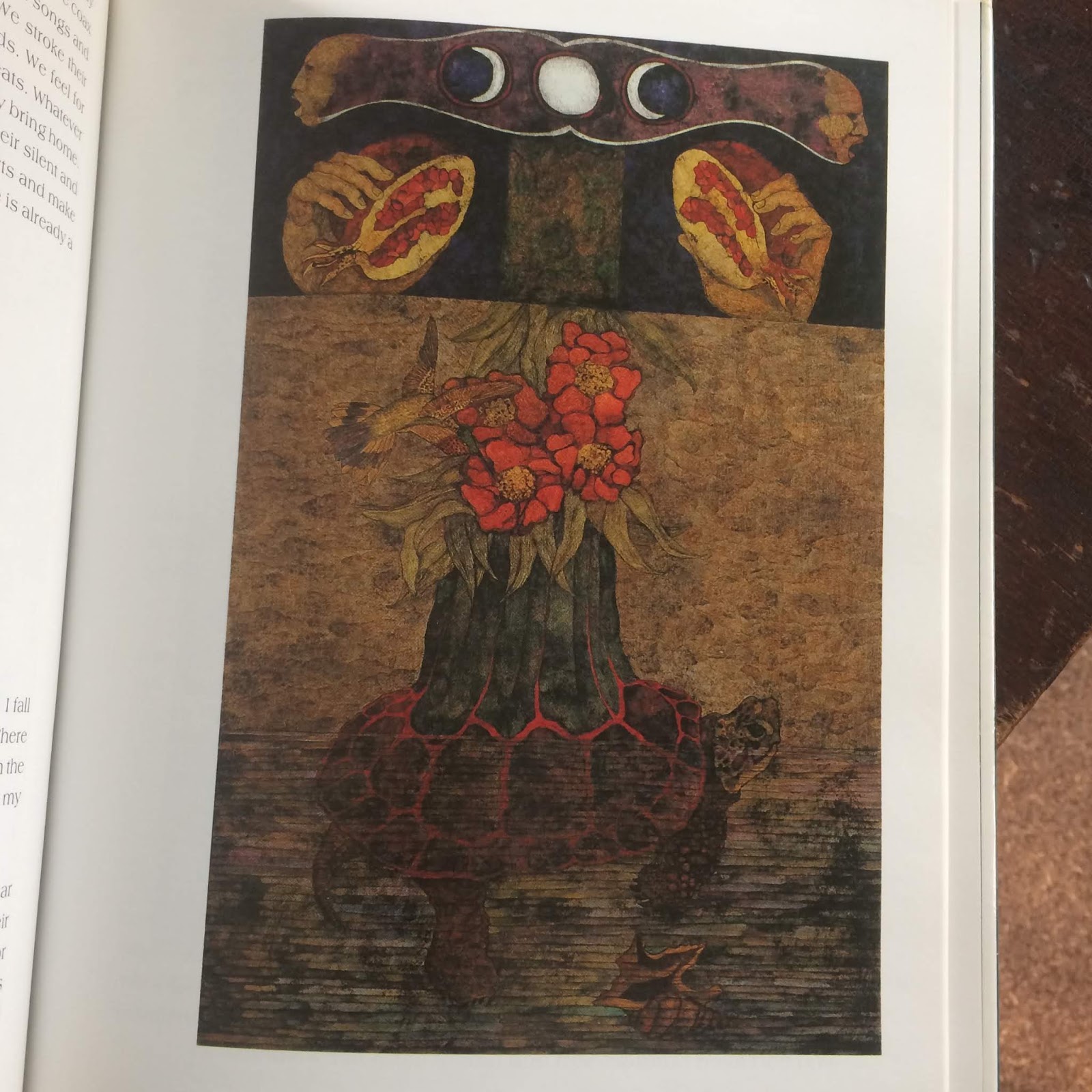
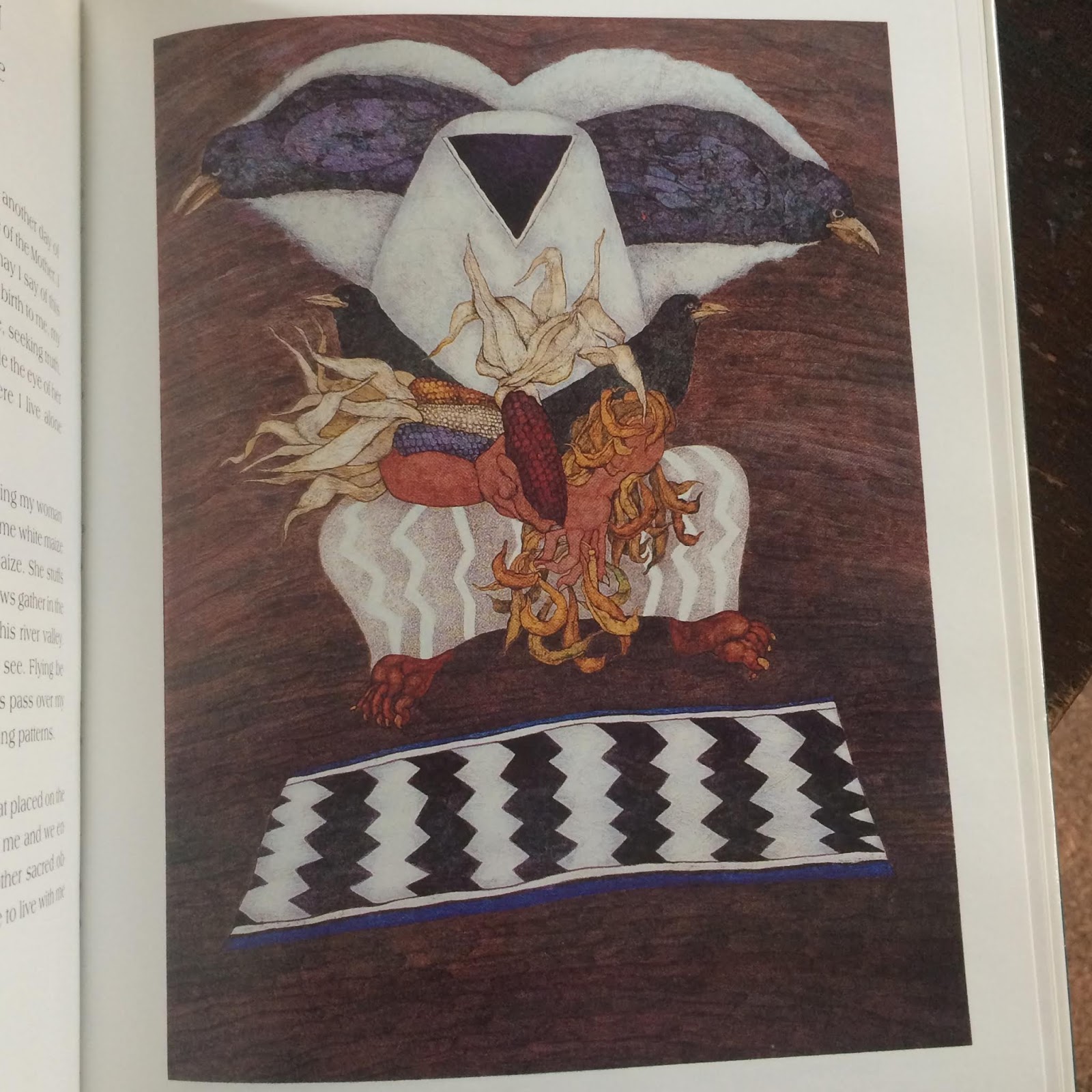
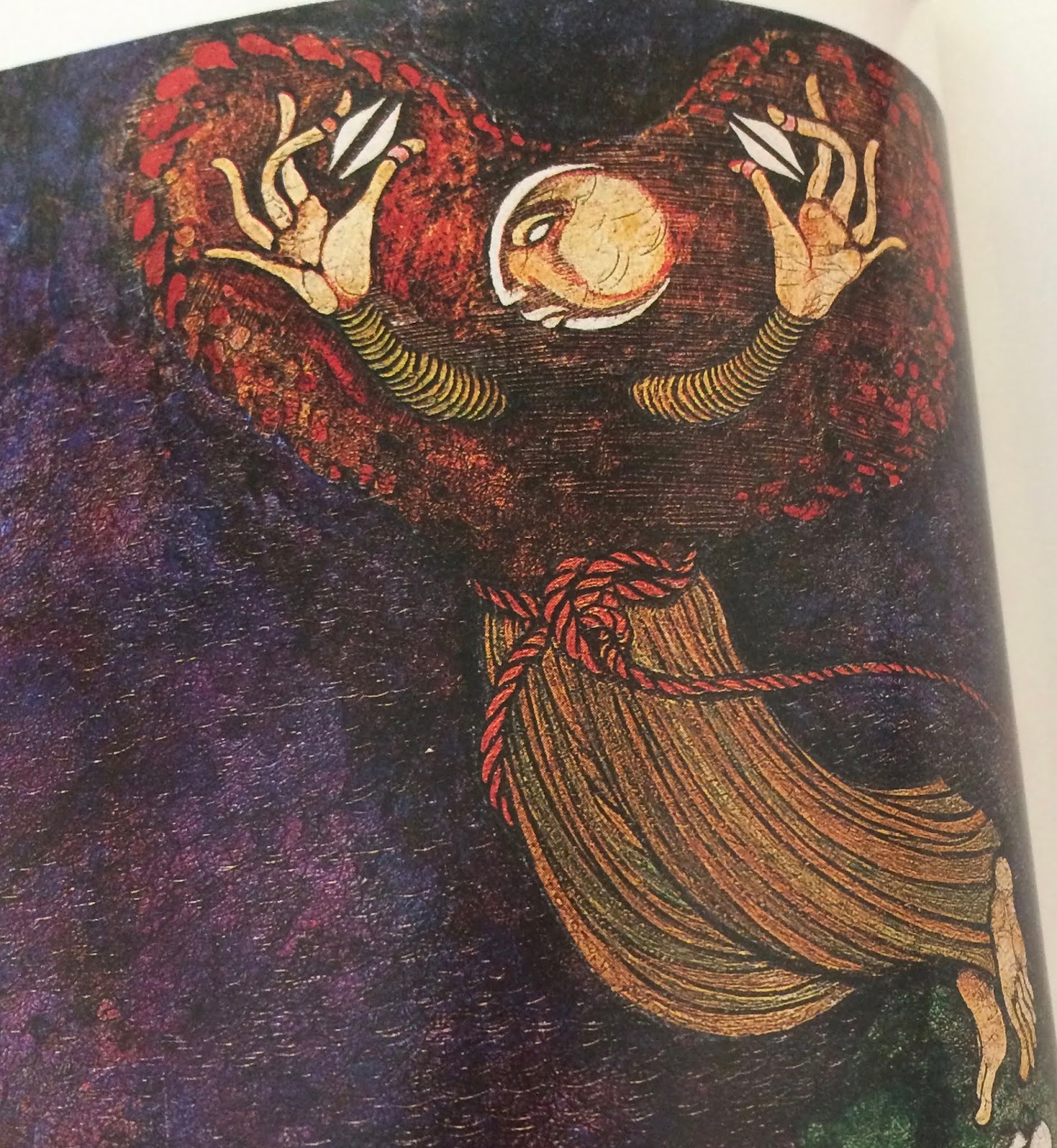
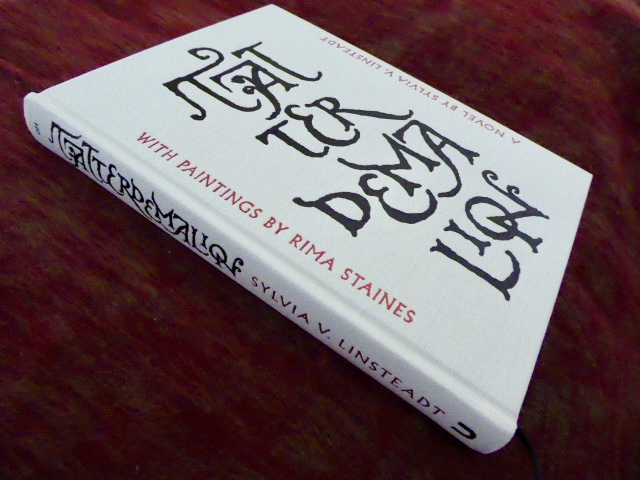
Then came Sylvia Linsteadt’s long-awaited Tatterdemalion, a post-apocalyptic novel inspired by the art of Rima Staines. 


I’ve been waiting for this book since I first read Witch Bottle, an excerpt from the then novel-in-progress, published in Dark Mountain: Issue 4, in the northern summer of 2013—almost four years ago! Then the publishing process, after a month of crowd-funding, took over a year, so the wait has been long and expectations have been high. The book I now have in my hands is a thing of beauty, filled with Rima’s extraordinary, earthy and strange art, from which Sylvia’s poetic, wild, myth-filled story was birthed. 


For more information about the book and how it came to be, please click here and watch the video, in which Sylvia says:

The novel is really a call to attention. Right now we’re surrounded by environmental, cultural, social collapse, and embedded in this dominant narrative, that really treats land and animals, plants, stones, water, people, and especially marginalised peoples, as objects to be used, rather than subjects to be honoured and respected in their own right. So we’re really in great need of new narratives and new stories to help us reimagine what it means to be human in a more-than-human world.


I've said it before myself—we desperately need new stories. So, if you are interested in reading this greatly needed new story, special editions of Tatterdemalion can still be purchased via Unbound, though a trade edition has also just been released. Most importantly, you will be supporting a young writer in making a living from her craft.


And if you are not familiar with the work of either Sylvia or Rima, I suggest you take a look at their magnificent blogs, which have partially inspired my own humble efforts in the blogosphere. They are both wise and talented women: Sylvia at The Gleewoman’s Notes and Rima at The Hermitage

Next came Kate Walters’s Iona Notebooks, a limited edition book published by Guillemot Press, composed of paintings, drawings and writing that Kate made during residencies on the Hebridean island of Iona.


I first came across Kate’s work through the Dark Mountain books (with works published in issues 6 and 10), and (the sadly now defunct) EarthLines magazine, in issues 10 and 12, as well as gracing the front and back covers of the very last issue.


What intrigued me about her work was not just the subject matter, style and aesthetic, but her working methods, which are shamanic in nature, drawing forth imagery from a womb-like and unknown place. She uses a technique which she calls ‘becoming the hollow bone’, in which she

instruct[s her] ego and personality to step aside to allow other voices to come through. Using the drum, strong intention, and the drawn mark [she is] able to respond in the moment to humans or trees or place … (‘Featured Artist: Kate Walters – Riding into Darkness on my Horse-of-Music-Body’, EarthLines, Issue 12: July 2015, p. 66). 

She often works with her eyes closed and with her non-dominant hand (a technique I have been inspired to try myself), and especially explores the connections and interactions between humans and animals, and the Divine Feminine.


I bought the Iona Notebooks, which came with six postcards as well, as a birthday present to myself. It is a book of beauty, shamanic wisdom and inspiration which I will treasure.


For more information about Kate and her work, please pay a visit to her website.

Lastly, a friend gave me a pure white cyclamen to congratulate me on my first year of blogging.