Showing posts with label moon. Show all posts

Wednesday, 7 April 2021

Bearer

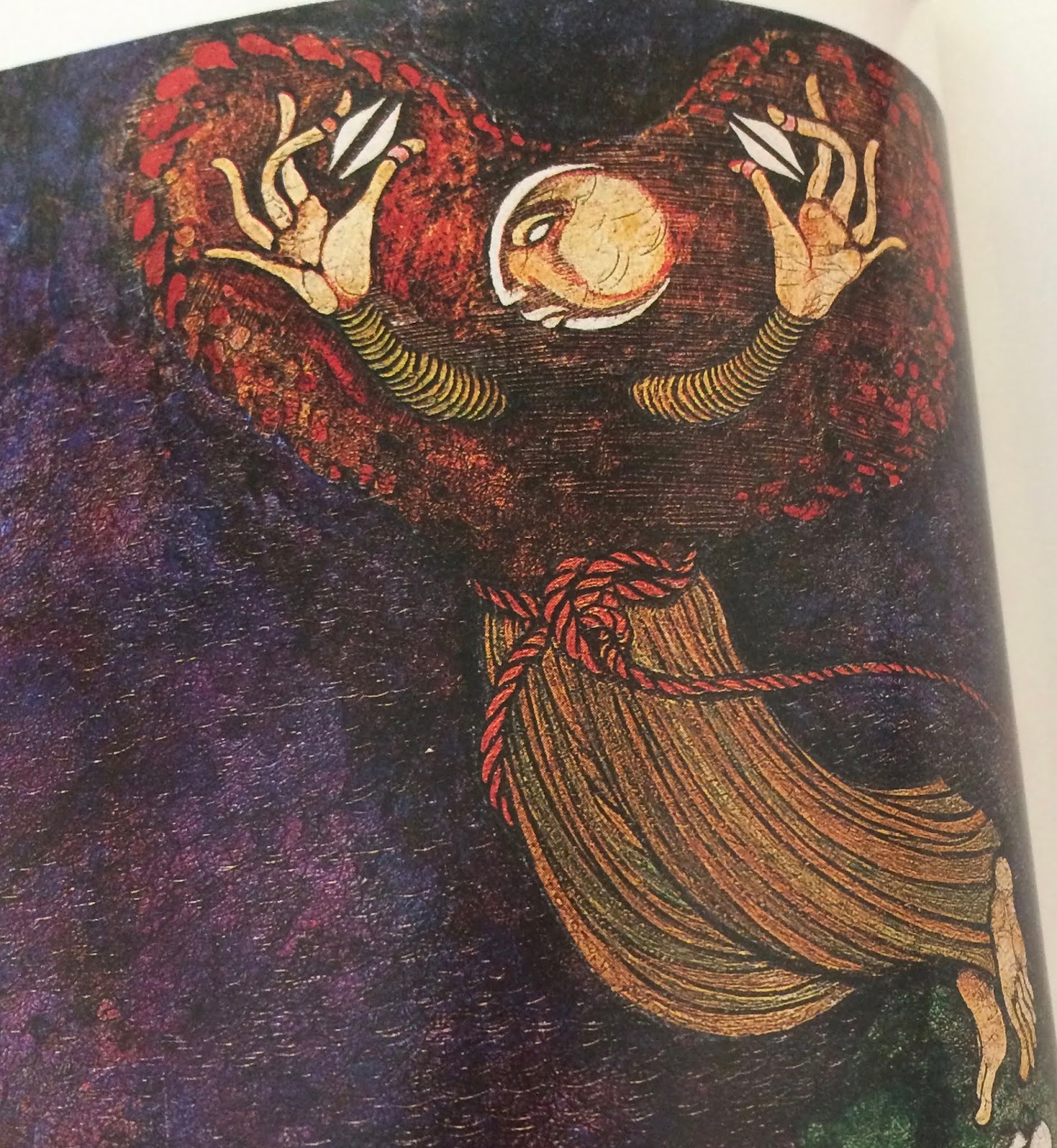
This painting was inspired by a Belorussian cross-stitch pattern!


Found at MagPie’s Corner – East Slavic Rituals, Witchcraft and Culture, it depicts the ‘Butter Lady’ of the spring festival of Maslenitsa, holding crepes and flames. However, I saw the figure in a more celestial light, as a goddess bearing the sun and the moon in her hands. 

From MagPie's Corner
Her horned headdress was inspired by images of Russian horned kichka hats, referring to the female elk, worn by mothers for fertility and protection. Though of course horns are also an ancient moon symbol. 

She is available on Redbubble.


Bearer, watercolours, gouache and acrylics on gesso prepared paper (2021)

Saturday, 13 March 2021

When Earth and Sky Were One

For more than a month I’ve been working sporadically on this painting, wondering if I would ever complete it, grappling with problems (despite doing more preparatory planning than usual), and in particular feeling confronted by the many colours.

As I’m not much of a colourist I tend to use just a few related tones, but this painting demanded much more, and who was I to deny the muse? 


I’m still unsure how successful an image this is—it’s so bright!—but it has been growing on me.


I realised only recently that the light sides of the moons face away from the suns in each corner. An oversight, perhaps, but this is because the suns were a late addition to the design, and the moons were always intended to receive their light from the centre, from source. Ultimately, the suns do too.


Here, I repeat the symbols that keep returning: bird, snake, moon, spirals and hands. 


The title refers not to earth and sky being one and the same, but to their being connected, and thus part of the whole. (For more on this idea please see my previous post Resacralising the Sky.) 


As with all my art, this image is available from my Redbubble shop.


When Earth and Sky Were One, watercolours, gouache, and gold and copper acrylic
on gesso prepared paper (2021)

Friday, 22 January 2021

Connecting with Cycles

This is a study made in preparation for a larger work, complete with wonky moons and spirals. But then, I am a bit wonky myself. 

Summer is not an easy season to move through, and my energy levels have been low, so it feels good just to complete something, however wobbly it is.


Progress in my studio is slow and sporadic at present, but there are ideas a-brewing. I have also set up an artist page on Facebook, to keep things a little more seperate from my personal profile. You can follow me there if you feel so inclined.


I don’t know precisely what I want to do with my art, seeing as illness keeps me regularly fluctuating between enthusiasm and apathy, but I think it is good to be taking tiny steps towards whatever growth and change may occur.


Connecting with Cycles, felt tip pen, ink and gold paint on paper (2021)

Wednesday, 19 August 2020

Mundus

I have a poetic sensibility such that I find certain words and phrases to be highly evocative, and I often wish that I could create an artwork, poem or story to illustrate them. Such was the case with mundus, which in Latin means ‘world,’ though it is also an origin of the word ‘mound’ (the Middle English form of which—‘mounde’—also meant ‘world’). 


The word came to my attention in Barbara C. Walker’s Woman’s Encyclopedia of Myths and Secrets as related to the Greek abaton, a subterranean ‘pit’ in pagan temples which people entered ‘to “incubate,” or to sleep overnight in magical imitation of the incubatory sleep of the womb …’ (p. 2). The ‘incubus’ or spirit who visited people in their dark, underworld sleep brought dreams that would afterwards be interpreted for healing or prophesy.


The abaton was the human-made equivalent of the natural caves and crevices that people originally saw as the womb(s) of Mother Earth. Megalithic tombs and barrow-mounds were built upon the same principle—the mound representing the pregnant belly of the Goddess, where the dead could be laid to rest in preparation for rebirth. In the Neolithic period both temples and tombs were often built in the shape of the belly or whole body of the Goddess. Thus we have ‘womb-temples’ and ‘womb-tombs’. Walker even states that ‘tomb’ and ‘womb’ are linguistically related (p. 1092), and that mundus meant both ‘earth’ and ‘womb’ (p. 154), though I am not entirely sure if this is etymologically correct. 


However, ‘tomb’ is certainly related to words that mean ‘earth-hill,’ such as the Latin tumulus, which may also have links to a proto-Indo-European root meaning ‘to swell’—just like a pregnant belly—and so it does bring us full circle back to the womb, and the mound, once more.


So, in my mind at least, I can connect these words thusly:


mundus

mound

tomb

womb

world


As is often the case with my work, the inspiration for the image itself came from a number of sources, most notably the circles within an arch in The Alchemist by Rima Staines, a print of which I recently framed. (She reminds me that the creative process is indeed an alchemical one.) 


Rima Staines – The Alchemist (2012)

I also referred to a number of images by the late Meinrad Craighead, whose enigmatic work is frequently provoking new visions. Sacred Hearts, a core influence for Our Lady of the Seeds, with mound-body, moon and orbs, is still haunting me; and the broad-featured face is loosely based on Hagia Sophia.


Sacred Hearts (1990)
Hagia Sophia (1987)

As I’ve been looking at a lot of prehistoric imagery over the past couple of years, the shapes and symbols of numerous menhirs, orthostats and petroglyphs have also seeped into my consciousness. 


I have even referenced my own art. The leaf- or flame-like shapes that sprout from the mound are the same as those in Fluency, which I described as ‘lines of connection, or emanations of energy—little jewels of life and sensation’. Here though, I can more definitely call them leaves, the topmost of which sprouts from the head of the figure, whose headwear started off more like the veils of a nun before elongating into a seed-like form. The vertical nature of it links the above world with the deep below—a recurring theme in my art.


It interests me how I keep returning to the same motifs: full and crescent moons, circles and mounds, triangles and vertical movement. I like the repetition and echo of forms, the circles within circles, the sacred geometry, one thing held within another.


It is not easy, and it can come so sporadically and with such difficulty that I am in constant dialogue with doubt. Yet I feel as if I am finally making the kind of art I always wanted to make.


I shall leave the last word to Marija Gimbutas: ‘Burial in the womb is analogous to a seed being planted in the earth, and it was therefore natural to expect new life to emerge from the old’ (The Language of the Goddess, p. 151).


Mundus, felt tip pen, ink, watercolour, gouache, gold acrylic and gold pen (2020)

Thursday, 19 March 2020

Matrix (An Homage to Meinrad Craighead)

These are certainly strange times we are living through, and uncertainty is likely to be with us for some months to come. This, therefore, is a small offering, a creation long in the making, that I hope brings some solace—and if not that, at least a temporary distraction from the anxiety-laden news.

There are a number of inspiration-threads to this work. I will try to weave them together as best I can here.

Matrix, watercolours on gesso prepared card (2020)
As lunar symbolism has been a core part of my art over the past year, the ‘triple goddess’ symbol has often been on my mind. 


While there may be some dispute surrounding the authenticity or validity of this symbol and concept in a contemporary sense, there is no doubt that there were numerous threefold goddesses in ancient times (the Fates, for instance), and that their triune nature is embodied by the lunar cycle, and vice versa. Thus the number three has symbolic (and, for me, aesthetic) significance. In my studies of Neolithic cultures it also came to my attention that very similar symbols can be found, such as this one from Knowth, Ireland (1), indicating that the roots of this image are very deep indeed.


In my explorations I came across ‘Lunulae / Crescents in Ancient Europe’ by Max Dashu, which displays some beautiful examples of the crescent moon/horn shape across time and cultures. It’s hard to believe that there isn’t some kind of ongoing meaning behind this symbol, though much remains a mystery. As Dashu says, ‘This whole post is about questions, not conclusions’. 

Messenger of the Invisible
Further searching led me to the lunitsa (‘little moon’)—the same symbol, inverted, and said to represent a bird (though the moon too), in ancient Slavic cultures, from shamanic ‘bird culture’ origins (2). I’m not sure of the veracity of this claim, and its almost impossible to find more in-depth information, though it does fit with the symbolism of Old Europe, and likely has some connection to it. Additionally, Phoenix of Elder Mountain says, ‘The moon and bird are the oldest pre-pagan female symbol for the emotional body, the feminine and the moon. Its a dual symbol which symbolizes the “soul bird” and the moon.’ All of this reminds me of my painting Messenger of the Invisible, which suggests that the lunula-bird has been subconsciously at work in me for some time.
Rainmaker

Since the aim with my art is not to create an image that is historically accurate, but rather to work intuitively and synthesise numerous influences into symbols that have meaning for me, the above information was enough to get ideas flowing. (Though it is always nice when the symbols naturally fall into place based on what we know of ancient realities, however disputed they may be—and more often than not, they do!)

If the lunitsa is a bird, I knew I would echo it with the snake, since the bird and snake are so entwined now in my mind. The snake would be an answering crescent, much like the serpent who arches like a rainbow, flowing with life-giving water, in my painting Rainmaker.

The other core influence for this image was Meinrad Craighead’s Symbols of the Mother (3). The simplicity, yet depth of meaning, in this work drew me in and wouldn’t let me go, and led to my use of a vertical format (rather than the horizontal design of the triple goddess symbol), and to the separation of the ‘upper and lower waters’/earth from sky/underworld from upperworld.


I scribbled down my first design in late January, so it feels like this painting has taken an age to come to fruition. There were false starts, an uncooperative painting technique (combined with my limited skills), plus rain and illness delays. I also made things difficult for myself by requiring accuracy and symmetry, based as the design was on a kind of sacred geometry. I very much doubted if I would finish it at all, but I persevered and found a way through to the end—at which point I was still without a title. The most obvious thought was to call it Goddess, my first thought just Untitled. But in listening to an interview with Max Dashu recently the perfect word came up: Matrix—the Latin for ‘womb,’ with its connotations of source or origin.

And just like that, everything fell into place. I hope it is a fitting homage to Meinrad. 

References
1. Image of megalithic designs, Knowth, Co. Meath, Ireland (middle or second half of 4th millennium BC), from Marija Gimbutas, The Language of the Goddess: Unearthing the Hidden Symbols of Western Civilization, HarperSanFrancisco: New York, 1989, p. 286
3. Text and image from Meinrad Craighead, The Sign of the Tree: Meditation in Images & Words, Artists House/Mitchell Beazley: London, 1979, pp. 110–111

Saturday, 3 August 2019

She is One, She is Two

At long last, my new painting—quite a lesson in perseverance—is complete. 

She is One, She is Two, watercolours and gold acrylic gouache on gesso prepared paper (2019)
The main inspiration for this piece was the Neolithic figurine of a dual goddess (perhaps a forerunner of later mother–daughter pairs, such as Demeter and Persephone) from Çatal Hüyük in modern day Turkey. I find this little figure, with two torsos sprouting from one lower body, quite evocative. Is she both mother and maiden as Anne Baring and Jules Cashford suggest in The Myth of the Goddess: Evolution of an Image? Is she a representation of the two integrated sides of the Goddess?—the interplay of light with darkness, full moon with new moon, life with death, matter with spirit—those dancing complementary opposites.


Baring and Cashford state, ‘we could anticipate that our habit of thinking in opposites might have dulled us into assuming that they are absolutes in themselves and not provisional distinctions of inseparable terms belonging to one underlying unity (my emphasis, p. 665). 

Thus, the simple truth: she is one, she is two.

Of course, this symbolism calls to mind the moon, which led me to the secondary inspiration: an image of Artemis from an Etruscan vase (6th century BC), wearing a dress decorated with squares and a cross and dot design. Baring and Cashford point out that these cross/fourfold designs, representing the lunar phases, date as far back as the Neolithic period!


I must also acknowledge that some inspiration came from my previous work, Rainmaker

My initial drawings for this painting also brought self-comfort to mind. The notion of being able to hold my own hand, to offer myself support when I feel alone. Of course, relationship with others is necessary, yet the relationship we have with ourselves provides the foundation for all else.

This work is far from perfect. There are mistakes. But she is born!

Now I am off in search of the next elusive image. Wish me luck.

Tuesday, 26 February 2019

Messenger of the Invisible

It has taken me some time to complete (and then photograph) this new painting, mainly because midway I experienced (I suspect) some kind of fatigue-inducing virus, which meant—to my frustration!—that I did almost nothing for about a week. Also, it was initially intended to be nothing more than an ‘experiment’, but clearly I need to have a little more faith in myself and what I can create, for I am very pleased with the results.

Messenger of the Invisible, watercolour and gouache on gesso prepared paper (2019)
I have not been writing, and thus feel unable to say much more at present, but I am including some quotes below that elucidate some of the ideas behind this work, and what she represents. All are taken from the absolutely brilliant book I have been reading by Anne Baring and Jules Cashford, The Myth of the Goddess: Evolution of an Image (Arkana: London, 1991).


The bird who appears out of a distant sky has always been a messenger of wonder as the visible incarnation of the invisible world. In many Bronze Age myths the cosmic egg of the universe was laid by the Cosmic Mother Bird, and its cracking open was the beginning of time and space. (p. 13)

The bird was the life of the waters, the epiphany of the goddess as the deep watery abyss of cosmic space and as the seas and the rivers, underground wells and streams. The bird that flies high above the earth and the bird that swims on waters resting upon the earth linked two dimensions that were not the native element of human beings yet surrounded them above and below. The image of the bird at home in both dimensions brought the upper and lower waters together, offering an image of a unified world. (pp. 58–59)


The bird, since Palaeolithic times the messenger of the vast incomprehensible distance and so of the whole invisible world, was taken by the Minoans, as by many another culture, to constitute the supreme image of epiphany. (‘Epiphany’ in Greek means literally the ‘showing forth’ of the sacred, which is the presence of the divine recognized as immanent in creation.) (p. 124)


The moon was an image in the sky that was always changing yet was always the same. What endured was the cycle, whose totality could never be seen at any one moment. All that was visible was the constant interplay between light and dark in an ever-recurring sequence. Implicitly, however, the early people must have come to see every part of the cycle from the perspective of the whole. The individual phases could not be named, nor the relations between them expressed, without assuming the presence of the whole cycle. The whole was invisible, an enduring and unchanging circle, yet it contained the visible phases. Symbolically, it was as if the visible ‘came from’ and ‘returned to’ the invisible – like being born and dying, and being born again. (p. 147)

Monday, 27 August 2018

Wise Words: The Moon Is Yours (Their Progress Is Not Our Progress)

The moon is yours. And it belongs to the U’wa child and to the Hopi Indians, to the Inuit and to the Mexican woman collecting water and to the monks of Tibet. It belongs to every moth that flies towards it, to every dog who barks for it and to every cat on the hackled prowl for it. Untouched, it is a global commons unparalleled, for it belongs to the minds of millions upon millions of people; an emblem of purity, of women, of imagination or of time itself; a beautiful place of thought which can mean a million different things to a million different minds, all on one night. ‘The moon shines bright. In such a night’ as Shakespeare said, it shone for Dido, for Medea, for Troilus and Cressida all alike. But a few hundred overprivileged white males plan probes and moon maps and say the far side of the moon would be the site for an Observatory. Like an exact parallel with ‘progress’ on earth, it uses all the tools of imperialism – from Observatories, maps, enclosures and sheer political force – to colonize a commons. Their progress is not our progress. To lose the moon and be given instead a petrol station, a Hilton hotel, an industrial estate, a quarry and a nuclear waste deposit is not a good swap but a terrible theft; a theft from the very soul of humanity. And we, the millions who have lost something so infinitely precious, are expected to applaud it?

(Jay Griffiths, Pip Pip: A Sideways Look at Time, Flamingo: London, 1999, pp. 217–218)

Detail from Memory, by Meinrad Craighead, from her book, The Mother's Songs: Images of God the Mother (1986)

Thursday, 12 July 2018

Witchlines: Dancing The Labyrinth

Here is the second of my Witchlines pieces exploring the world of Minoan Crete—or Ariadnean Crete, as it should be. This prompt asked us to write about a ritual, involving bull, labyrinth, and sacred dance. 

Woman dancing in a circle (the centre figure holds a snake), clay figures, c. 1300 BCE, Heraklion Archaeological Museum
(Source: Wikimedia, by Jebulon)
Dancing the Labyrinth

Half-closed eyes under the round eye of the moon, under the gaze of the mountain, the shelter of the trees. Whirling, skirt unfurled, face upturned. The air heavy with poppy smoke, the scent of night, and the sweetness of the honey and wine we have offered to the earth.
Between us is a red thread, a sacred cord. Grasped in the hands of seven young women, led by Her—Most Holy, Most Pure—the Mistress of the Darkness, the spiralling ways, crowned with horns. We thread the air with circles. We weave ourselves in and out of time.
As we move like an eddy of water, a twist in the wind, night seems like day, rich with colour, and the moon’s light is an echo of the sun. 

This is a waking sleep.

From a part of myself that is aware, and still, I notice the great moon-beast, tethered to an olive tree. His hide seems to glisten in the moonlight, and his muzzle is wet and dripping. He snorts, stamps a hoof, tosses his head, dancing his own dance, resonating with a rhythm only he hears—ears flicking, muscles rippling. Garlanded with fragrant flowers, he smells sweetly of crocus and herbs.

I understand, now, the love held for this great bull, his pale hide and dark eyes. The blessing of his presence in this dance, to call forth what is yet to be born from the round belly of the earth, and what is to be born anew—the spark of energy that moves in and out of all things, always circling.

As we whirl we begin to feel it—a humming, a throbbing—an excitement in the air, an intoxication of life. Under our feet, we feel the earth inhale. 

The cord in our hands grows warm, sinuous as a serpent, and we thread it in a circle around the bull and the olive tree, tracing an ancient way that goes deep. We feel Her labyrinthine path beneath our bare feet, leading us onwards; we feel the labyrinth opening inside ourselves. The bull’s low bellow, and the tree’s movement in the night breeze incite us, and we move faster, faster, abandoning ourselves to Her will.

Suddenly, the Most Holy, Most Pure, She changes course, leads us inwards, ever closer to the bull; and we slow, open our eyes to see the beautiful horns reaching for the sky, the stars, drawing down the moonlight, calling in the light-in-darkness, the darkness-in-light. We touch the horns as we pass—blessing, being blessed—and the bull bows his massive head, lulled by the poppy smoke, gentled by night.

Then, eyes opened, and seeing anew—awakened fully—we orbit once more, spiralling out and away from the sweetly sleeping bull, our hair flying behind us, merging with the dark.

Below our feet, with a scent of honey and wine, the earth exhales.

White bull's head ritual rhyton, terracotta, from Gournia, 1600–1450 BCE, Heraklion Archaeological Museum
(Source: Wikimedia, by Jebulon

Thursday, 9 November 2017

Bright With Darkness: A Poem

There is no harvest, no ripeness
only gleanings from
bare ground
glimpses 
of what may be

The sweet and simple 
sleep of youth 
is gone 
has been gone for years 
gone with the dreams of wonder

I do not belong to myself
but to circumstances 
uncontrollable, unasked for

But what if I called? What if I stared 
into her face? Did I willingly 
turn to stone, choosing stagnation 
over life? 

Perhaps there are reasons why 
based not on reason, but a deeper 
knowing, beneath understanding—
a holy mystery

I chose this

A small pebble 
buried in the earth—
must I dig my way out?

I love the depths, and darkness 
and would rather dwell there 

Yet mountains call—peaks—
places of clear sight; 
perhaps a better vantage from which 
to see into the dark deep

After all 
the moon’s light is not her own
though she wears it as if illumined 
from within 
bright with darkness 
bridging both

Only in the third place can the mind merge 
the opposites

If I have a patch of dark 
bare earth 
below
and air and sunlight
above 
perhaps, in the place between
something will grow

(October 2017)

The Moon, by Adam Cebula (Source: Wikimedia Commons)