The moon is yours. And it belongs to the U’wa child and to the Hopi Indians, to the Inuit and to the Mexican woman collecting water and to the monks of Tibet. It belongs to every moth that flies towards it, to every dog who barks for it and to every cat on the hackled prowl for it. Untouched, it is a global commons unparalleled, for it belongs to the minds of millions upon millions of people; an emblem of purity, of women, of imagination or of time itself; a beautiful place of thought which can mean a million different things to a million different minds, all on one night. ‘The moon shines bright. In such a night’ as Shakespeare said, it shone for Dido, for Medea, for Troilus and Cressida all alike. But a few hundred overprivileged white males plan probes and moon maps and say the far side of the moon would be the site for an Observatory. Like an exact parallel with ‘progress’ on earth, it uses all the tools of imperialism – from Observatories, maps, enclosures and sheer political force – to colonize a commons. Their progress is not our progress. To lose the moon and be given instead a petrol station, a Hilton hotel, an industrial estate, a quarry and a nuclear waste deposit is not a good swap but a terrible theft; a theft from the very soul of humanity. And we, the millions who have lost something so infinitely precious, are expected to applaud it?
(Jay Griffiths, Pip Pip: A Sideways Look at Time, Flamingo: London, 1999, pp. 217–218)
 |
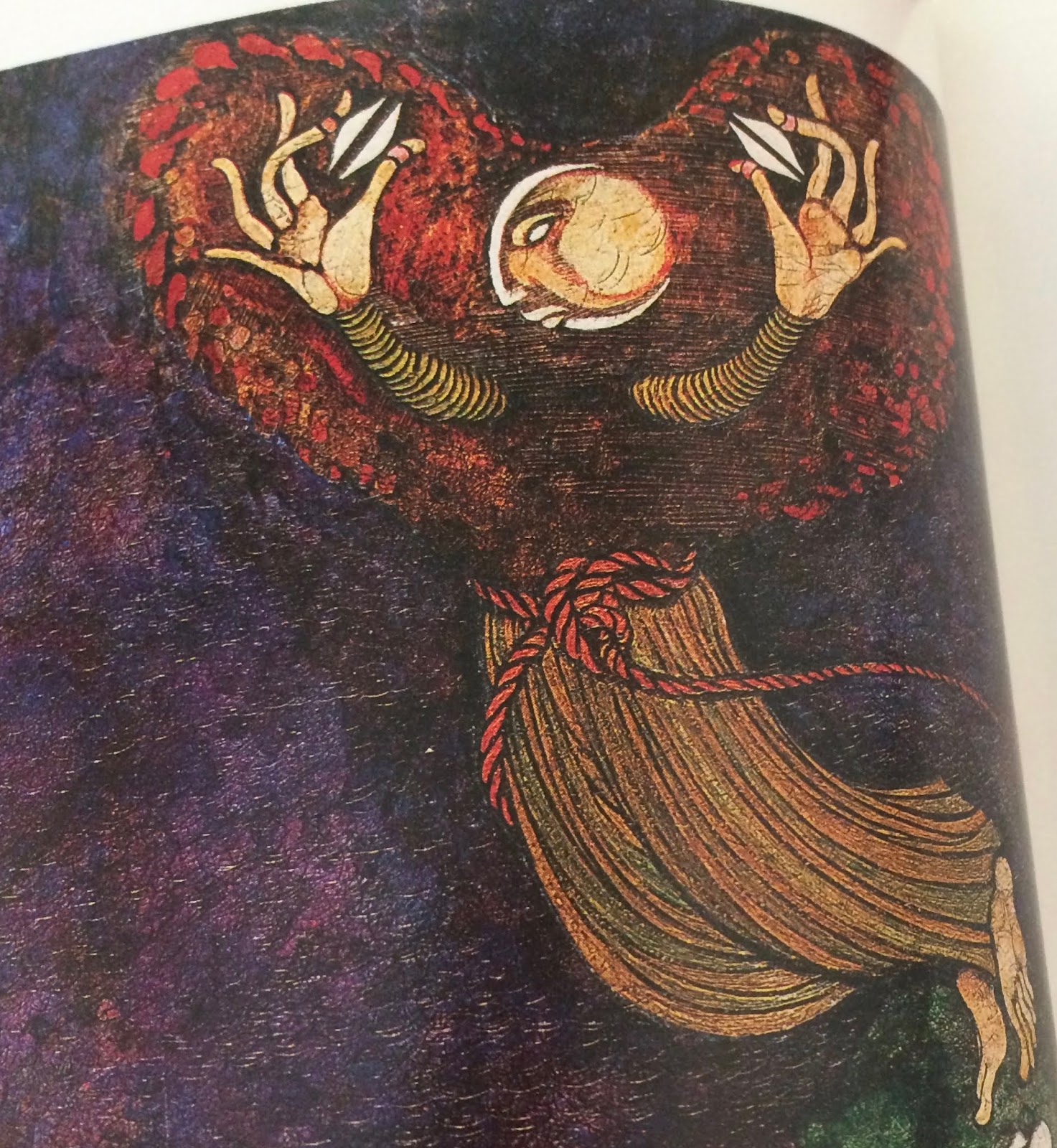
| Detail from Memory, by Meinrad Craighead, from her book, The Mother's Songs: Images of God the Mother (1986) |